Condenser Water Treatment
Water used in cooling towers and evaporative condensers must be managed to control scale, corrosion, mineral concentration, and biological growth.
Evaporation removes water from the system but leaves most dissolved minerals behind. As evaporation continues, those minerals become more concentrated in the circulating water.
Proper condenser-water treatment combines water monitoring, makeup water, blowdown, chemical treatment, and system controls to maintain water quality and protect heat-transfer surfaces.
What You Will Learn
By the end of this lesson you should be able to:
Describe how evaporation increases the concentration of dissolved minerals and other contaminants.
Recognize that increasing mineral concentration can cause deposits to form on heat-transfer surfaces.
Recognize how poor water chemistry can damage piping, condenser surfaces, and cooling-tower components.
Recognize how these measurements help evaluate condenser-water conditions.
Describe how fresh water enters the system and concentrated water is removed.
Describe how sensors, controllers, chemical-feed equipment, and automatic blowdown can work together.
Why Does Condenser Water Need Treatment?
Cooling-tower and evaporative-condenser systems continually expose circulating water to outdoor air and evaporation.
As water evaporates, the water itself leaves the system as vapor, but most dissolved minerals remain behind.
Over time, the concentration of those minerals increases unless some concentrated water is removed and replaced with fresh makeup water.
Technician Point
Evaporation removes water, not the dissolved minerals carried by that water.
This is why mineral concentration increases in a recirculating condenser-water system.
Cooling-Tower Water Management
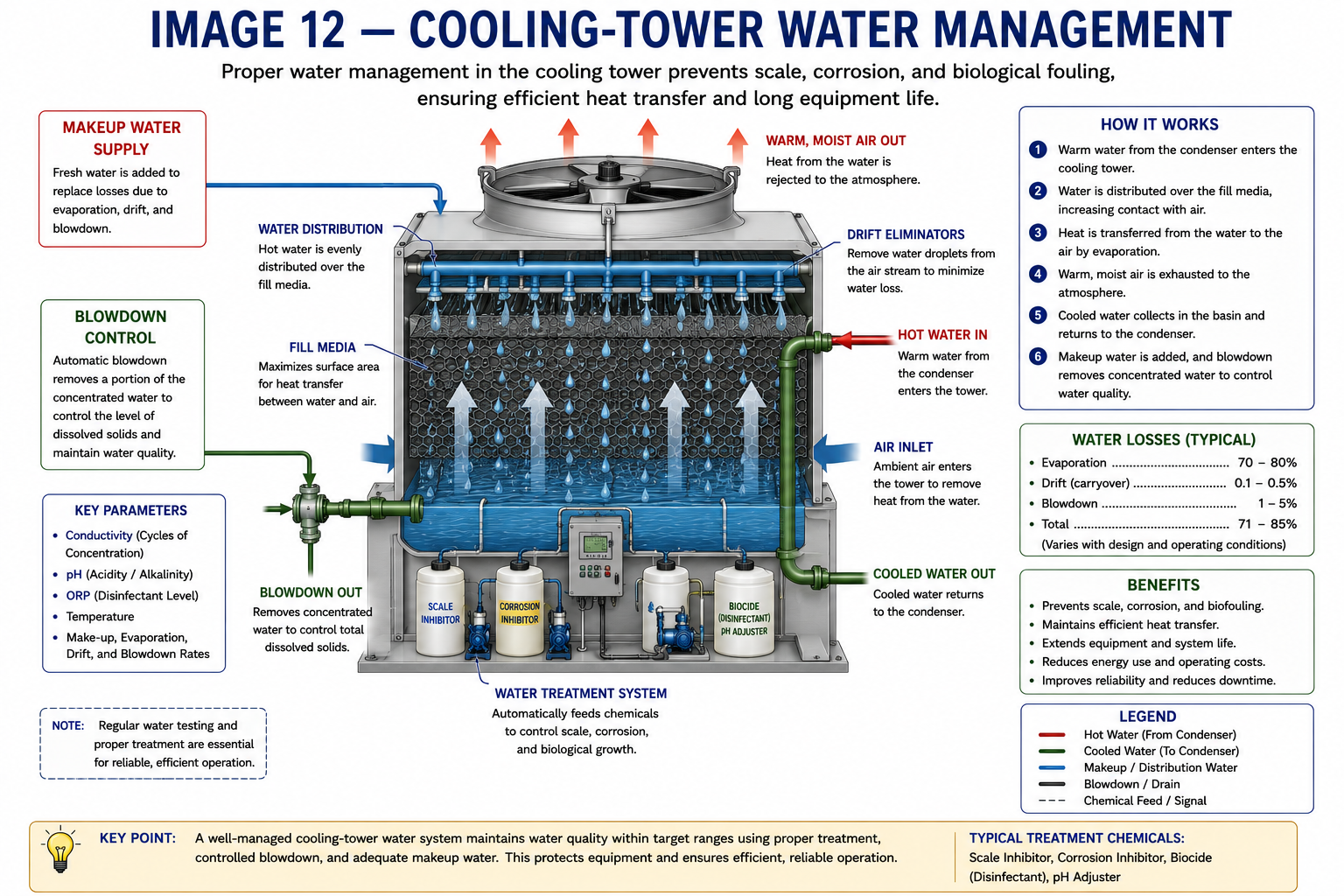
The goal is not simply to keep enough water in the system. The water must also remain suitable for use in the condenser-water loop.
Evaporation Concentrates Minerals
Fresh Water Enters
Makeup water contains naturally occurring dissolved minerals.
Water Evaporates
Some circulating water leaves the system as water vapor.
Minerals Remain Behind
Most dissolved minerals stay in the circulating water.
Concentration Increases
Repeated evaporation increases the concentration of dissolved solids.
Scale
Scale forms when dissolved minerals come out of solution and deposit on system surfaces.
These deposits can build up on condenser tubes, piping, tower fill, spray nozzles, and other water-contact surfaces.
Clean Heat-Transfer Surface
Heat can move efficiently through the metal surface between refrigerant and cooling water.
Scaled Heat-Transfer Surface
Mineral deposits create an insulating layer that reduces heat transfer.
Scale Hurts Efficiency
Scale does not need to completely block a tube to create a problem.
Even a relatively thin layer can increase resistance to heat transfer and make the condenser work harder.
Corrosion
Water chemistry can also attack metal surfaces.
Corrosion can damage condenser tubing, piping, pumps, cooling-tower basins, and other components in the water circuit.
Water Treatment Must Balance Two Risks
Too much mineral concentration can promote scale.
Poor chemistry can also promote corrosion.
pH
pH is a measure of how acidic or alkaline the condenser water is.
As water evaporates and system chemistry changes, pH can also change.
Maintaining an appropriate pH range is part of controlling both corrosion and scale formation.
pH Is a Chemistry Indicator
pH does not measure mineral concentration directly, but it provides important information about the chemical condition of the water.
Conductivity
Conductivity is a useful way to monitor the concentration of dissolved ionic material in condenser water.
As dissolved solids become more concentrated, conductivity generally increases.
Water Evaporates
The volume of water in the system decreases.
Dissolved Solids Remain
Minerals and other dissolved material stay in the recirculating water.
Conductivity Increases
The controller can use this change as an indication that dissolved solids are becoming more concentrated.
Makeup Water
Water is continuously lost from cooling-tower and evaporative-condenser systems through evaporation, drift, and blowdown.
Fresh water must be added to replace those losses. This replacement water is called makeup water.
Water Leaves the System
Evaporation, drift, and blowdown reduce the amount of water remaining in the circulating loop.
Makeup Water Enters
Fresh water restores the proper operating water level.
Blowdown
If makeup water were added only to replace evaporated water, dissolved minerals would continue becoming more concentrated.
Blowdown removes a controlled amount of concentrated circulating water from the system.
Fresh makeup water then replaces the discharged water.
Mineral concentration increases as evaporation continues.
A portion of concentrated water is discharged.
Fresh water enters to replace the discharged water.
Important
Blowdown is not simply water waste.
It is a controlled water-management process used to limit the concentration of dissolved solids.
Chemical Treatment
Water-treatment chemicals may be added to help control scale, corrosion, and biological growth.
The exact treatment program depends on the water chemistry, system materials, operating conditions, and equipment design.
Scale Control
Treatment can help reduce the tendency of dissolved minerals to form deposits on heat-transfer surfaces.
Corrosion Control
Treatment can help protect metal surfaces from chemical attack.
Biological Control
Water-treatment programs may also control algae, bacteria, slime, and other biological growth.
Computerized Condenser Water Treatment
Modern condenser-water systems can use computerized controllers to continuously monitor water conditions and operate treatment equipment automatically.
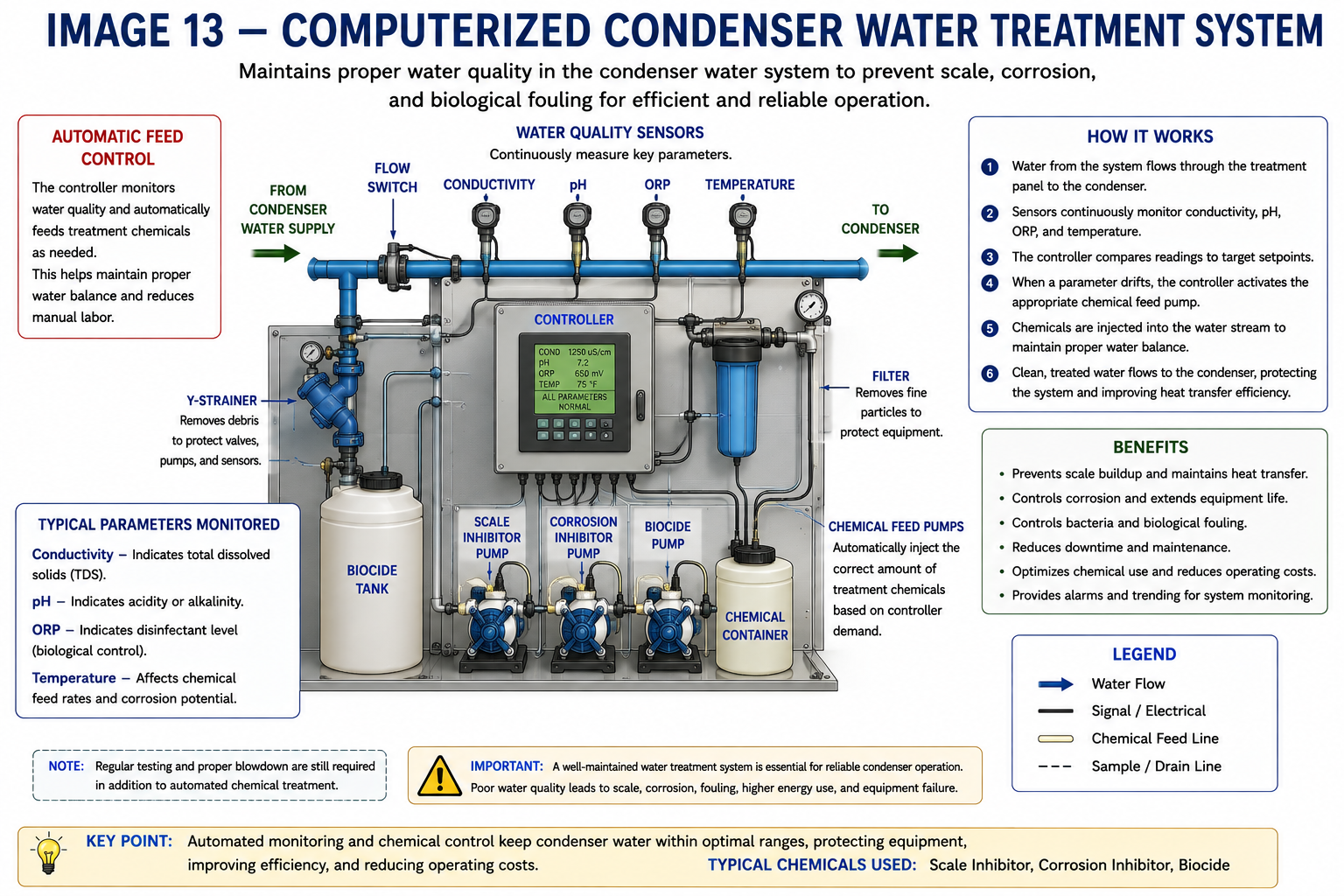
A typical control system may receive information from conductivity, pH, oxidation-reduction potential, temperature, flow, or other sensors depending on the installation.
The controller can then operate valves and chemical-feed equipment based on the water-treatment program.
How an Automated Treatment System Works
Sensors Measure Water Conditions
Water-quality sensors provide information to the treatment controller.
The Controller Evaluates the Readings
The measured conditions are compared with programmed control limits.
Control Outputs Operate
The controller can operate blowdown valves, chemical pumps, alarms, or other treatment devices.
Water Conditions Are Adjusted
The treatment system continues monitoring and correcting conditions as required.
Automatic Conductivity Blowdown
Conductivity can be used to control blowdown automatically.
As mineral concentration increases, conductivity rises. When the measured conductivity reaches the programmed limit, the controller can open a blowdown valve.
Dissolved solids have become more concentrated.
Concentrated circulating water is discharged.
Fresh water replaces the discharged water.
Dissolved solids are diluted toward the desired operating range.
Automatic Chemical Feed
Computerized controllers may also operate chemical-feed pumps.
These pumps meter treatment chemicals from storage containers into the circulating condenser-water system.
Controller
Determines when treatment is required based on programmed logic and sensor information.
Chemical Feed Pump
Delivers a controlled amount of treatment chemical into the water circuit.
Controlled Feed Matters
Water-treatment chemicals should not simply be added without control.
The treatment program must maintain the required water chemistry while avoiding excessive or insufficient chemical feed.
Water Treatment Protects Heat Transfer
Condenser-water treatment is not separate from refrigeration-system performance.
The condition of the water directly affects the condenser’s ability to reject heat.
Clean Heat-Transfer Surfaces
Allow efficient heat transfer between the refrigerant and condenser water.
Fouled Heat-Transfer Surfaces
Scale, corrosion products, or biological deposits can interfere with heat transfer and water flow.
Think of Water Treatment as Condenser Maintenance
Poor water treatment can eventually become a refrigeration-system performance problem.
Put the Concepts Together
Evaporation removes water while leaving most dissolved minerals behind.
Increasing mineral concentration can contribute to scale formation.
Water chemistry must also be controlled to reduce corrosion.
Conductivity provides an indication of dissolved ionic concentration.
pH provides information about the chemical condition of the water.
Blowdown removes concentrated circulating water.
Makeup water replaces water lost through evaporation, drift, and blowdown.
Chemical treatment can help control scale, corrosion, and biological growth.
Computerized controllers can automate monitoring, blowdown, chemical feed, and alarms.
Proper water treatment helps preserve condenser heat-transfer performance.
Can You Explain Condenser Water Treatment?
You should be able to answer these questions before continuing.
1. Why do dissolved minerals become more concentrated in cooling-tower water?
2. What is scale?
3. How can scale affect condenser performance?
4. Why must corrosion be controlled?
5. What does pH tell us about condenser water?
6. What does conductivity indicate?
7. What is makeup water?
8. What is blowdown?
9. Why is fresh makeup water added after blowdown?
10. What are three general problems chemical treatment may be used to control?
11. What types of equipment can a computerized water-treatment controller operate?
12. How can conductivity be used to control automatic blowdown?
What You Should Have Learned
Cooling-tower and evaporative-condenser water requires ongoing treatment and monitoring.
Evaporation increases the concentration of dissolved minerals in circulating water.
Scale can reduce heat transfer by insulating condenser surfaces.
Corrosion can damage condenser-water system components.
Conductivity and pH are useful water-quality measurements.
Blowdown removes concentrated water and makeup water replaces system losses.
Chemical treatment can help control scale, corrosion, and biological growth.
Computerized controllers can automate water monitoring and treatment functions.
Good condenser-water treatment supports efficient heat rejection and reliable system operation.
Control the Water to Protect the Condenser
A recirculating condenser-water system constantly changes as water evaporates and fresh water enters.
Successful water treatment manages those changes through monitoring, blowdown, makeup water, and chemical treatment.
Monitor · Control Concentration · Treat the Water · Protect Heat Transfer