Condenser Subcooling
Subcooling occurs after refrigerant vapor has completely condensed into liquid and additional heat is removed from that liquid refrigerant.
In an air-cooled condenser, this normally occurs in the final portion of the condenser coil. Measuring subcooling requires two temperatures: the refrigerant condensing temperature and the actual liquid-line temperature leaving the condenser.
This lesson explains where subcooling occurs, how the two required temperatures are obtained, and how condenser subcooling is calculated.
What You Will Learn
By the end of this lesson you should be able to:
Recognize that subcooling occurs after refrigerant has completely condensed into liquid.
Recognize the final few passes of the condenser as the area identified in the source lesson where subcooling takes place.
Use condenser pressure and the refrigerant pressure-temperature relationship to determine the condensing-point temperature.
Use a clamp-on thermometer on the liquid line at the condenser outlet.
Subtract the leaving liquid-line temperature from the condensing temperature.
What Is Subcooling?
During the condensing portion of the condenser, refrigerant changes from vapor to liquid.
Once all of the refrigerant has become liquid, additional heat can still be removed. When the liquid refrigerant temperature falls below its condensing temperature, the refrigerant is subcooled.
Technician Point
Subcooling occurs after condensation is complete.
The refrigerant is already liquid. Additional heat removal lowers the temperature of that liquid below the condensing-point temperature.
Where Does Subcooling Occur?
The source lesson states that subcooling takes place in the last few passes of the condenser. :contentReference[oaicite:1]{index=1}
Superheated Vapor Enters
Hot, high-pressure refrigerant vapor enters the condenser through the compressor discharge line.
Refrigerant Condenses
Heat is removed until the refrigerant changes completely from vapor to liquid.
Liquid Is Subcooled
Additional heat is removed from the liquid refrigerant in the final portion of the condenser.
Subcooled Liquid Leaves
High-pressure liquid refrigerant leaves the condenser through the liquid line.
Measuring Condenser Subcooling
Two values are required to determine condenser subcooling:
Condensing temperature and liquid-line temperature.
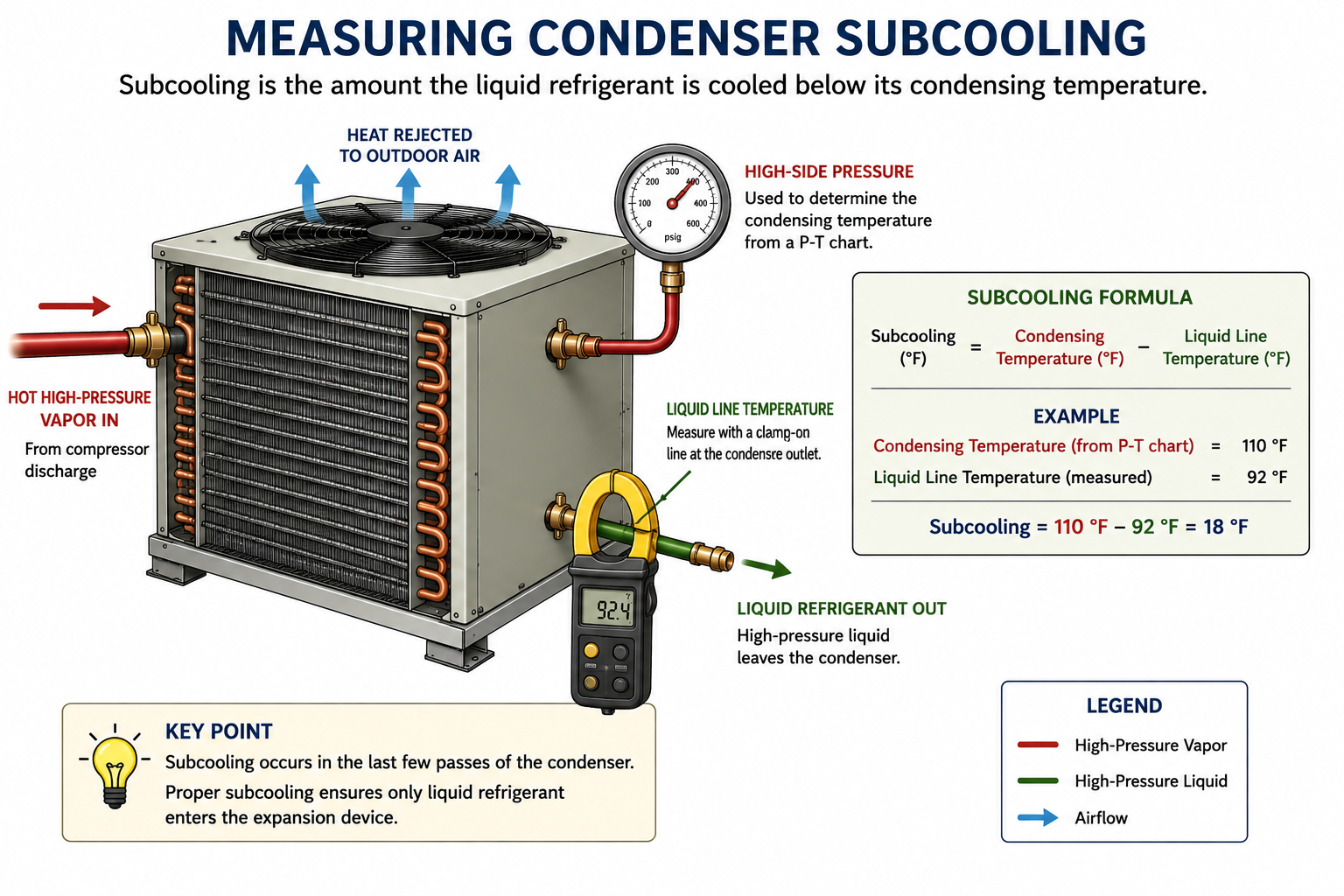
About the Refrigerant Inlet Shown in Figure 1
The hot, high-pressure vapor entering the condenser comes from the compressor discharge line.
The compressor may be physically remote from the condenser. The illustration shows the refrigerant connection to the condenser, not a requirement that the compressor be located inside or immediately beside the condenser assembly.
Determine Condenser Pressure
The first value needed is the refrigerant pressure in the condenser.
The source lesson explains that the condensing-point temperature is found by converting condenser pressure to temperature. :contentReference[oaicite:2]{index=2}
Important
The pressure reading itself is not the condensing temperature.
The condenser pressure must first be converted to the corresponding temperature for the refrigerant being used.
Convert Pressure to Condensing Temperature
Use the refrigerant pressure-temperature relationship to convert the measured condenser pressure into the corresponding condensing-point temperature.
Obtain the high-side refrigerant pressure.
Find the temperature corresponding to that pressure for the refrigerant in the system.
This becomes the first temperature used in the subcooling calculation.
Measure the Leaving Liquid-Line Temperature
The source instructs the technician to measure refrigerant temperature by placing a clamp-on thermometer on the liquid line at the condenser outlet. :contentReference[oaicite:3]{index=3}
Measurement Location
Measure the liquid line where the refrigerant leaves the condenser.
Measurement Tool
Use a clamp-on thermometer as described in the source lesson.
Technician Point
The pressure-derived condensing temperature and the measured liquid-line temperature are two different values.
Both are required to calculate subcooling.
Calculate Subcooling
The source defines the calculation as the condensing-point temperature minus the temperature of the refrigerant leaving the condenser. :contentReference[oaicite:4]{index=4}
CONDENSER SUBCOOLING
Subcooling Example
The illustration used in this lesson provides a simple example of the calculation.
110°F
92°F
110°F − 92°F = 18°F
Result
The liquid refrigerant is 18°F below its condensing temperature in this example.
What Does the Subcooling Number Represent?
The subcooling value represents the temperature difference between the refrigerant’s condensing temperature and its actual temperature after leaving the condenser as liquid.
Condensing Temperature
The temperature determined from the condenser refrigerant pressure.
Liquid-Line Temperature
The actual refrigerant temperature measured at the condenser outlet.
Subcooling
The difference between those two temperatures is the amount of condenser subcooling.
Put the Measurement Procedure Together
Measure Condenser Pressure
Obtain the high-side refrigerant pressure.
Find Condensing Temperature
Convert condenser pressure to the corresponding refrigerant temperature.
Measure Liquid-Line Temperature
Place a clamp-on thermometer on the liquid line at the condenser outlet.
Subtract
Subtract the liquid-line temperature from the condensing temperature.
Keep the Two Temperatures Straight
The most important part of the procedure is understanding where each temperature comes from.
Do Not Use Pressure as Temperature
Condenser pressure must first be converted to the corresponding refrigerant condensing temperature.
Measure the Liquid Line
The second temperature is the actual refrigerant temperature measured at the condenser outlet.
Subtract in the Correct Order
Condensing temperature comes first, followed by the leaving liquid-line temperature.
Put the Concepts Together
Subcooling occurs after the refrigerant has completely condensed into liquid.
The source places subcooling in the last few passes of the condenser.
Condenser pressure is converted to the corresponding refrigerant condensing temperature.
The leaving liquid-line temperature is measured with a clamp-on thermometer at the condenser outlet.
Subcooling equals condensing temperature minus liquid-line temperature.
The compressor discharge line supplying the condenser may originate from a compressor located remotely from the condenser.
Can You Calculate Condenser Subcooling?
You should be able to answer these questions before continuing.
1. When in the condensing process does subcooling begin?
2. Where does the source lesson say subcooling occurs in the condenser?
3. What pressure must be measured to determine condensing temperature?
4. How is condenser pressure converted into condensing temperature?
5. Where should the liquid-line temperature be measured?
6. What type of thermometer does the source specify?
7. What is the formula for condenser subcooling?
8. If condensing temperature is 110°F and liquid-line temperature is 92°F, what is the subcooling?
9. Does the compressor shown by implication in the condenser inlet have to be physically next to the condenser?
What You Should Have Learned
Subcooling is additional cooling of liquid refrigerant after condensation is complete.
The source identifies the final few condenser passes as the area where subcooling occurs.
Condensing temperature is determined from condenser refrigerant pressure.
Liquid-line temperature is measured at the condenser outlet with a clamp-on thermometer.
Condenser subcooling is calculated by subtracting liquid-line temperature from condensing temperature.
The two temperatures used in the calculation come from different measurements and should not be confused.
Two Temperatures, One Calculation
Condenser subcooling requires only two temperature values once condenser pressure has been converted correctly:
Condensing Temperature − Liquid-Line Temperature = Subcooling
The key is knowing where each value comes from and measuring the liquid-line temperature at the condenser outlet.