Condenser Fundamentals
The condenser is the next major component in the refrigeration cycle after the compressor.
Hot, high-pressure refrigerant vapor leaves the compressor through the discharge line and enters the condenser. Inside the condenser, heat is removed from the refrigerant and transferred to another medium, usually air or water.
As heat is removed, the refrigerant changes from a high-pressure vapor into a high-pressure liquid before continuing toward the expansion device.
What You Will Learn
By the end of this lesson you should be able to:
Describe how the condenser rejects heat from the refrigerant to air or water.
Recognize that the condenser receives hot, high-pressure refrigerant vapor from the compressor discharge line.
Recognize that the refrigerant leaves the condenser as a high-pressure liquid and may be subcooled.
Distinguish desuperheating, condensing, and subcooling.
Recognize air-cooled and water-cooled condensers.
Relate condenser operation to the pressure difference created by the compressor and the continuation of the refrigeration cycle.
The Condenser’s Place in the Refrigeration Cycle
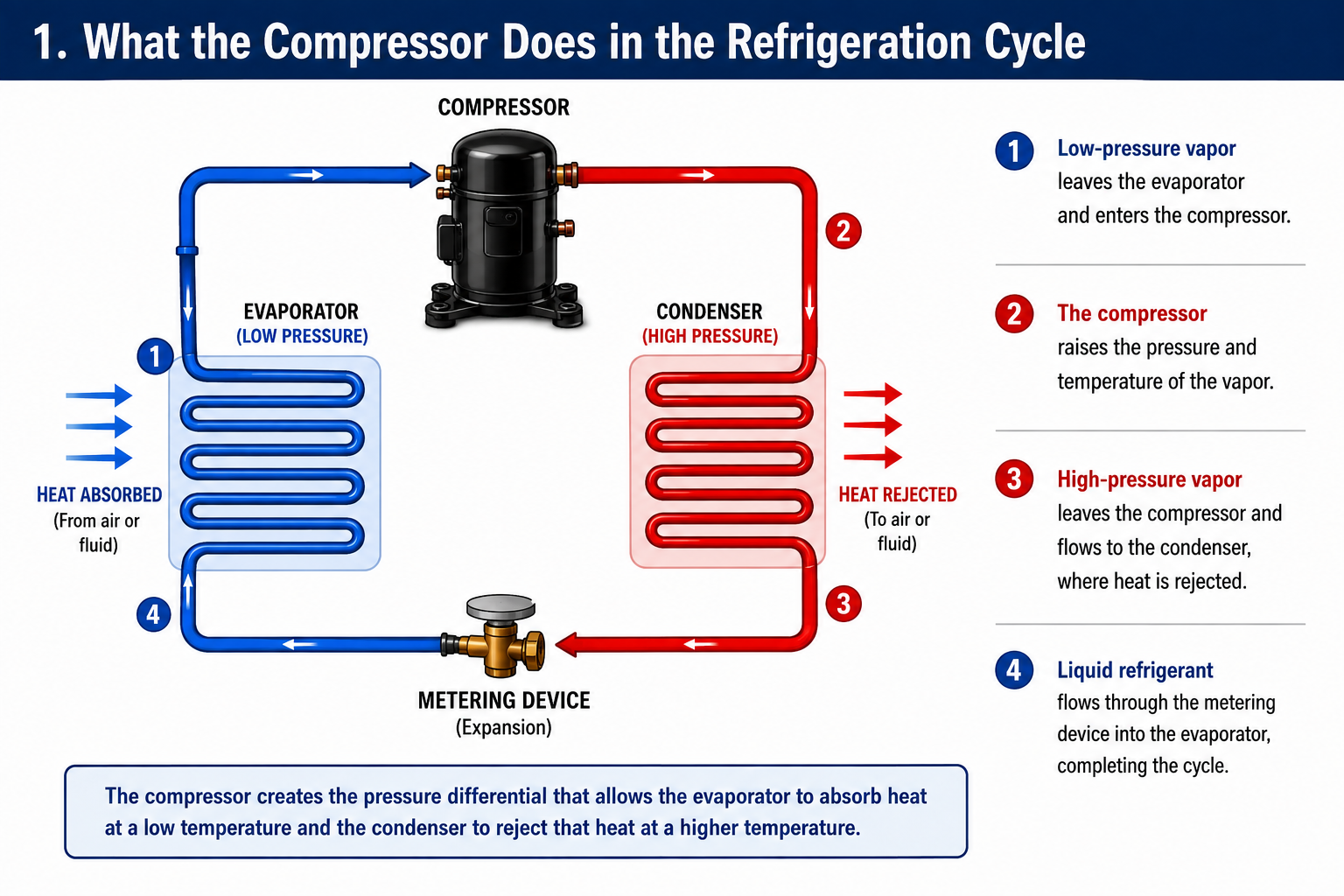
The compressor raises refrigerant pressure and temperature. The resulting hot, high-pressure vapor then travels through the compressor discharge line to the condenser.
The condenser receives that vapor and removes heat from it.
Technician Point
The compressor and condenser do not have to be physically next to each other.
The compressor discharge line carries hot, high-pressure refrigerant vapor from the compressor to the condenser, which may be located remotely.
What Does the Condenser Do?
The condenser is a heat-rejection device.
It transfers heat from the refrigerant to another medium. In most air-conditioning systems, that medium is outdoor air. In water-cooled systems, the heat is transferred to circulating water.
Refrigerant Entering
Refrigerant enters the condenser after leaving the compressor discharge connection.
Refrigerant Leaving
After enough heat has been removed, refrigerant leaves the condenser as liquid and may be subcooled.
Central Concept
The condenser removes heat from the refrigerant.
The refrigerant gives up heat so it can change from vapor to liquid and continue through the refrigeration cycle.
What Happens Inside the Condenser?
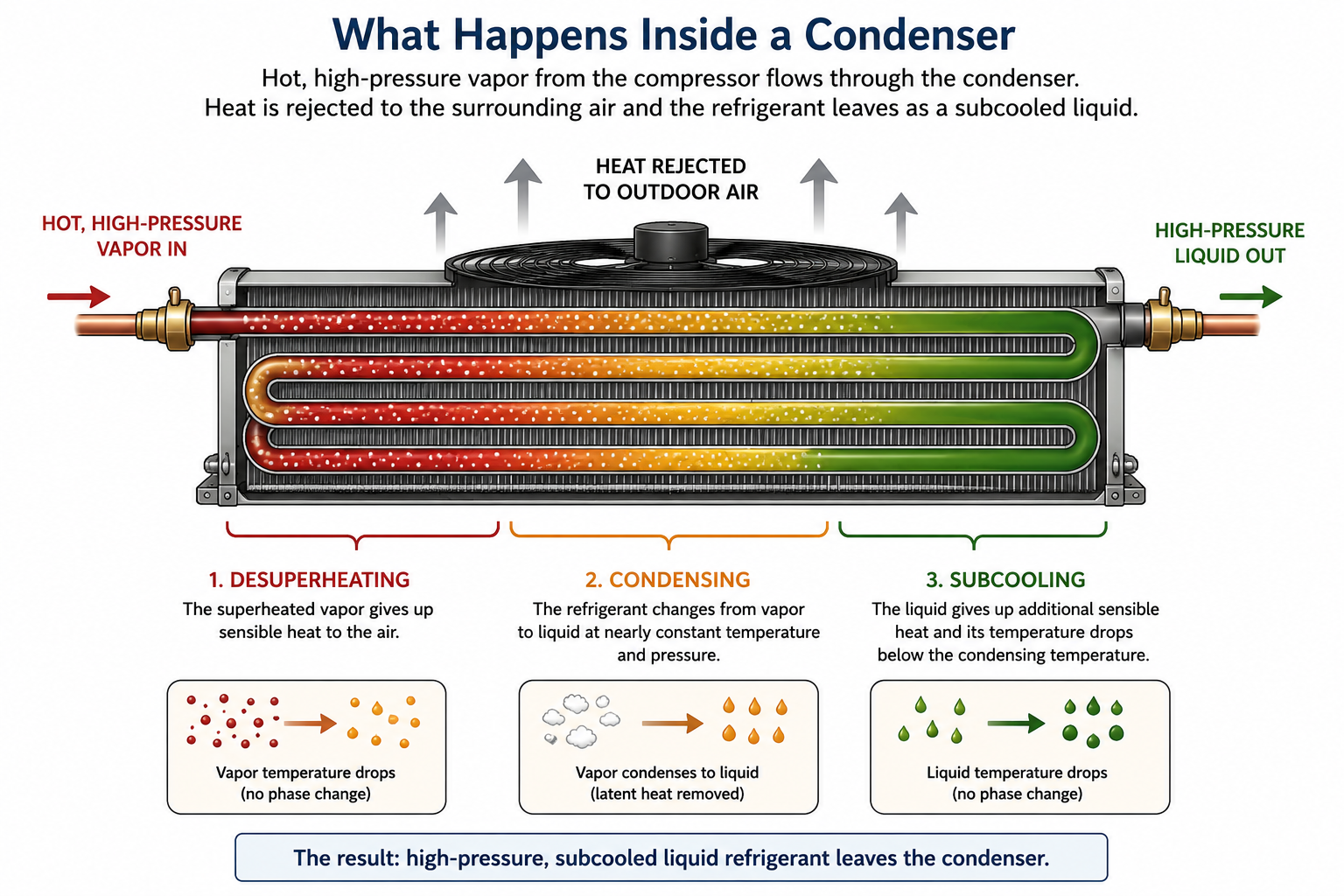
Heat removal inside the condenser can be divided into three basic regions.
1
Desuperheating
Hot refrigerant vapor enters the condenser at a temperature above its condensing temperature.
The first heat removed lowers the temperature of the superheated vapor until it reaches the condensing temperature.
2
Condensing
Once the refrigerant reaches its condensing temperature, additional heat removal causes the refrigerant to change from vapor to liquid.
This phase change occurs while the refrigerant remains on the high-pressure side of the system.
3
Subcooling
After the refrigerant has completely condensed into liquid, additional heat removal can reduce the liquid temperature below the condensing temperature.
This condition is called subcooling.
Heat Must Flow From Hotter to Cooler
For the condenser to reject heat, the refrigerant must be at a higher temperature than the medium receiving the heat.
In an air-cooled condenser, the refrigerant must be hotter than the outdoor air.
In a water-cooled condenser, the refrigerant must be hotter than the cooling water.
Heat-Transfer Rule
Heat flows from the warmer substance to the cooler substance.
The condenser maintains the temperature difference needed for heat to leave the refrigerant.
Two Main Types of Condensers
The source material identifies two main condenser categories: air-cooled and water-cooled. :contentReference[oaicite:1]{index=1}
Air-Cooled Condenser
Heat is transferred from the refrigerant to air moving across the condenser coil.
Fans or blowers are commonly used to move air through the coil.
Water-Cooled Condenser
Heat is transferred from the refrigerant to water flowing through or around the condenser heat exchanger.
The warmed water must then reject that heat elsewhere.
The detailed operation of each condenser type will be covered in later lessons.
Air-Cooled Condensers
Air conditioning primarily uses forced-draft air-cooled condensers.
The source describes these systems as using fans or blowers to move air through a condenser coil and fins attached to the condenser tubing to increase the surface area available for heat transfer. :contentReference[oaicite:2]{index=2}
Why Fins Are Used
Fins increase the surface area exposed to the air.
More surface area allows more heat to be transferred from the refrigerant tubing to the surrounding air.
Water-Cooled Condensers
Water-cooled condensers transfer refrigerant heat to circulating water.
The source later divides water-cooled condensers into three basic designs:
Tube-in-Tube
A smaller water tube is located inside a larger refrigerant passage.
Shell-and-Tube
Multiple water tubes pass through a larger shell containing refrigerant.
Shell-and-Coil
A water coil is located inside a shell containing refrigerant.
These three designs are identified in the source presentation and will be examined in detail in the water-cooled condenser lesson. :contentReference[oaicite:3]{index=3}
Follow the Refrigerant Through the Condenser
Hot, high-pressure refrigerant vapor leaves the compressor.
The discharge line carries the vapor to the condenser.
The condenser removes superheat from the vapor.
Additional heat removal changes the refrigerant from vapor to liquid.
Additional heat removal after condensation can subcool the liquid.
High-pressure liquid refrigerant leaves the condenser and continues toward the expansion device.
Can You Explain Condenser Fundamentals?
You should be able to answer these questions before continuing.
1. What major component comes immediately before the condenser in the refrigeration cycle?
2. What refrigerant condition enters the condenser?
3. What line carries refrigerant from the compressor to the condenser?
4. Does the compressor have to be physically next to the condenser?
5. What is the primary purpose of the condenser?
6. What refrigerant condition leaves the condenser?
7. What are the three basic heat-removal regions inside the condenser?
8. What happens during desuperheating?
9. What happens during condensing?
10. What is subcooling?
11. What are the two main condenser categories?
12. Why must the refrigerant be hotter than the air or water receiving the heat?
What You Should Have Learned
The condenser follows the compressor in the refrigeration cycle.
Hot, high-pressure vapor travels from the compressor to the condenser through the discharge line.
The compressor may be physically remote from the condenser.
The condenser rejects heat from the refrigerant to air or water.
The refrigerant passes through desuperheating, condensing, and possibly subcooling regions.
The refrigerant changes from high-pressure vapor to high-pressure liquid inside the condenser.
The two main condenser categories are air-cooled and water-cooled.
Heat can leave the refrigerant only when the refrigerant is hotter than the medium receiving the heat.
The Condenser Rejects the Heat
The evaporator absorbs heat into the refrigerant.
The compressor raises the refrigerant pressure and temperature.
The condenser then gives that heat a place to leave the refrigeration system.
Hot Vapor In · Heat Rejected · High-Pressure Liquid Out