Compressor Problems and Protection
Compressor failures are often caused by conditions elsewhere in the refrigeration system rather than by the compressor alone.
Liquid refrigerant, excessive operating pressure, improper charge, oil loss, refrigerant migration, and poor system maintenance can all shorten compressor life or cause immediate damage.
This lesson explains several common compressor problems described in the source material and introduces the methods used to protect the compressor from those conditions.
What You Will Learn
By the end of this lesson you should be able to:
Describe why liquid refrigerant entering the compressor can cause severe mechanical damage.
Recognize the effects of dirty condenser coils and improper refrigerant charge on compressor pressure and temperature.
Describe how liquid refrigerant can move into the compressor crankcase during the off cycle.
Recognize what can happen when liquid refrigerant mixes with compressor oil and rapidly boils during startup.
Describe how keeping the compressor crankcase warm can reduce refrigerant migration during the off cycle.
Recognize how pump-down operation can reduce the amount of refrigerant available to migrate into the compressor crankcase.
The Compressor Depends on the Entire System
The compressor is mechanically central to the refrigeration cycle, but it operates under conditions created by the entire refrigeration system.
If condenser airflow is poor, refrigerant charge is incorrect, liquid refrigerant returns to the compressor, or oil is lost, the compressor can be forced to operate under damaging conditions.
Technician Point
A failed compressor may be the result of another system problem.
Replacing a compressor without finding the cause of the failure can lead to another compressor failure.
Compressor Problems at a Glance
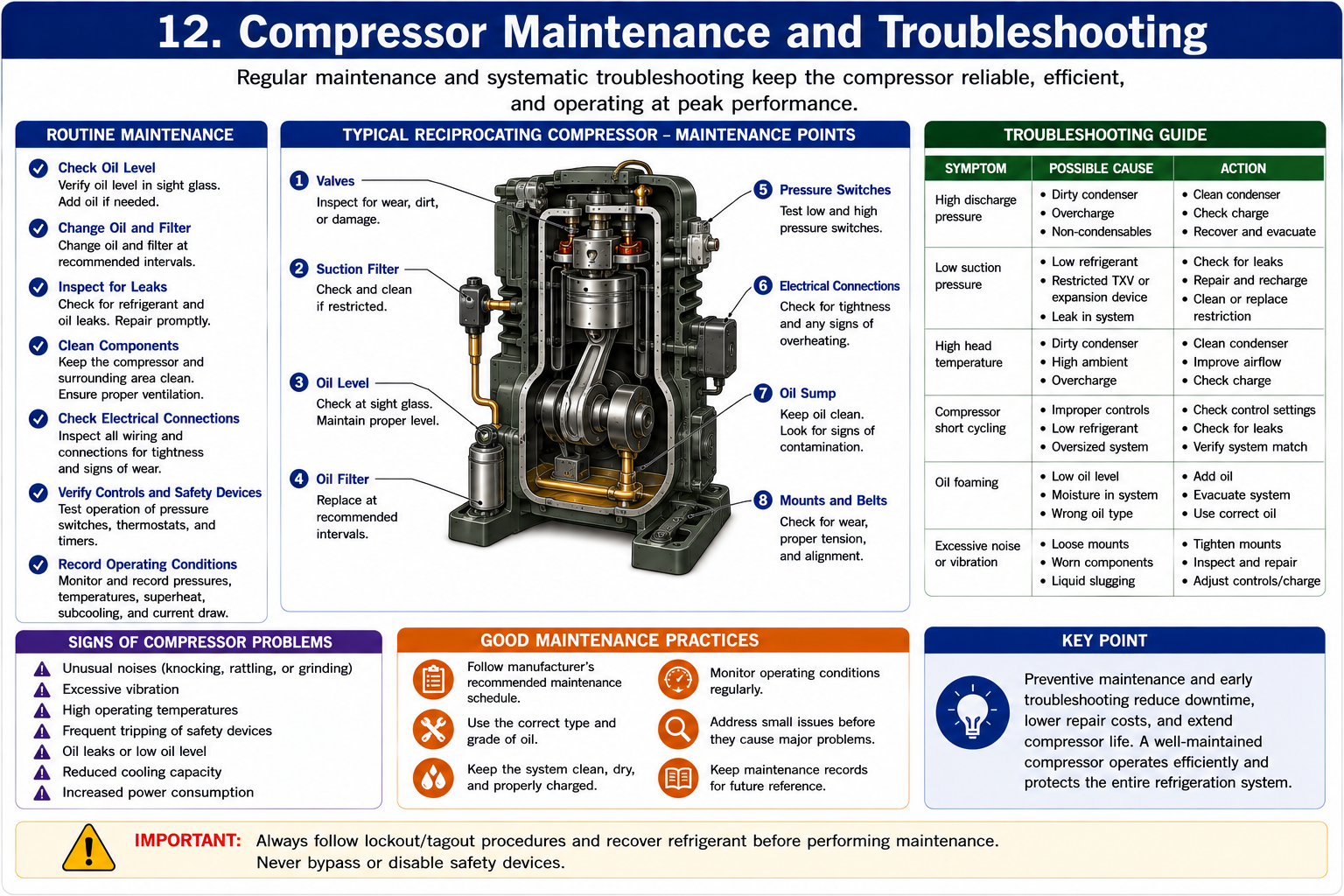
The following illustration summarizes several common compressor problems and the protective practices associated with them.
Liquid Slugging
A compressor is designed to compress refrigerant vapor.
If liquid refrigerant enters the compressor, the condition is called slugging.
The source states that liquid does not compress and warns that slugging can break compressor rods, valves, pistons, or other internal mechanical parts. :contentReference[oaicite:1]{index=1}
Normal Condition
Low-pressure refrigerant vapor returns from the evaporator and enters the compressor.
Abnormal Condition
Liquid refrigerant reaches the compressor and can create damaging hydraulic forces inside the compression mechanism.
Remember
A compressor is a vapor pump.
Liquid refrigerant reaching the compressor is a serious operating condition.
Dirty Condenser Coils
The compressor must raise refrigerant pressure high enough for heat to be rejected through the condenser.
If the condenser cannot reject heat effectively, system operating pressure and compressor temperature can increase.
The source specifically identifies dirty condenser coils as a condition that can raise pressure, overheat the compressor, reduce efficiency, and shorten compressor life. :contentReference[oaicite:2]{index=2}
Condenser Becomes Dirty
Heat transfer from the refrigerant to the surrounding air is reduced.
Condensing Pressure Rises
The compressor must work against a higher discharge pressure.
Compressor Runs Hotter
Higher operating temperature and pressure can reduce compressor efficiency and life.
Improper Refrigerant Charge
The source also identifies improper refrigerant charge as a condition that can adversely affect compressor pressure, temperature, efficiency, and lifespan. :contentReference[oaicite:3]{index=3}
Incorrect System Operation
An improper refrigerant charge can cause the refrigeration system to operate outside its intended pressure and temperature conditions.
Compressor Stress
Abnormal system pressures and temperatures can increase compressor workload and contribute to overheating or reduced compressor life.
Technician Point
Correct compressor operation depends on correct system operation.
Compressor protection therefore includes maintaining proper condenser performance and proper refrigerant charge.
Refrigerant Migration
The source defines refrigerant migration as the movement of liquid refrigerant into the compressor crankcase. :contentReference[oaicite:4]{index=4}
This commonly becomes a concern while the compressor is off.
Refrigerant Migration
Refrigerant migration is the movement of refrigerant toward and into the compressor crankcase during the compressor off cycle.
Compressor Stops
Refrigerant circulation through the normal refrigeration cycle stops.
Liquid Refrigerant Collects
Refrigerant can migrate into the compressor crankcase.
Oil Becomes Refrigerant-Rich
Liquid refrigerant can mix with or become dissolved in the compressor oil.
Oil Foaming at Startup
When a compressor containing refrigerant-rich oil starts, the pressure in the crankcase changes rapidly.
The source states that the presence of liquid refrigerant can affect oil-pump operation and can produce violent foaming at startup. :contentReference[oaicite:5]{index=5}
Liquid refrigerant is present in the crankcase.
The compressor starts and crankcase pressure changes.
Refrigerant rapidly boils out of the oil.
The oil can foam violently.
Oil can be carried out of the crankcase with the refrigerant.
Why This Is Dangerous
The source warns that violent foaming can result in the loss of oil from the compressor crankcase. :contentReference[oaicite:6]{index=6}
If the compressor loses enough oil, moving parts may no longer receive adequate lubrication.
Crankcase Heaters
The source identifies crankcase heaters as one method used to reduce or prevent refrigerant migration during the compressor off cycle. :contentReference[oaicite:7]{index=7}
A crankcase heater keeps the compressor crankcase warmer while the compressor is off.
Without Crankcase Heating
Liquid refrigerant may migrate into and collect in the compressor crankcase during the off cycle.
With Crankcase Heating
Keeping the crankcase warmer helps discourage refrigerant from remaining as liquid in the compressor crankcase.
Protection During the Off Cycle
A crankcase heater protects the compressor primarily while the compressor is not running.
Pump-Down Control
The source also identifies pump-down control as a method used to reduce or stop refrigerant migration during the compressor off cycle. :contentReference[oaicite:8]{index=8}
A pump-down arrangement reduces the amount of refrigerant left on the low side of the refrigeration system when the compressor shuts off.
Cooling Demand Ends
The system begins the shutdown sequence.
Refrigerant Is Removed From the Low Side
The compressor continues operating long enough to reduce refrigerant remaining in the evaporator and suction side.
Less Refrigerant Can Migrate
Reducing refrigerant on the low side reduces the amount available to migrate toward the compressor crankcase.
Compressor Protection Devices
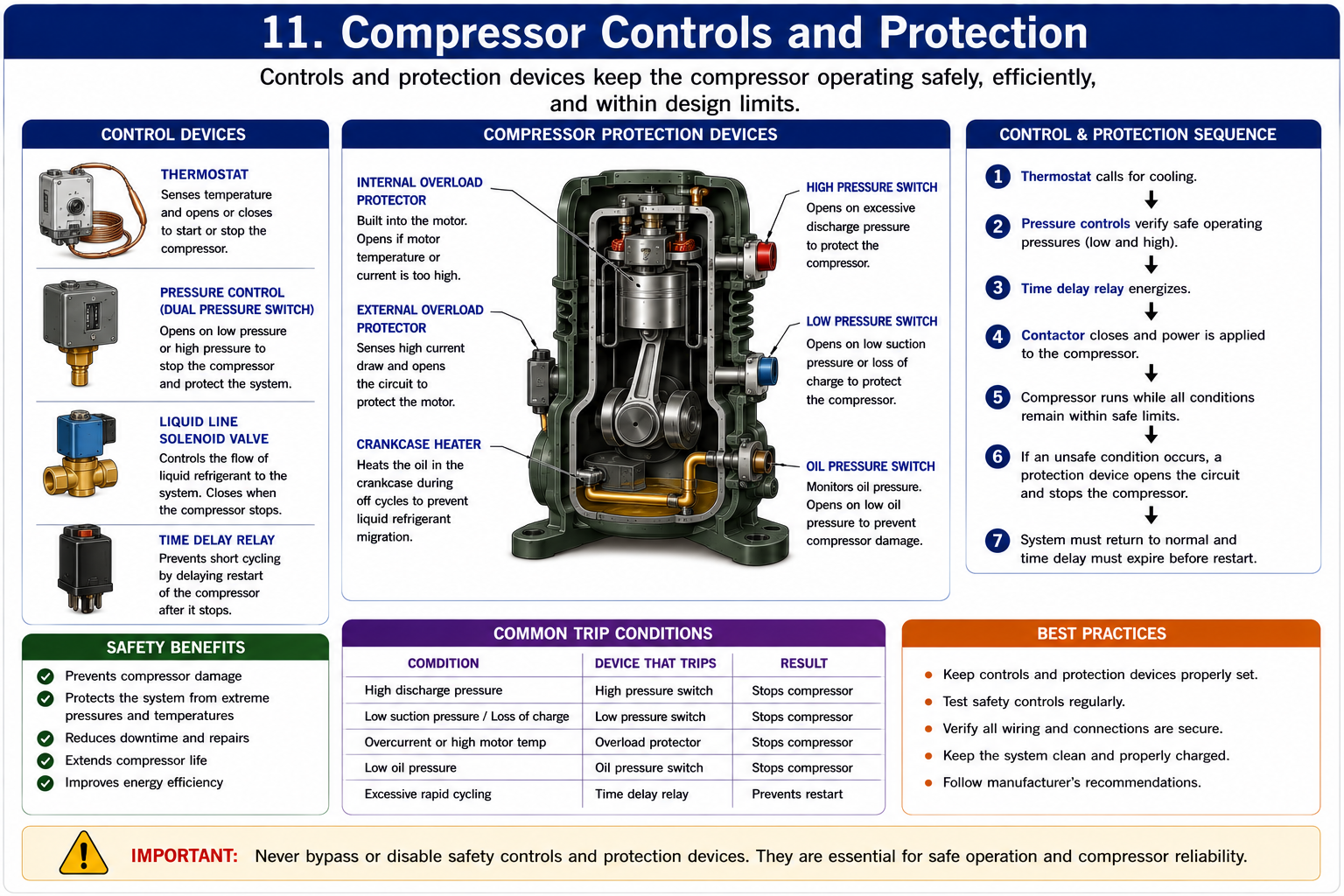
Compressor protection is not limited to one component. Safe operation depends on several controls and operating conditions working together.
Protecting the Compressor
The source material points to several different ways compressor life can be protected.
Keep Liquid Refrigerant Out
Prevent slugging and reduce the risk of liquid refrigerant interfering with compressor oil.
Maintain Condenser Performance
Dirty condenser coils can raise operating pressure and compressor temperature.
Maintain Correct Refrigerant Charge
Improper system charge can create harmful pressure and temperature conditions.
Protect the Oil
Oil loss, foaming, contamination, or inadequate lubrication can damage compressor components.
Control Refrigerant Migration
Crankcase heaters and pump-down controls can reduce refrigerant collecting in the compressor during the off cycle.
Find the Cause of Failure
Correct the system condition that caused compressor damage before returning the system to service.
Think in Terms of Cause and Effect
Compressor problems often develop as a sequence rather than as a single isolated event.
Dirty condenser, improper charge, liquid return, migration, or lubrication problem
High pressure, high temperature, liquid in the compressor, oil foaming, or oil loss
Higher mechanical load, poor lubrication, or damaging hydraulic forces
Loss of efficiency, internal wear, mechanical damage, or compressor failure
Technician Point
Do not stop troubleshooting at the failed compressor.
Determine what caused the compressor to fail.
Put the Concepts Together
Compressors are designed to compress refrigerant vapor rather than liquid.
Liquid slugging can cause immediate mechanical compressor damage.
Dirty condenser coils can raise system pressure and compressor temperature.
Improper refrigerant charge can reduce compressor efficiency and lifespan.
Refrigerant migration can move liquid refrigerant into the compressor crankcase during the off cycle.
Refrigerant-rich oil can foam violently when the compressor starts.
Oil foaming can cause oil to be carried out of the compressor crankcase.
Crankcase heaters and pump-down controls can reduce refrigerant migration.
Can You Explain Compressor Problems and Protection?
You should be able to answer these questions before continuing.
1. What is liquid slugging?
2. Why can liquid refrigerant cause mechanical compressor damage?
3. How can a dirty condenser affect compressor pressure and temperature?
4. How can improper refrigerant charge affect compressor life?
5. What is refrigerant migration?
6. When is refrigerant migration most likely to become a concern?
7. What can happen when refrigerant-rich compressor oil experiences a rapid pressure change at startup?
8. How can oil foaming lead to loss of lubrication?
9. What is the purpose of a crankcase heater?
10. What is the purpose of pump-down control?
11. Why should the cause of compressor failure be determined before a replacement compressor is returned to service?
What You Should Have Learned
Liquid refrigerant entering the compressor can cause slugging and severe mechanical damage.
Compressor operating conditions are affected by the condition of the entire refrigeration system.
Dirty condenser coils and improper refrigerant charge can increase compressor stress and reduce compressor life.
Refrigerant migration is the movement of liquid refrigerant into the compressor crankcase.
Liquid refrigerant in the crankcase can interfere with compressor oil and oil-pump operation.
Refrigerant boiling rapidly from the oil at startup can cause violent foaming and oil loss.
Crankcase heaters help reduce refrigerant migration during the compressor off cycle.
Pump-down controls can reduce the amount of refrigerant available to migrate toward the compressor.
Protecting the compressor requires finding and correcting the system conditions that create damaging operating conditions.
Protect the Compressor by Protecting the System
Compressor reliability depends on more than the compressor itself.
Correct refrigerant flow, correct charge, good condenser heat transfer, proper lubrication, and protection from refrigerant migration all contribute to compressor life.
Remember:
Vapor Only · Correct Pressure · Correct Temperature · Proper Lubrication · Control Migration