Category: Huntsman Senior Games 2026

  • Road to Huntsman: 53 Days Out — Finishing Recovery Week With a Breaststroke Focus

    Today marks 53 days until my first event at the 2026 Huntsman World Senior Games, and today’s swim completed what has deliberately been a much lighter week of training.

    I again held the workout to 2,500 meters. Most of the first 2,000 meters was easy mixed freestyle and breaststroke swimming. Then, rather than simply adding more distance, I finished with 500 meters devoted entirely to breaststroke.

    That was intentional because tomorrow marks another change in the training plan. After using this week to recover from two extremely large weekends, I’m going to spend the coming week putting substantially more emphasis on the 100-meter and 200-meter breaststroke.

    August 15 Workout Summary

    MetricResult
    Total Distance2,500 m
    Breaststroke Distance1,500 m
    Freestyle Distance1,000 m
    Total Swim Time44:29.02
    Total Rest Time5:55.46
    Total Session Time50:24.48
    Overall Moving Pace1:46.76 /100 m
    Average Freestyle Pace1:35.77 /100 m
    Average Breaststroke Pace1:54.09 /100 m

    Workout Structure

    The first 2,000 meters were deliberately easy and mixed. Stroke identification below comes from the FORM goggles’ length-by-length data rather than relying solely on the name FORM assigned to each set.

    Set Structure Stroke Composition Distance Swim Time Pace /100 Rest
    1 1 × 1000 500 FR / 500 BR 1,000 m 17:35.01 1:45.50 0:28.84
    2 1 × 200 100 FR / 100 BR 200 m 3:29.90 1:44.95 0:46.97
    3 2 × 400 400 FR / 400 BR 800 m 14:23.91 1:47.99 1:11.03
    4 6 × 50 300 BR 300 m 5:21.24 1:47.08* 2:31.14
    5 2 × 100 200 BR 200 m 3:38.96 1:49.48* 0:57.48

    *Pace for interval sets is calculated from swimming time only. Recovery between repetitions is excluded.

    The First 2,000 Meters: Easy by Design

    The first 2,000 meters weren’t intended to produce race benchmarks. They were primarily continuous mixed-stroke swimming at a controlled effort.

    The opening 1,000 meters contained exactly 500 meters of freestyle and 500 meters of breaststroke and took 17:35.01.

    That was followed by another 200 meters split evenly between the two strokes and then 2 × 400 meters, again containing equal amounts of freestyle and breaststroke.

    By the 2,000-meter mark I had accumulated exactly 1,000 meters freestyle and 1,000 meters breaststroke. That was enough general aerobic work for today.

    The final 500 meters changed the purpose of the workout.

    6 × 50M Breaststroke

    The first breaststroke-specific set was 6 × 50 meters with recovery between each repeat.

    50MTime100M Equivalent Pace
    152.951:45.90
    252.791:45.58
    352.391:44.78
    454.831:49.66
    554.871:49.74
    653.411:46.82

    The fastest was 52.39, but the more useful result was the consistency. All six repeats fell within a range of only 2.48 seconds.

    The final repeat also came back down to 53.41 after two 54-second swims. There wasn’t a progressive collapse across the set.

    Finishing With 2 × 100M Breaststroke

    The final set was the most relevant to where my training goes next: 2 × 100-meter breaststroke.

    100M Time Current Best Difference
    1 1:51.50 1:42.55 +8.95
    2 1:47.46 1:42.55 +4.91

    The second 100 was actually 4.04 seconds faster than the first.

    That’s noteworthy because it came at the very end of the workout. I had already completed 2,400 meters, including 1,400 meters of breaststroke, before beginning that final 100.

    A 1:47.46 isn’t a new benchmark—my current best remains 1:42.55—but today wasn’t intended to be a benchmark workout. Finishing an easy 2,500-meter session with a sub-1:48 breaststroke 100 is a useful result going into a week specifically devoted to improving the stroke.

    Current Huntsman Benchmarks

    Today’s workout doesn’t change any of my official race-distance training benchmarks.

    Event Current Training Best 2025 Bronze 2025 4th
    1500M Freestyle 24:21.26 25:04.75 25:06.88
    800M Freestyle 12:40.25 12:32.85 12:56.76
    200M Breaststroke 3:31.71 3:39.92 4:00.27
    100M Breaststroke 1:42.55 1:32.97 1:37.95

    The Breaststroke Hump

    The freestyle events have made significant jumps during this training cycle. Breaststroke has improved too, particularly the 200, but I feel like I’ve reached a point where simply swimming more breaststroke isn’t necessarily producing the improvement I want in the 100 and 200.

    That’s the hump I want to work on next.

    My current 200-meter training best of 3:31.71 is already faster than the 2025 Huntsman bronze-medal result. The 100-meter best of 1:42.55, however, remains 4.60 seconds behind last year’s fourth-place time and 9.58 seconds behind bronze.

    The answer probably isn’t another enormous endurance block. The next step is to concentrate more specifically on the things that determine breaststroke speed: maintaining an effective stroke under load, getting more speed from each pull and kick, controlling stroke timing, improving turns and pullouts, and learning to hold a faster pace without technique deteriorating.

    Tomorrow Starts a Breaststroke Week

    The recovery week has done what I wanted it to do.

    I reduced the swimming volume, stayed active, took a complete day away from the pool yesterday with a dryland run, and returned today for another controlled 2,500-meter swim.

    Tomorrow I’ll begin a week with a much stronger breaststroke emphasis.

    That doesn’t mean simply piling on thousands of meters of breaststroke. The objective will be quality and specificity.

    I want to work specifically on the two events where there is still a speed problem to solve: the 100-meter and 200-meter breaststroke.

    The 100 requires more speed. The 200 requires finding the balance between that speed and holding technically sound breaststroke for four lengths of a 50-meter competition pool.

    53 Days to Go

    There are now 53 days until the first race.

    This week was about backing away from the enormous training loads of the previous two weekends and giving that work time to settle in.

    Today was an appropriate way to finish that phase: 2,500 controlled meters, an easy first 2,000, then six consistent breaststroke 50s and two breaststroke 100s to finish.

    Tomorrow the objective changes.

    Instead of asking how much breaststroke I can swim, the question for the coming week will be:

    What do I need to change to make my breaststroke faster?

    With 53 days remaining, there is still time to find out.

    Today’s headline: An easy 2,500-meter swim closed out recovery week, with the final 500 meters dedicated entirely to breaststroke. Tomorrow begins a more intensive week aimed specifically at breaking through the plateau in my 100 and 200 breaststroke times.
  • Road to Huntsman: 54 Days Out — Getting Out of the Pool

    Today marks 54 days until my first event at the 2026 Huntsman World Senior Games, and for the first time this week the day’s workout had nothing to do with swimming.

    That was intentional.

    After several consecutive days in the pool—and two very large weekend swimming workouts before that—I wanted a day that would give my shoulders and swimming-specific muscles a genuine break without turning the day into complete inactivity.

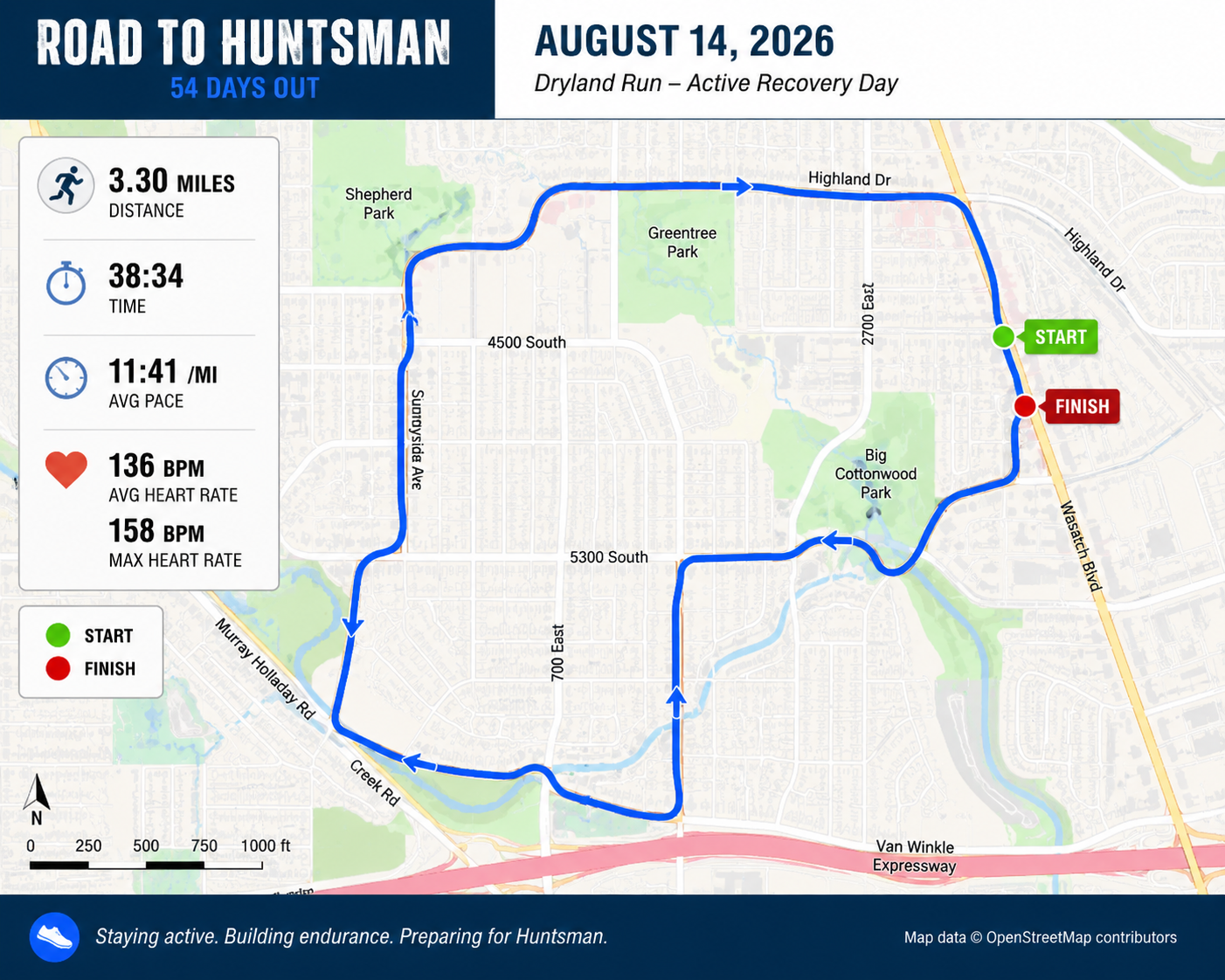
    So today’s Road to Huntsman workout was a 3.3-mile run.

    Road to Huntsman August 14 dryland run route map
    August 14 dryland run — 3.30 miles of active recovery away from the pool.

    August 14 Workout Summary

    Metric Result
    ActivityRunning
    Distance3.30 miles
    Time38:34
    Average Pace11:41 /mile
    Distance5.32 km
    Average Pace7:15 /km
    Average Heart Rate136 bpm
    Maximum Heart Rate158 bpm

    Run Structure

    The run wasn’t intended to be a race or a running benchmark. The objective was simply to stay aerobically active while taking swimming out of the equation for a day.

    Segment Time Pace
    Mile 111:3011:30 /mile
    Mile 210:4310:43 /mile
    Mile 312:0312:03 /mile
    Final 0.30 mile4:18Approximately 14:11 /mile
    Total38:3411:41 /mile

    The second mile was the quickest at 10:43. Pace then backed off during the second half, which was completely acceptable for the purpose of today’s workout. This wasn’t supposed to become another hard training test.

    Why Run Instead of Swim?

    One of the challenges in preparing for four swimming events is remembering that more swimming isn’t automatically better swimming.

    I’ve been deliberately holding the swimming volume down this week following two extremely long weekend workouts. The last three pool sessions were each limited to approximately 2,500 meters, but even reduced-volume swimming still repeatedly loads the shoulders, chest, back and the other muscles involved in freestyle and breaststroke.

    Today removed that repetitive swimming load completely.

    Running allowed me to continue working aerobically while giving the upper body a day away from thousands of additional swimming strokes.

    Recovery Doesn’t Always Mean Rest

    This week has reinforced an important distinction in my training plan: recovery and inactivity aren’t necessarily the same thing.

    There are certainly times when complete rest is appropriate. But today I wanted to remain active while changing the physical stress.

    A 38-minute run accomplished that.

    My cardiovascular system still had work to do. My legs had work to do. But my shoulders didn’t have to complete another freestyle pull or breaststroke recovery.

    That’s an important distinction as the training becomes increasingly specific over the next several weeks.

    The Recovery Week So Far

    This week wasn’t intended to produce another enormous training load. The goal has been to absorb the work from the previous weekends while continuing to train with purpose.

    Date Primary Focus Volume
    August 11Recovery + 200M breaststroke focus2,500 m swim
    August 12Recovery + 100M breaststroke focus2,500 m swim
    August 13Continuous mixed-stroke endurance2,500 m swim
    August 14Dryland / active recovery3.30-mile run

    The pattern is deliberate. Training hasn’t stopped, but the type and amount of stress have changed.

    No Swimming Benchmarks Today

    Obviously, today’s run doesn’t change any of my Huntsman swimming benchmarks.

    Event Current Training Best 2025 Bronze 2025 4th
    1500M Freestyle24:21.2625:04.7525:06.88
    800M Freestyle12:40.2512:32.8512:56.76
    200M Breaststroke3:31.713:39.924:00.27
    100M Breaststroke1:42.551:32.971:37.95

    But that doesn’t mean today was unrelated to those numbers.

    The purpose of recovery is to make the next quality workout better. A day away from the pool can contribute to an October swimming performance just as surely as another interval set can.

    54 Days to Go

    There are now 54 days until my first race at Huntsman.

    At this stage, one of the challenges is resisting the temptation to treat every day as an opportunity to add more meters.

    The fitness doesn’t improve during the workout itself. The workout provides the stimulus. The improvement comes when the body has an opportunity to recover and adapt to that stimulus.

    Today’s run was part of creating that opportunity.

    I stayed active. I got more than 38 minutes of aerobic work. I covered 3.3 miles. But for an entire day, my shoulders and swimming muscles didn’t have to do their normal job.

    Tomorrow they’ll be one day fresher because of it.

    Today’s headline: Sometimes the best swimming workout is not swimming. A 3.3-mile run kept the Road to Huntsman moving forward while giving the muscles that have been doing thousands of meters in the pool a needed day away from swimming.

  • Road to Huntsman: 58 Days Out — Building Endurance Without Building Volume

    Today marks 58 days until the 2026 Huntsman World Senior Games, and I continued the reduced-volume recovery week by once again stopping the workout at 2,500 meters.

    The difference today was how those 2,500 meters were organized. Rather than repeated 100-meter efforts with substantial recovery, today’s workout consisted primarily of two continuous 1,000-meter mixed-stroke swims, followed by a continuous 500-meter mixed-stroke finish.

    The result was a workout with considerably less rest and more continuous swimming, while still maintaining the 2,500-meter volume limit I’ve been using during this recovery period.

    August 13 Workout Summary

    MetricResult
    Total Distance2,500 m
    Freestyle Distance1,250 m
    Breaststroke Distance1,250 m
    Total Swim Time44:04.37
    Total Rest Time1:39.13
    Total Session Time45:43.50
    Overall Moving Pace1:45.77 /100 m
    Average Freestyle Pace1:36.49 /100 m
    Average Breaststroke Pace1:55.06 /100 m

    Workout Structure

    The FORM file describes the primary set as 2 × 1000 meters, but the length-by-length stroke data provide the more useful picture. Each 1,000 contained exactly 500 meters freestyle and 500 meters breaststroke.

    The final 500 meters was also evenly divided between the two strokes, giving the entire workout a perfect 50/50 split: 1,250 meters freestyle and 1,250 meters breaststroke.

    Set Structure Freestyle Breaststroke Total Swim Time Pace /100 Rest
    1 Mixed 500 m 500 m 1000 m 17:24.86 1:44.49 0:37.86
    2 Mixed 500 m 500 m 1000 m 17:44.99 1:46.50 1:01.27
    3 Alternating FR/BR 250 m 250 m 500 m 8:54.52 1:46.90 —

    The First 1000M

    The first 1,000 meters was completed in 17:24.86, averaging 1:44.49 per 100 meters across the combined strokes.

    Within that swim, the 500 meters of freestyle totaled approximately 8:03.08, an average of 1:36.62 per 100 meters.

    The 500 meters of breaststroke totaled approximately 9:21.78, averaging 1:52.36 per 100 meters.

    That breaststroke pace is particularly useful because it was accumulated inside a continuous 1,000-meter swim rather than as isolated repetitions with long recovery periods.

    The Second 1000M

    After only 37.86 seconds of recovery, I started the second 1,000 meters.

    The second 1,000 was completed in 17:44.99, just 20.13 seconds slower than the first.

    Stroke First 1000 Second 1000 Change
    Freestyle — 500 m 8:03.08 8:05.40 +2.32 sec
    Breaststroke — 500 m 9:21.78 9:39.59 +17.81 sec
    Total 1000 17:24.86 17:44.99 +20.13 sec

    This comparison makes the fatigue pattern fairly clear.

    Freestyle barely changed. Five hundred meters of freestyle in the second 1,000 was only 2.32 seconds slower than in the first.

    Almost all of the slowdown occurred in breaststroke. The second 500 meters of accumulated breaststroke was 17.81 seconds slower than the first.

    That continues a pattern I’ve seen in several workouts: freestyle remains remarkably resistant to fatigue, while breaststroke pace is more sensitive to accumulated workload.

    Finishing With Another 500M

    After the second 1,000, I rested for 1:01.27 and then completed another continuous 500 meters, alternating freestyle and breaststroke by 25-meter lengths.

    The final 500 was completed in 8:54.52, averaging 1:46.90 per 100 meters overall.

    The freestyle portion remained strong at approximately 7:55.22 per 500-meter equivalent pace, while the breaststroke portion reflected the accumulated breaststroke fatigue from the first 2,000 meters.

    Stroke Comparison Across the Entire Workout

    Stroke Distance Moving Time Average Pace /100 m
    Freestyle 1,250 m 20:06.09 1:36.49
    Breaststroke 1,250 m 23:58.28 1:55.06

    Today’s structure makes this an unusually clean comparison because the two strokes were swum for exactly the same distance.

    Freestyle was approximately 18.6 seconds per 100 meters faster than breaststroke across the entire workout.

    No Benchmark Changes Today

    Today’s workout wasn’t structured as a race-distance time trial for any of my four Huntsman events. Because the freestyle and breaststroke were deliberately mixed within the longer swims, I’m not going to manufacture race benchmarks from portions of those sets.

    My current event benchmarks therefore remain unchanged:

    Event Current Training Best 2025 Bronze 2025 4th
    1500M Freestyle 24:21.26 25:04.75 25:06.88
    800M Freestyle 12:40.25 12:32.85 12:56.76
    200M Breaststroke 3:31.71 3:39.92 4:00.27
    100M Breaststroke 1:42.55 1:32.97 1:37.95

    Current Gap to the 2025 Standards

    Event Current Benchmark Gap to Bronze Gap to 4th
    1500M Freestyle 24:21.26 43.49 sec faster 45.62 sec faster
    800M Freestyle 12:40.25 7.40 sec behind 16.51 sec faster
    200M Breaststroke 3:31.71 8.21 sec faster 28.56 sec faster
    100M Breaststroke 1:42.55 9.58 sec behind 4.60 sec behind

    A Different Kind of Recovery Workout

    The last several days have all been limited to 2,500 meters, but they haven’t been identical workouts.

    August 11 emphasized breaststroke with substantial recovery and produced a new 200-meter breaststroke benchmark. August 12 concentrated on repeated 100-meter breaststroke efforts with freestyle separating them.

    Today kept the same 2,500-meter ceiling but changed the stimulus again. Instead of frequent stops, almost the entire workout consisted of long continuous swimming.

    There was only 1 minute 39 seconds of rest during the entire 2,500 meters.

    That allowed me to maintain the reduced-volume recovery plan while still getting meaningful endurance work from both of my Huntsman strokes.

    58 Days to Go

    Today’s workout didn’t produce a new race-distance benchmark, and it wasn’t supposed to.

    The useful result was consistency.

    I completed 2,500 meters with an exact 50/50 split between freestyle and breaststroke, only 1:39 of total rest, and almost no deterioration in freestyle pace between the first and second 1,000-meter blocks.

    Breaststroke showed more fatigue, which continues to identify an important training opportunity for the remaining weeks: maintaining breaststroke mechanics and speed as accumulated breaststroke distance increases.

    Most importantly, I again stopped at the planned 2,500 meters.

    The goal this week isn’t to prove that I can swim farther. It’s to absorb the heavy training from the previous two weekends while continuing to touch the specific skills and energy systems I’ll need in October.

    Today’s headline: 2,500 meters, exactly half freestyle and half breaststroke, only 1:39 of total rest, and a second 1,000-meter block only 20 seconds slower than the first. A controlled endurance session that stayed within the recovery-week plan.

  • Road to Huntsman: Recovery Mode with a 100M Breaststroke Focus

    Today’s Huntsman training continued the recovery approach I started this week. I again limited the workout to 2,500 meters, but this time the primary objective was the 100-meter breaststroke.

    Rather than trying to set another personal training best, the goal was to accumulate quality 100-meter breaststroke efforts while keeping the total training load under control.

    The workout included 1,150 meters of breaststroke and 1,350 meters of freestyle. Most importantly, it provided nine dedicated 100-meter breaststroke swims spread throughout the session.

    August 12 Workout Summary

    MetricResult
    Total Distance2,500 m
    Freestyle Distance1,350 m
    Breaststroke Distance1,150 m
    Total Swim Time41:31.4
    Total Rest Time8:30.0
    Total Session Time50:01.4
    Overall Moving Pace1:39.7 /100 m
    Average Freestyle Pace1:32.1 /100 m
    Average Breaststroke Pace1:48.5 /100 m

    Workout Structure

    The first 1,000 meters consisted of alternating 100-meter freestyle and breaststroke repeats. The second portion shifted to alternating 150-meter freestyle and 100-meter breaststroke, followed by short mixed work to finish.

    Set Stroke Distance Swim Time Pace /100 Rest
    1Freestyle100 m1:33.851:33.850:10.57
    2Breaststroke100 m1:45.761:45.760:18.78
    3Freestyle100 m1:29.441:29.440:16.50
    4Breaststroke100 m1:46.121:46.120:23.38
    5Freestyle100 m1:29.401:29.400:18.49
    6Breaststroke100 m1:45.121:45.120:27.60
    7Freestyle100 m1:33.011:33.010:15.67
    8Breaststroke100 m1:48.271:48.270:22.31
    9Freestyle100 m1:32.381:32.380:18.80
    10Breaststroke100 m1:47.031:47.030:22.16
    11Freestyle150 m2:18.681:32.450:19.09
    12Breaststroke100 m1:50.261:50.260:30.88
    13Freestyle150 m2:20.001:33.330:21.67
    14Breaststroke100 m1:47.451:47.450:28.45
    15Freestyle150 m2:21.331:34.220:40.95
    16Breaststroke100 m1:48.531:48.530:19.76
    17Freestyle150 m2:21.991:34.660:21.94
    18Breaststroke100 m1:49.331:49.330:31.91
    19–21Mixed FR / BR300 m4:59.311:39.771:11.37
    22Freestyle100 m1:33.321:33.32—
    23Breaststroke100 m1:50.861:50.86—

    The Main Set: Repeating the 100M Breaststroke

    The important numbers today weren’t necessarily the fastest numbers. They were the repeated 100-meter breaststroke performances.

    100M BreaststrokeTimeDifference From Best
    11:45.76+3.21
    21:46.12+3.57
    31:45.12+2.57
    41:48.27+5.72
    51:47.03+4.48
    61:50.26+7.71
    71:47.45+4.90
    81:48.53+5.98
    91:49.33+6.78

    My current 100-meter breaststroke training best remains 1:42.55 from August 9.

    Today’s fastest 100 was 1:45.12, only 2.57 seconds slower than that benchmark. More importantly, three of the first five breaststroke 100s were under 1:47.

    That is useful information on a recovery day. I wasn’t trying to produce one all-out 100 and then stop. The objective was to repeatedly return to the 100-meter breaststroke while alternating it with freestyle.

    Where Fatigue Appeared

    The breaststroke times also provide a clear picture of accumulated fatigue.

    The opening breaststroke block was generally in the 1:45–1:48 range. During the second half, most of the dedicated 100s moved toward approximately 1:47–1:50.

    That’s a relatively modest decline considering the number of 100-meter breaststroke repeats completed. More importantly, there wasn’t a dramatic collapse in pace.

    For a workout designed around recovery rather than maximum performance, that’s probably more useful than producing a single exceptionally fast repeat.

    Freestyle Stayed Strong

    Freestyle was primarily being used to separate the breaststroke efforts, but the pace remained surprisingly strong.

    Across 1,350 meters of freestyle, the average moving pace was approximately 1:32.1 per 100 meters.

    The opening five 100-meter freestyle repeats were:

    100MTime
    11:33.85
    21:29.44
    31:29.40
    41:33.01
    51:32.38

    That’s another indication that reducing total distance this week has not meant losing speed. The workload is lower, but the quality of the swimming remains good.

    Updated Huntsman Benchmarks

    Today’s workout does not change any of my four official event benchmarks.

    Event Today’s Best Qualifying Effort Current Best 2025 Bronze 2025 4th
    1500M Freestyle—24:21.2625:04.7525:06.88
    800M Freestyle—12:40.2512:32.8512:56.76
    200M Breaststroke—3:31.713:39.924:00.27
    100M Breaststroke1:45.121:42.551:32.971:37.95

    Current Gap to the 2025 Medal Standards

    EventCurrent BenchmarkGap to BronzeGap to 4th
    1500M Freestyle24:21.2643.49 sec faster45.62 sec faster
    800M Freestyle12:40.257.40 sec behind16.51 sec faster
    200M Breaststroke3:31.718.21 sec faster28.56 sec faster
    100M Breaststroke1:42.559.58 sec behind4.60 sec behind

    Why Today’s Workout Matters

    It’s easy to evaluate a workout by asking whether I set a personal best.

    That wasn’t the point today.

    This is a recovery week following two very large weekend training sessions. The objective is to allow the previous workload to produce adaptation without simply stacking more fatigue on top of it.

    Today’s 2,500 meters accomplished that while still providing highly specific training for the 100-meter breaststroke.

    I completed repeated 100-meter breaststroke efforts, kept several of them reasonably close to my current best, maintained strong freestyle between them, and stopped the workout at the planned 2,500 meters.

    That last part may be as important as anything else.

    There was no reason to turn a productive 2,500-meter recovery workout into another 4,000- or 5,000-meter endurance session simply because I felt capable of continuing.

    Recovery Week Continues

    The pattern this week is becoming clear: less volume without abandoning quality.

    Yesterday concentrated on breaststroke with a strong 200-meter effort. Today shifted the emphasis toward repeated 100-meter breaststroke swimming.

    Neither workout exceeded 2,500 meters.

    That is intentional. The endurance base doesn’t need to be demonstrated every day. Right now the objective is to absorb the previous training, maintain race-specific speed and technique, and emerge from the recovery period ready for the next build phase.

    Today’s headline: No new personal best—and that’s perfectly fine. Nine dedicated 100-meter breaststroke efforts, a fastest repeat of 1:45.12, strong freestyle between them, and the discipline to stop at the planned 2,500 meters.

  • Road to Huntsman: 60 Days Out — Recovery, Breaststroke and a New 200M Benchmark

    Today marks 60 days until the 2026 Huntsman World Senior Games. After two extremely long weekend workouts in consecutive weeks, today’s objective was deliberately different: reduce the overall workload while putting most of the swimming emphasis on breaststroke.

    The result was a 2,500-meter session—considerably shorter than Sunday’s 6,000 meters—with 1,525 meters of breaststroke and 975 meters of freestyle.

    Despite being primarily a recovery and technique-focused day, the workout produced an unexpected result: a continuous 200-meter breaststroke in 3:31.71. That becomes my fastest dedicated 200-meter breaststroke training swim so far.

    August 11 Workout Summary

    Metric Result
    Total Distance2,500 m
    Breaststroke Distance1,525 m
    Freestyle Distance975 m
    Total Swim Time41:54.1
    Total Rest Time12:40.5
    Total Session Time54:34.6
    Overall Swim Pace1:40.6 /100 m
    Average Breaststroke Pace1:44.8 /100 m
    Average Freestyle Pace1:34.0 /100 m

    Workout Structure

    The workout was intentionally broken into shorter sets with substantially more recovery than a normal endurance workout. Stroke identification comes directly from the FORM goggles’ length-by-length data rather than assuming that mixed sets were a single stroke.

    Set Structure Stroke Distance Swim Time Pace /100 Rest
    11 × 100Freestyle100 m1:31.721:31.70:27.3
    21 × 200Breaststroke200 m3:31.711:45.90:46.3
    31 × 100Freestyle100 m1:33.121:33.10:13.5
    412 × 25Breaststroke300 m4:46.741:35.6*3:17.6
    51 × 100Freestyle100 m1:33.151:33.20:16.9
    614 × 50Breaststroke700 m12:09.571:44.2*4:27.4
    75 × 100Freestyle500 m8:02.631:36.5*1:29.5
    84 × 100Mixed: 175 FR / 225 BRMixed400 m6:52.311:43.11:42.1
    91 × 100Breaststroke100 m1:53.151:53.2—

    *The pace shown for interval sets is calculated from swimming time only. Recovery between individual repetitions is excluded.

    The Main Result: 200M Breaststroke

    Early in the workout, immediately after a 100-meter freestyle warm-up, I swam a continuous 200-meter breaststroke in 3:31.71.

    This was an in-water push start, consistent with the way I’ve been recording my training benchmarks.

    My previous dedicated 200-meter breaststroke benchmark was 3:41.3 from August 3. Today’s swim improves that by approximately 9.6 seconds.

    Performance Time Pace /100 m Difference from Today
    2025 Huntsman Bronze 3:39.92 1:49.96 Today is 8.21 sec faster
    2025 Huntsman 4th 4:00.27 2:00.14 Today is 28.56 sec faster
    8/11/2026 Training 3:31.71 1:45.86 —

    This is particularly encouraging because today was not intended to be a major benchmark workout. The 200 came near the beginning of a deliberately reduced-volume recovery session.

    Breaststroke Focus

    After the 200-meter benchmark, most of today’s breaststroke work shifted toward shorter repetitions.

    The first speed-oriented block was 12 × 25 meters breaststroke. The individual 25s were generally in the 22–24 second range, with the fastest at approximately 22.21 seconds.

    That was followed later by 14 × 50 meters breaststroke. The first several 50s were very consistent:

    50M Time
    150.37
    250.57
    350.92
    451.57
    551.40
    651.59
    752.17
    852.46
    952.76
    1051.98
    1150.46
    1254.17
    1353.74
    1455.41

    There is a visible fatigue pattern near the end of the set, but that was acceptable today. The objective wasn’t to turn this into another high-load endurance session. The shorter repetitions allowed me to work on breaststroke speed and mechanics while keeping the total workout under control.

    Freestyle as Active Recovery

    Freestyle served primarily as recovery and stroke variation today, but the pace remained solid.

    The dedicated 5 × 100-meter freestyle set was:

    100M Time
    11:34.66
    21:38.52
    31:35.37
    41:35.77
    51:38.31

    Considering that freestyle was not the priority today, maintaining roughly 1:35–1:38 per 100 meters was a useful sign that yesterday’s 800-meter effort and the preceding weekend workload had not produced a major loss of swimming quality.

    Updated Huntsman Benchmarks

    Event Previous Best Current Best 2025 Bronze 2025 4th
    1500M Freestyle 25:46.0 24:21.26 25:04.75 25:06.88
    800M Freestyle 13:30.2 12:40.25 12:32.85 12:56.76
    200M Breaststroke 3:41.3 3:31.71 ⭐ 3:39.92 4:00.27
    100M Breaststroke 1:44.0 1:42.55 1:32.97 1:37.95

    Current Gap to the 2025 Medal Standards

    Event Current Benchmark Gap to Bronze Gap to 4th
    1500M Freestyle 24:21.26 43.49 sec faster 45.62 sec faster
    800M Freestyle 12:40.25 7.40 sec behind 16.51 sec faster
    200M Breaststroke 3:31.71 8.21 sec faster 28.56 sec faster
    100M Breaststroke 1:42.55 9.58 sec behind 4.60 sec behind

    Recovery Doesn’t Have to Mean Doing Nothing

    Today’s workout illustrates an important distinction in the training plan.

    A recovery session doesn’t necessarily mean getting into the pool and swimming everything slowly. It can also mean reducing total workload while keeping selected portions of the workout technically focused and relatively fast.

    Sunday was 6,000 meters. Today was 2,500.

    Instead of another endurance test, today’s workload was broken into short repetitions with frequent recovery. More than 60 percent of the distance was breaststroke, allowing me to concentrate specifically on one of my Huntsman strokes without accumulating another enormous training load.

    60 Days to Go

    The last three days have produced new training benchmarks in three different Huntsman events:

    Date Event New Benchmark
    August 91500M Freestyle24:21.26
    August 10800M Freestyle12:40.25
    August 11200M Breaststroke3:31.71

    That’s encouraging, but it also reinforces the decision not to keep increasing the workload simply because the times are improving.

    The endurance work has been done. This week is about absorbing it.

    Today’s 2,500 meters accomplished exactly what I wanted from the session: substantially lower volume, a strong breaststroke emphasis, plenty of recovery between repetitions, and enough speed to keep the race-specific work moving forward.

    Today’s headline: A recovery-focused 2,500-meter workout produced a 3:31.71 200-meter breaststroke—my new training best and 8.21 seconds faster than the 2025 Huntsman bronze-medal benchmark.

  • Planning My Taper for the 2026 Huntsman World Senior Games

    After two extremely long weekend training sessions in a row, I’ve reached an important point in my preparation for the 2026 Huntsman World Senior Games: deciding when to stop building fitness and start allowing that fitness to show.

    My first swimming event is October 7, which leaves a little more than eight weeks.

    The conclusion I’ve reached is that it’s too early for the actual taper—but it’s exactly the right time for a recovery and consolidation week.

    Because of some health-related considerations, I’m also planning a somewhat longer taper than many swimmers might use. Rather than waiting until the final week or two, my formal taper will begin around September 17, approximately 20 days before my first race.

    The Basic Plan

    The next eight weeks aren’t simply going to be “train hard until taper.”

    I’m dividing them into four phases:

    1. Recovery and consolidation

    After two unusually demanding weekends, I’ll reduce volume for a week and give my body an opportunity to absorb the training I’ve already done.

    This isn’t the taper. It’s recovery between training blocks.

    2. Race-specific training

    After the recovery week, I’ll return to normal training, but the emphasis will increasingly move away from accumulating distance and toward the events I’ll actually be racing:

    • 1500m Freestyle
    • 800m Freestyle
    • 200m Breaststroke
    • 100m Breaststroke

    The endurance base is largely established. The objective now is converting that endurance into sustainable race pace, efficient technique, and speed.

    3. Final quality block

    The first half of September will contain the final serious race simulations and benchmark workouts.

    After approximately September 13, there isn’t much additional fitness to be gained that will outweigh the risk of carrying fatigue into October.

    4. The taper

    My formal taper begins around September 17.

    Training volume will progressively decline while race-specific intensity remains. The idea isn’t to stop swimming or simply swim easily for three weeks.

    It’s to remove fatigue without allowing the adaptations from months of training to disappear.

    Training Calendar

    August 2026

    SunMonTueWedThuFriSat
    1
    2345678
    910 Recovery11 Recovery12 Recovery13 Recovery14 Recovery15 Recovery
    16 Recovery17 Build18 Build19 Build20 Build21 Build22 Build
    23 Build24 Build25 Build26 Build27 Build28 Build29 Build
    30 Build31 Build

    August goal: Absorb the recent heavy workload, then return to race-specific training.

    The biggest change will probably be the weekend sessions. I don’t need another enormous workout every Saturday simply to demonstrate that I can complete the distance. Long sessions still have a place, but quality is becoming more important than raw volume.


    September 2026

    SunMonTueWedThuFriSat
    1 Build2 Build3 Build4 Build5 Build
    6 Build7 Final Quality8 Final Quality9 Final Quality10 Final Quality11 Final Quality12 Final Quality
    13 Final Test14 Transition15 Transition16 Transition17 TAPER18 TAPER19 TAPER
    20 TAPER21 TAPER22 TAPER23 TAPER24 TAPER25 TAPER26 TAPER
    27 TAPER28 TAPER29 TAPER30 TAPER

    September goal: Finish the fitness-building phase and gradually shift the priority from accumulating fitness to eliminating fatigue.

    The September 7–13 period will be particularly important. That’s where I want the final meaningful race simulations.

    After that, I’m no longer trying to prove fitness in training.


    October 2026

    SunMonTueWedThuFriSat
    1 TAPER2 TAPER3 TAPER
    4 TAPER5 TAPER6 Pre-Race7 RACE

    October goal: Arrive at the starting block rested, sharp, and ready to race.

    What the Taper Will Look Like

    I’m planning approximately a three-week taper, with training volume declining progressively.

    A rough target is:

    PeriodTraining VolumeObjective
    Aug. 10–1660–70%Recovery/consolidation
    Aug. 17–Sep. 6NormalRace-specific development
    Sep. 7–13Normal/slightly reducedFinal quality workouts
    Sep. 14–16~80%Transition
    Sep. 17–23~70%Taper begins
    Sep. 24–30~50–60%Shed accumulated fatigue
    Oct. 1–5~30–40%Freshness and speed
    Oct. 6Very lightPre-race
    Oct. 7RACETime to find out if the plan worked

    These percentages aren’t intended to dictate every workout. They’re guidelines for controlling overall workload.

    Importantly, volume decreases much more than intensity.

    I’ll still include short race-pace efforts, starts, turns, and technically good swimming. What disappears is much of the repetitive distance surrounding those efforts.

    Why I’m Taking a Longer Taper

    There isn’t one perfect taper for every athlete.

    Age, training history, accumulated fatigue, race distances, recovery rate, and individual health considerations all affect how quickly someone recovers from a heavy training block.

    For me, health-related recovery considerations make a somewhat longer taper appropriate.

    That doesn’t mean three weeks of resting.

    It means progressively reducing the amount of work while maintaining enough intensity to keep the body prepared to race.

    I’d much rather arrive in Utah wondering whether I could have done one more hard workout than arrive wondering whether I did one too many.

    The Long Workouts Have Done Their Job

    This may be the most important realization at this stage of training.

    I’ve now completed two extremely long weekend workouts in consecutive weeks.

    Those sessions had a purpose. They helped establish endurance and demonstrated that I can handle substantial workloads.

    But repeating enormous sessions every weekend doesn’t necessarily produce better results.

    Eventually the cost of the workout begins exceeding the benefit.

    The focus now changes from:

    “How much work can I complete?”

    to:

    “How fast and efficiently can I swim the events I’m actually racing?”

    That means more attention to race pace, turns, starts, breaststroke technique, pacing discipline, and maintaining form while swimming fast.

    Sixty Days to Go

    The temptation this far from a major competition is to keep adding work.

    More meters. Longer sessions. Another benchmark. Another test.

    But training isn’t just the work itself.

    Training = stress + recovery + adaptation.

    The last two weekends provided plenty of stress.

    This week provides recovery.

    Then comes another focused training block.

    And beginning September 17, the objective changes again. At that point I’m not trying to build significantly more fitness.

    I’m trying to uncover the fitness I’ve already built.

    October 7 is the test—not the workouts leading up to it.

  • Road to Huntsman: 61 Days Out — A Major 800M Freestyle Breakthrough

    Today marks 61 days until the 2026 Huntsman World Senior Games, and this morning’s swim produced another major improvement in my race-specific training.

    Yesterday’s workout produced a breakthrough 1500-meter freestyle. Today I followed that with a dedicated 800-meter freestyle in 12:40.25, cutting nearly 50 seconds from my previous standalone 800-meter training best.

    More importantly, that time is now faster than the 2025 fourth-place Huntsman result in my age group and only 7.4 seconds behind last year’s bronze-medal time.

    August 10 Workout Summary

    Metric Result
    Total Distance2,500 m
    Freestyle Distance1,575 m
    Breaststroke Distance925 m
    Total Swim Time41:32.6
    Total Rest Time7:50.8
    Total Session Time49:23.3
    Overall Swim Pace1:39.7 /100 m
    Average Freestyle Pace1:33.3 /100 m
    Average Breaststroke Pace1:50.6 /100 m
    Average Moving Heart RateApproximately 130 bpm
    Maximum Heart Rate159 bpm

    Workout Structure

    The workout began with the dedicated 800-meter freestyle benchmark, followed by mixed 100-meter intervals and shorter freestyle and breaststroke repeats. Stroke identification was taken directly from the FORM file’s length-by-length stroke data.

    Set Structure Stroke Composition Distance Swim Time Pace /100 Rest
    1 1 × 800 800 FR 800 m 12:40.25 1:35.03 0:37.2
    210025 FR / 75 BR100 m1:46.41:46.40:20.4
    310050 FR / 50 BR100 m1:43.21:43.20:44.0
    410050 FR / 50 BR100 m1:39.51:39.50:13.3
    510050 FR / 50 BR100 m1:41.11:41.10:18.5
    610050 FR / 50 BR100 m1:41.81:41.80:31.5
    710075 FR / 25 BR100 m1:38.11:38.10:14.8
    810025 FR / 75 BR100 m1:45.81:45.80:22.1
    910050 FR / 50 BR100 m1:42.11:42.10:23.8
    1010050 FR / 50 BR100 m1:43.31:43.30:27.4
    1110050 FR / 50 BR100 m1:42.21:42.20:23.2
    12100100 FR100 m1:35.11:35.10:16.2
    13100100 BR100 m1:48.01:48.00:46.2
    145050 FR50 m0:43.41:26.90:14.6
    155050 BR50 m0:51.51:43.00:18.5
    165050 FR50 m0:44.91:29.70:14.6
    175050 BR50 m0:54.21:48.30:17.8
    18100100 BR100 m1:50.71:50.70:25.3
    19100100 FR100 m1:35.41:35.40:14.8
    205050 BR50 m0:54.21:48.50:26.7
    215050 BR50 m0:51.41:42.8—

    The Big Result: 800M Freestyle

    The first set of the workout was a continuous 800-meter freestyle completed in 12:40.25, averaging approximately 1:35.03 per 100 meters.

    My previous standalone 800-meter training benchmark was 13:30.2 from August 5. Today’s result improves that benchmark by approximately 49.95 seconds.

    Performance Time Pace /100 m Difference from Today
    2025 Huntsman Bronze 12:32.85 1:34.11 7.40 sec faster than today
    2025 Huntsman 4th 12:56.76 1:37.10 Today is 16.51 sec faster
    8/10/2026 Training 12:40.25 1:35.03 —

    This puts the 800-meter freestyle into a substantially different competitive position than it was only a week ago. Today’s training time is now comfortably faster than last year’s fourth-place performance and within single digits of the 2025 bronze-medal result.

    800M Pacing

    The 100-meter splits for the 800 were approximately:

    100M Split
    11:20.0
    21:36.1
    31:36.6
    41:37.4
    51:38.1
    61:37.5
    71:37.8
    81:36.7

    The first 100 meters was much quicker than the rest of the swim, after which the pace settled into a narrow range of approximately 1:36 to 1:38 per 100 meters.

    Most importantly, there was no significant late fade. The final 100 was approximately 1:36.7, slightly faster than several of the middle splits. That indicates that the pace was sustainable rather than simply the result of an overly aggressive opening.

    Breaststroke Work

    Today was not primarily a breaststroke benchmark session. Most of the breaststroke work was incorporated into mixed intervals, with only a few clean dedicated breaststroke repeats.

    The dedicated 100-meter breaststroke efforts were approximately 1:48.0 and 1:50.7, slower than my current 1:42.55 best from August 9. Therefore, the official 100-meter breaststroke benchmark does not change.

    There was no continuous dedicated 200-meter breaststroke effort today, so the current 200-meter benchmark remains unchanged as well.

    Updated Huntsman Benchmarks

    Event Previous Best Current Best 2025 Bronze 2025 4th
    1500M Freestyle 25:46.0 24:21.26 25:04.75 25:06.88
    800M Freestyle 13:30.2 12:40.25 ⭐ 12:32.85 12:56.76
    200M Breaststroke 3:41.3 3:41.3 3:39.92 4:00.27
    100M Breaststroke 1:44.0 1:42.55 1:32.97 1:37.95

    Current Gap to the 2025 Medal Standards

    Event Current Benchmark Gap to Bronze Gap to 4th
    1500M Freestyle 24:21.26 43.49 sec faster 45.62 sec faster
    800M Freestyle 12:40.25 7.40 sec behind 16.51 sec faster
    200M Breaststroke 3:41.3 1.38 sec behind 18.97 sec faster
    100M Breaststroke 1:42.55 9.58 sec behind 4.60 sec behind

    Two Days, Two Major Freestyle Benchmarks

    The last two workouts have dramatically changed the freestyle picture.

    Event Previous Benchmark New Benchmark Improvement
    1500M Freestyle 25:46.0 24:21.26 1:24.74 faster
    800M Freestyle 13:30.2 12:40.25 49.95 sec faster

    Yesterday’s 1500 put my training performance clearly ahead of the 2025 bronze and fourth-place standards. Today’s 800 moved that event past the 2025 fourth-place benchmark and within 7.4 seconds of bronze.

    61 Days to Go

    There are still 61 days until the Huntsman World Senior Games, so these training results are not predictions of race-day placement. The 2026 field may be faster or slower than the 2025 field, and training swims are not the same as tapered competition performances.

    What the benchmarks do provide is an objective way to measure progress.

    At this point, the 1500-meter freestyle has moved beyond last year’s bronze standard, the 800-meter freestyle is within 7.4 seconds of bronze, the 200-meter breaststroke remains only 1.38 seconds from the 2025 bronze time, and the 100-meter breaststroke remains within 4.6 seconds of fourth place.

    The encouraging part is that all four events are now within meaningful range of the 2025 competitive benchmarks, with another two months of training still remaining.

    Today’s headline: 800 meters in 12:40.25 — a new training best, faster than the 2025 fourth-place Huntsman time and only 7.4 seconds from last year’s bronze.

  • Road to Huntsman: 62 Days Out — A Breakthrough 1500M Freestyle

    Today marks 62 days until the 2026 Huntsman World Senior Games, and this morning’s swim produced one of the most significant benchmarks of my training so far.

    The workout totaled 6,000 meters and included 3,675 meters of freestyle and 2,325 meters of breaststroke. The most important result came right at the beginning: a continuous 1500-meter freestyle in 24:21.26.

    That was not just a personal training best. It was more than 43 seconds faster than the bronze-medal time in my age group at the 2025 Huntsman World Senior Games.

    August 9 Workout Summary

    Metric Result
    Total Distance6,000 m
    Freestyle Distance3,675 m
    Breaststroke Distance2,325 m
    Total Swim Time1:41:06.2
    Total Rest Time26:54.7
    Total Session Time2:08:00.9
    Overall Swim Pace1:41.1 /100 m
    Average Freestyle Pace1:35.3 /100 m
    Average Breaststroke Pace1:50.3 /100 m
    Maximum Heart Rate156 bpm

    Workout Structure

    The workout began with a dedicated 1500-meter freestyle, followed by shorter freestyle, breaststroke and mixed-stroke sets. Stroke identification in the FORM data was evaluated length-by-length rather than assuming that mixed sets were entirely one stroke.

    Set Structure Stroke Composition Distance Swim Time Pace /100 Rest
    11 × 15001500 FR1500 m24:21.31:37.40:52.6
    214 × 50350 FR / 350 BR700 m10:44.51:32.15:45.9
    32 × 50100 BR100 m1:44.51:44.50:41.0
    42 × 50100 FR100 m1:27.51:27.50:33.4
    52 × 50100 BR100 m1:42.61:42.60:59.5
    68 × 75300 FR / 300 BR600 m9:53.81:39.03:37.6
    71 × 300150 FR / 150 BR300 m5:20.71:46.90:50.7
    811 × 100600 FR / 500 BR1100 m18:34.31:41.36:37.2
    95 × 200475 FR / 525 BR1000 m18:22.81:50.32:58.6
    106 × 50300 BR300 m5:34.61:51.53:28.2
    112 × 100200 FR200 m3:19.81:39.90:30.2

    The Big Result: 1500M Freestyle

    The opening 1500 meters was completed in 24:21.26, averaging approximately 1:37.42 per 100 meters.

    My previous dedicated 1500-meter training benchmark was 25:46 on August 2. Today’s swim lowered that mark by approximately 1 minute 25 seconds.

    Performance Time Pace /100 m Difference
    2025 Huntsman Bronze25:04.751:40.32—
    2025 Huntsman 4th25:06.881:40.46—
    8/9/2026 Training24:21.261:37.4243.49 sec faster than 2025 bronze

    This is the first continuous 1500-meter training swim in this build that has moved clearly past the 2025 bronze-medal benchmark.

    The swim was also completed from an in-water push start rather than a racing block, so there was no starting-dive advantage included in the time.

    1500M Pace

    The first 100 meters was considerably faster than the rest of the swim, after which the pace settled into a fairly narrow range:

    100M Split 100M Split
    11:30.191:36.0
    21:38.6101:37.3
    31:38.1111:37.2
    41:38.4121:38.0
    51:37.0131:36.4
    61:39.9141:39.6
    71:37.5151:39.2
    81:38.0

    After the opening 100, most of the swim remained between approximately 1:36 and 1:40 per 100 meters. More importantly, there was no major late-race collapse. The final 300 meters were still very close to the pace maintained throughout the middle of the swim.

    What the 1500 Says About the 800M

    I did not swim a dedicated 800-meter time trial today, so I am not replacing my official 800-meter training benchmark based on an intermediate split.

    However, the first 800 meters of the 1500 were completed in approximately 12:57.6.

    The 2025 Huntsman fourth-place time for the 800-meter freestyle was 12:56.76. That means I passed through 800 meters during today’s 1500 only about 0.8 seconds behind last year’s fourth-place 800-meter race time—while still pacing myself to swim another 700 meters.

    That makes the next dedicated 800-meter test particularly interesting.

    100M Breaststroke

    The workout also produced a new dedicated 100-meter breaststroke training best of 1:42.55, improving on my previous benchmark of 1:44.0.

    The 2025 Huntsman fourth-place time was 1:37.95, which reduces the training gap to approximately 4.6 seconds.

    Updated Huntsman Benchmarks

    Event Previous Best Current Best 2025 Bronze 2025 4th
    1500M Freestyle 25:46.0 24:21.26 ⭐ 25:04.75 25:06.88
    800M Freestyle 13:30.2 13:30.2 12:32.85 12:56.76
    200M Breaststroke 3:41.3 3:41.3 3:39.92 4:00.27
    100M Breaststroke 1:44.0 1:42.55 ⭐ 1:32.97 1:37.95

    Current Gap to the 2025 Medal Standards

    Event Current Benchmark Gap to Bronze Gap to 4th
    1500M Freestyle 24:21.26 43.49 sec faster 45.62 sec faster
    800M Freestyle 13:30.2 57.35 sec behind 33.44 sec behind
    200M Breaststroke 3:41.3 1.38 sec behind 18.97 sec faster
    100M Breaststroke 1:42.55 9.58 sec behind 4.60 sec behind

    Progress So Far

    The 1500-meter progression over the past three weeks has been especially encouraging:

    Date 1500M Time
    July 1926:09.4
    August 225:46.0
    August 924:21.3

    That represents approximately 1 minute 48 seconds of improvement since July 19.

    The 200-meter breaststroke remains extremely close to the 2025 bronze standard, while the 100-meter breaststroke continues to improve. The 800-meter freestyle is the next event that needs a dedicated race-distance test because today’s first 800 meters during the 1500 strongly suggest that the existing 13:30 training benchmark no longer reflects my current fitness.

    62 Days to Go

    There are still 62 days of training before Huntsman. Today’s swim does not guarantee anything about race-day placement, and the 2026 field will not necessarily look like the 2025 field. But the purpose of comparing training performances to last year’s results is to provide an objective reference point for progress.

    At this point, the training data show that the 1500-meter freestyle has moved into a very different competitive range, the 200-meter breaststroke remains close to a podium benchmark, and there is still enough time left in the training cycle to continue improving all four events.

    Next major benchmark: a dedicated 800-meter freestyle to see whether the 12:57 intermediate split from today’s 1500 can translate into a faster standalone race-distance effort.

  • 64 Days Until Event – Friday = Rest Day!

    Rest day today. No swimming activity, everyone needs a day off. I don’t want to hurt myself so today and tomorrow are rest days.

    See you tomorrow.

  • 65 Days Until Event – Too Many 3’s Today

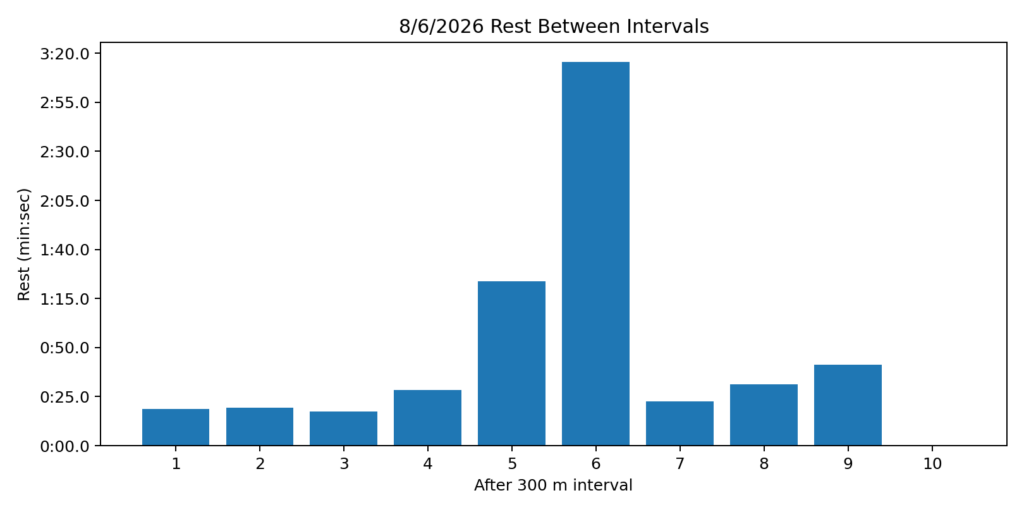
    Today was all about 300’s, like 10 of them. Mixed strokes, trying to work on technique and get rid of bad habits.

    8/6/2026 Workout Summary

    MetricResult
    Workout format10 × 300 m mixed stroke
    Total distance3,000 m
    Freestyle distance1,525 m
    Breaststroke distance1,475 m
    Total moving time52:33.9
    Total rest time7:38.5
    Total session time1:00:12.4
    Overall moving pace1:45.1/100 m
    Average freestyle pace1:35.4/100 m
    Average breaststroke pace1:55.2/100 m
    Fastest 300 m interval5:05.6 — Set 7
    Fastest overall interval pace1:41.9/100 m — Set 7

    Workout Structure

    Each row below is one continuous 300 m repeat. Freestyle and breaststroke distances come directly from Column G.

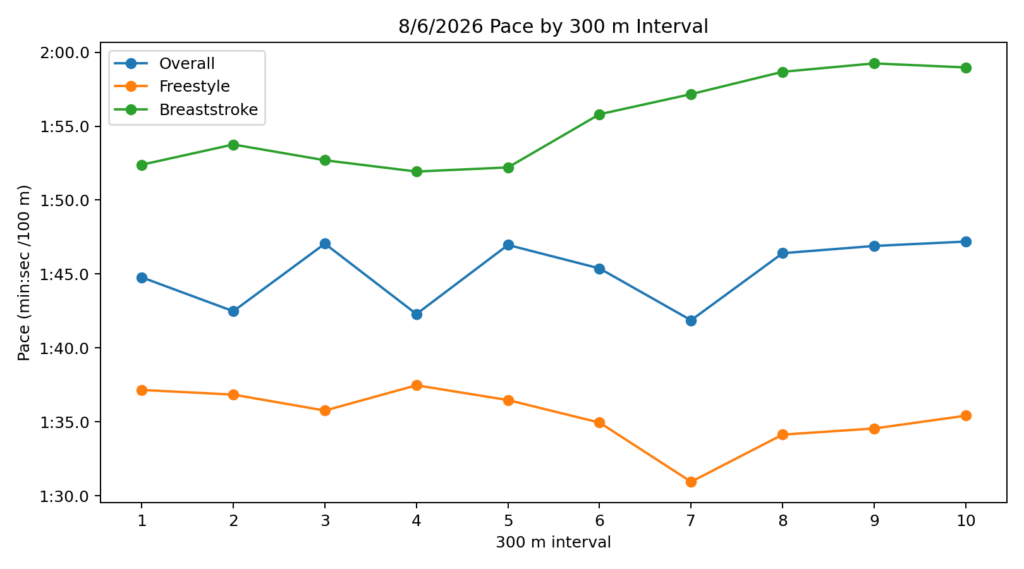
    SetFreestyleBreaststrokeTotal TimeOverall PaceFree PaceBreast PaceRest
    1150 m150 m5:14.31:44.81:37.21:52.40:18.6
    2200 m100 m5:07.41:42.51:36.81:53.80:19.5
    3100 m200 m5:21.11:47.01:35.81:52.70:17.3
    4200 m100 m5:06.91:42.31:37.51:51.90:28.5
    5100 m200 m5:20.91:47.01:36.51:52.21:23.8
    6150 m150 m5:16.11:45.41:34.91:55.83:15.7
    7175 m125 m5:05.61:41.91:30.91:57.20:22.5
    8150 m150 m5:19.21:46.41:34.11:58.70:31.3
    9150 m150 m5:20.71:46.91:34.51:59.20:41.3
    10150 m150 m5:21.61:47.21:35.41:59.0

    Stroke Analysis

    StrokeDistanceMoving TimeAverage Pace
    Freestyle1,525 m24:14.31:35.4/100 m
    Breaststroke1,475 m28:19.61:55.2/100 m

    Freestyle

    Freestyle performance was strong throughout:

    • First-half freestyle pace was generally 1:35.8–1:37.5/100 m.
    • After the long mid-workout rest, you accelerated to 1:30.9/100 m in Set 7.
    • The final three sets remained consistent at 1:34.1–1:35.4/100 m.

    That suggests you retained freestyle speed well and benefited noticeably from the longer recovery.

    Breaststroke

    Breaststroke shows a clearer fatigue pattern:

    • Sets 1–5: approximately 1:51.9–1:53.8/100 m
    • Set 6: 1:55.8
    • Sets 7–10: approximately 1:57.2–1:59.2

    Your breaststroke slowed roughly 6–7 seconds per 100 m from the strongest early repeat to the final portion. Because freestyle did not deteriorate similarly, this looks more like stroke-specific muscular fatigue than general aerobic exhaustion.

    The likely fatigue areas are the breaststroke kick, hip drive, and maintaining effective glide timing as the session progressed.

    Huntsman Benchmark Table

    There were no continuous 800 m or 1,500 m freestyle efforts, or continuous 100 m or 200 m breaststroke race tests, in this mixed-stroke workout. Therefore, none of your official event benchmarks change.

    Event8/6 Event TimeCurrent Best Training2025 Bronze2025 4th
    1500 m Freestyle—25:46.025:04.7525:06.88
    800 m Freestyle—13:30.212:32.8512:56.76
    200 m Breaststroke—3:41.33:39.924:00.27
    100 m Breaststroke—1:44.01:32.971:37.95

    Gap to Medal Table

    EventGap to BronzeGap to 4th
    1500 m Freestyle41.25 sec behind39.12 sec behind
    800 m Freestyle57.35 sec behind33.44 sec behind
    200 m Breaststroke1.38 sec behind18.97 sec ahead
    100 m Breaststroke11.03 sec behind6.05 sec behind

    Overall Evaluation

    This was primarily a mixed-stroke threshold and fatigue-resistance session, not an event time trial.

    The strongest findings are:

    • Freestyle pace averaged a very good 1:35.4/100 m across more than 1,500 m of accumulated swimming.
    • Freestyle speed was preserved through the end of the workout.
    • Breaststroke began near 1:52/100 m, but faded toward 1:59/100 m.
    • The workout therefore exposed a useful training target: maintaining breaststroke mechanics after roughly 700–900 m of accumulated breaststroke.
    • Your Huntsman benchmarks should remain unchanged because the stroke changes within each 300 prevented a valid continuous race-distance comparison.

    Not sure what tomorrow will bring. I may take a few rest days! We will see.