Battery Faults, Service Decisions, and Restoration
Battery-system diagnosis does not end when a fault code or abnormal measurement is found. The technician must determine what the information actually means, decide whether the problem involves an individual component or the larger system, determine the appropriate service action, and restore the equipment in a controlled sequence.
This final lesson in Part V brings the battery troubleshooting process together. The emphasis is on using fault information as diagnostic evidence, avoiding unnecessary component replacement, recognizing conditions that require manufacturer support or equipment replacement, and verifying charging, discharging, communications, and backup operation after service.
A Fault Code Is the Beginning of Diagnosis — Not the End
Modern battery energy-storage systems can provide extensive diagnostic information. Batteries, inverters, transfer equipment, gateways, meters, and communications devices may report faults, warnings, operating restrictions, and device status.
This information can quickly narrow the diagnostic process, but a displayed fault should not automatically be interpreted as proof that the component displaying the fault has failed. The fault may identify a condition detected by the component rather than the actual source of the problem.
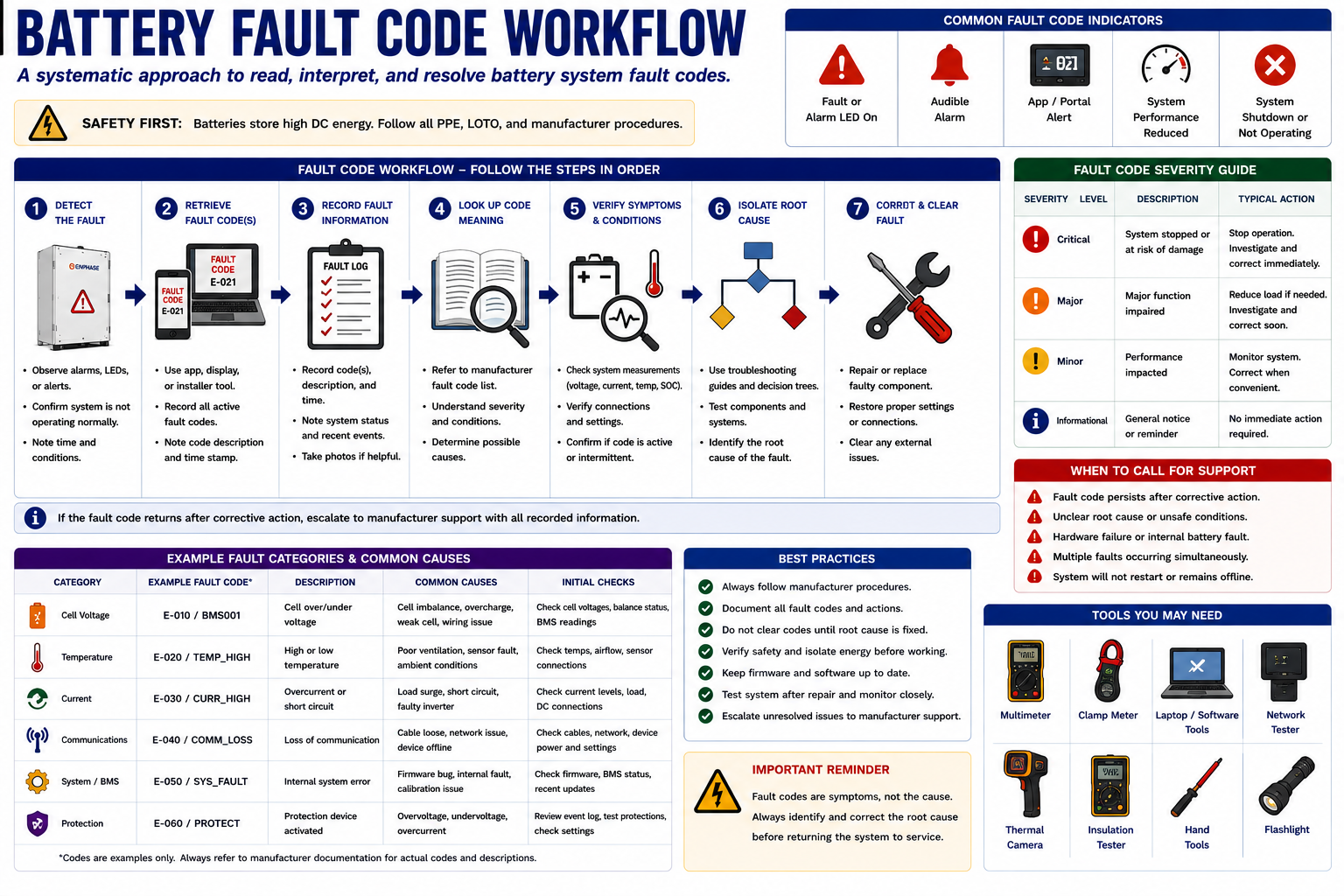
Record the Information Before Resetting Equipment
When arriving at a system with an active fault, record the available information before restarting equipment or operating disconnects. A reset may clear the fault display or change the conditions that produced it.
Fault Code
Record the exact code or message rather than describing it from memory.
Affected Device
Identify which battery, inverter, gateway, transfer device, or other component is reporting the condition.
Time and History
Determine when the fault occurred and whether it is active, intermittent, recurring, or historical.
Operating Mode
Record whether the system was charging, discharging, idle, grid connected, or operating in backup.
System Conditions
Record state of charge, PV production, building load, utility status, and other available operating information.
Physical Condition
Record any related visual, thermal, wiring, environmental, or equipment findings.
Use the Correct Manufacturer Documentation
Battery-system fault codes are manufacturer- and model-specific. The same number or description should not be assumed to have the same meaning across different equipment.
Use the service documentation appropriate to the exact equipment and, where relevant, its firmware or product generation. Determine what condition causes the fault, what checks the manufacturer recommends, whether operation is intentionally restricted, and what procedure is provided for clearing or restoring the system.
Technician principle: Translate the fault code into a condition that can be tested. Do not translate it directly into a replacement part.
The Device Reporting the Problem May Not Be the Device Causing It
Suppose a battery reports that charging is unavailable. The battery may be correctly responding to an abnormal condition elsewhere in the system. Power-conversion equipment may be offline, communications may be lost, an external disconnect may be open, or the control system may not permit charging.
Likewise, an inverter may report a battery-related fault because the battery has intentionally opened its internal contactors in response to temperature, voltage, communications, or another protective condition.
The reported fault identifies where the abnormal condition was detected. Diagnosis determines where it originated.
Classify the Problem Before Making the Service Decision
Electrical
Abnormal voltage, current, wiring, connections, protective devices, or other electrical conditions.
Battery
Battery-management, state-of-charge, temperature, internal protection, or other battery-related conditions.
Power Conversion
Inverter, charger, hybrid inverter, or other conversion-equipment problems.
Transfer
Utility detection, isolation, backup-source establishment, or transfer-equipment problems.
Communications
Missing devices, communications wiring, network, gateway, pairing, addressing, or configuration problems.
Metering
Incorrect current-sensor orientation, meter configuration, device assignment, or inaccurate system power-flow information.
Configuration
Operating modes, reserve settings, schedules, limits, commissioning, or other configuration conditions.
Loads
Backup overload, excessive starting demand, non-backed-up circuits, or individual load and branch-circuit problems.
What Should Happen After the Diagnosis?
Once the failed function has been identified, determine the appropriate corrective action. The correct response may be considerably different depending on whether the problem is an external wiring defect, configuration problem, communications fault, failed power component, or internal battery condition.
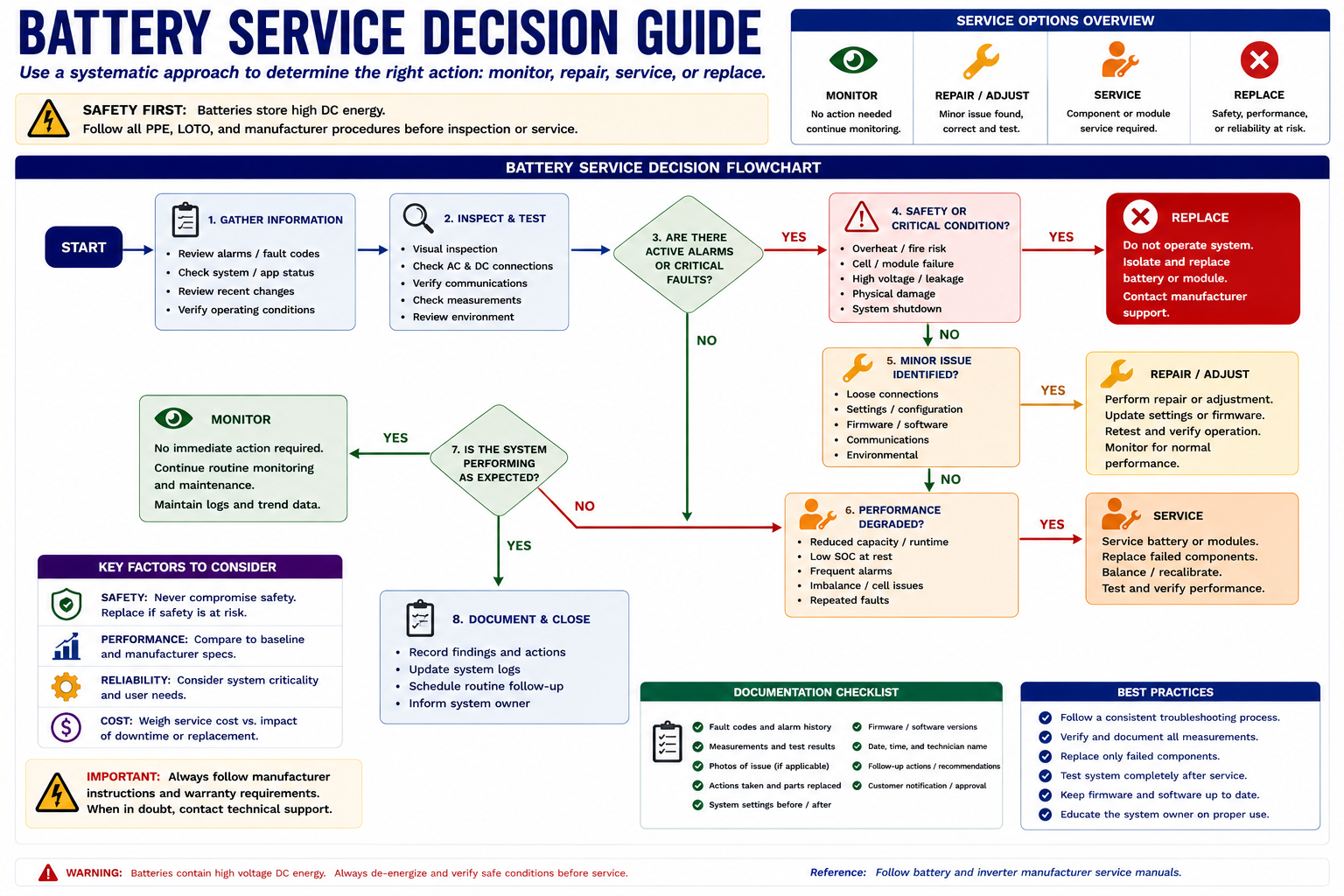
Some Problems Can Be Corrected Without Replacing Major Equipment
Depending on the equipment and manufacturer procedures, field-correctable problems may include external wiring defects, damaged communications connections, incorrect configuration, improperly positioned disconnects, metering or sensor problems, loose service-accessible connections, or other conditions within the technician’s authorized service scope.
Correct the identified cause rather than simply resetting the equipment and assuming the problem is resolved.
A Reset Is Appropriate Only When the Fault Condition Has Been Understood
Some faults are temporary and may be cleared according to the manufacturer’s procedure after the condition that produced them is no longer present. Others will immediately return because the underlying problem remains.
Repeatedly resetting a system without determining why it is faulting can hide intermittent problems, erase diagnostic evidence, and delay the correct repair.
A successful restart is not the same as a successful repair.
Replace a Component When the Diagnosis Supports Replacement
Power-conversion equipment, transfer equipment, communications devices, sensors, and other external components may require replacement when approved testing establishes that the component has failed and repair is not appropriate.
Before replacement, record model numbers, serial numbers, ratings, configuration information, communications assignments, wiring arrangements, and other information needed to obtain and commission the correct replacement.
Internal Battery Faults Require a Different Service Decision
A confirmed internal battery fault does not normally lead to cell-level troubleshooting as part of routine field service. Battery packs can contain hazardous voltage, very high available current, energized internal buses, stored electrochemical energy, and manufacturer-specific protection systems.
Follow the manufacturer’s service process for the installed equipment. Depending on the product and fault, this may involve manufacturer technical support, replacement of an approved field-replaceable assembly, or replacement of the complete battery unit.
Do Not Turn a System-Level Service Call Into an Internal Battery Repair
If the diagnostic process identifies an internal battery condition, remain within the service procedures provided for the equipment. Do not bypass the BMS, defeat interlocks, bridge contactors, substitute protective devices, or access internal cells or bus structures simply to force the battery to operate.
Determine Whether One Device Failed or the Entire System Is Affected
Battery installations often contain several devices that depend on common power, communications, metering, and control equipment. A common-system failure can make several individual devices appear faulty at the same time.
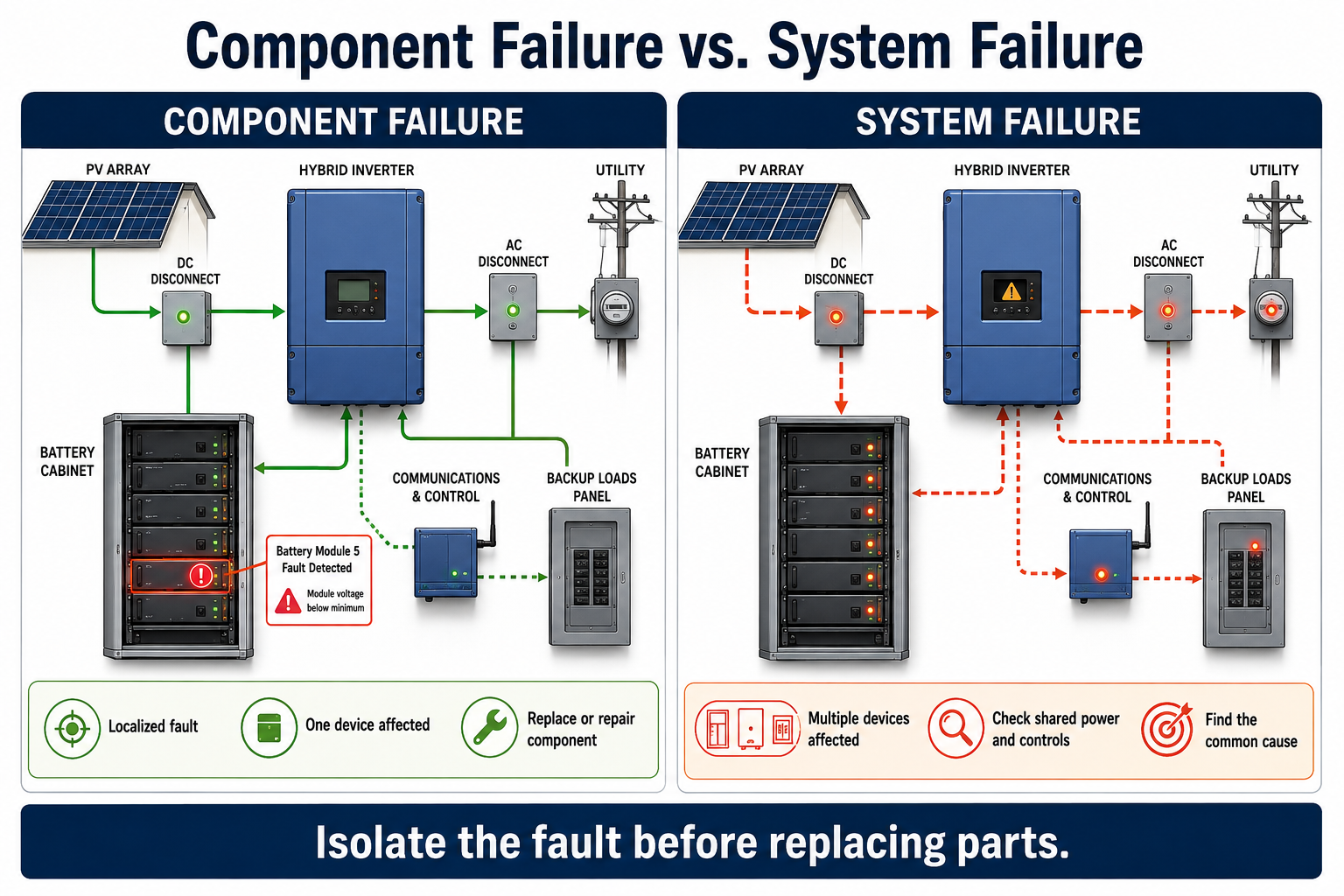
One Abnormal Device Among Otherwise Normal Equipment
If several similar devices share the same operating conditions but only one is abnormal, the evidence may point toward an individual component or its local wiring and communications.
Examples can include one battery offline while other batteries operate normally, one communications device missing while the network remains functional, or one branch of equipment failing while other comparable branches operate correctly.
Several Abnormal Devices Suggest a Common Cause
When multiple components fail simultaneously, look for the functions they share. Common causes can include lost AC power, an open disconnect, common power-conversion equipment, transfer equipment, a gateway, communications infrastructure, metering, configuration, or another system-level condition.
Diagnostic principle: Multiple simultaneous symptoms usually deserve a search for a common failure point before several independent component failures are assumed.
Use Working Components as Diagnostic References
When several identical battery units, modules, inverters, or communications devices are installed, compare the abnormal equipment with units that are operating correctly.
Compare status indicators, communications, temperatures where appropriate, electrical conditions, configuration, wiring, and monitoring information. Differences can help narrow the fault without requiring unnecessary disassembly.
Do Not Replace the Failed Part Without Asking Why It Failed
A component failure can be the result of another condition. Before installing replacement equipment, look for evidence of overheating, moisture, incorrect wiring, damaged conductors, poor connections, environmental exposure, blocked ventilation, incorrect configuration, repeated overload, or another external cause.
Installing a new component without correcting the cause can produce a second failure.
Inspect the Completed Work
After corrective work is complete, inspect everything affected by the service procedure before restoring the system.
Connections
Verify that service-accessible electrical and communications connections are complete and correctly installed.
Conductors
Confirm proper routing, support, protection, and absence of visible damage.
Equipment
Verify mounting, covers, fittings, clearances, and any components disturbed during service.
Disconnects
Confirm that disconnecting means are in the appropriate condition for the restoration procedure.
Configuration
Verify settings, device assignments, communications configuration, and replacement-equipment commissioning where applicable.
Work Area
Remove tools, temporary equipment, loose materials, and anything that could interfere with normal equipment operation.
Restore the System in a Controlled Sequence
Battery systems should be returned to operation according to the manufacturer’s startup or restoration procedure. The sequence can be important because different devices may require power, communications, and initialization in a particular order.
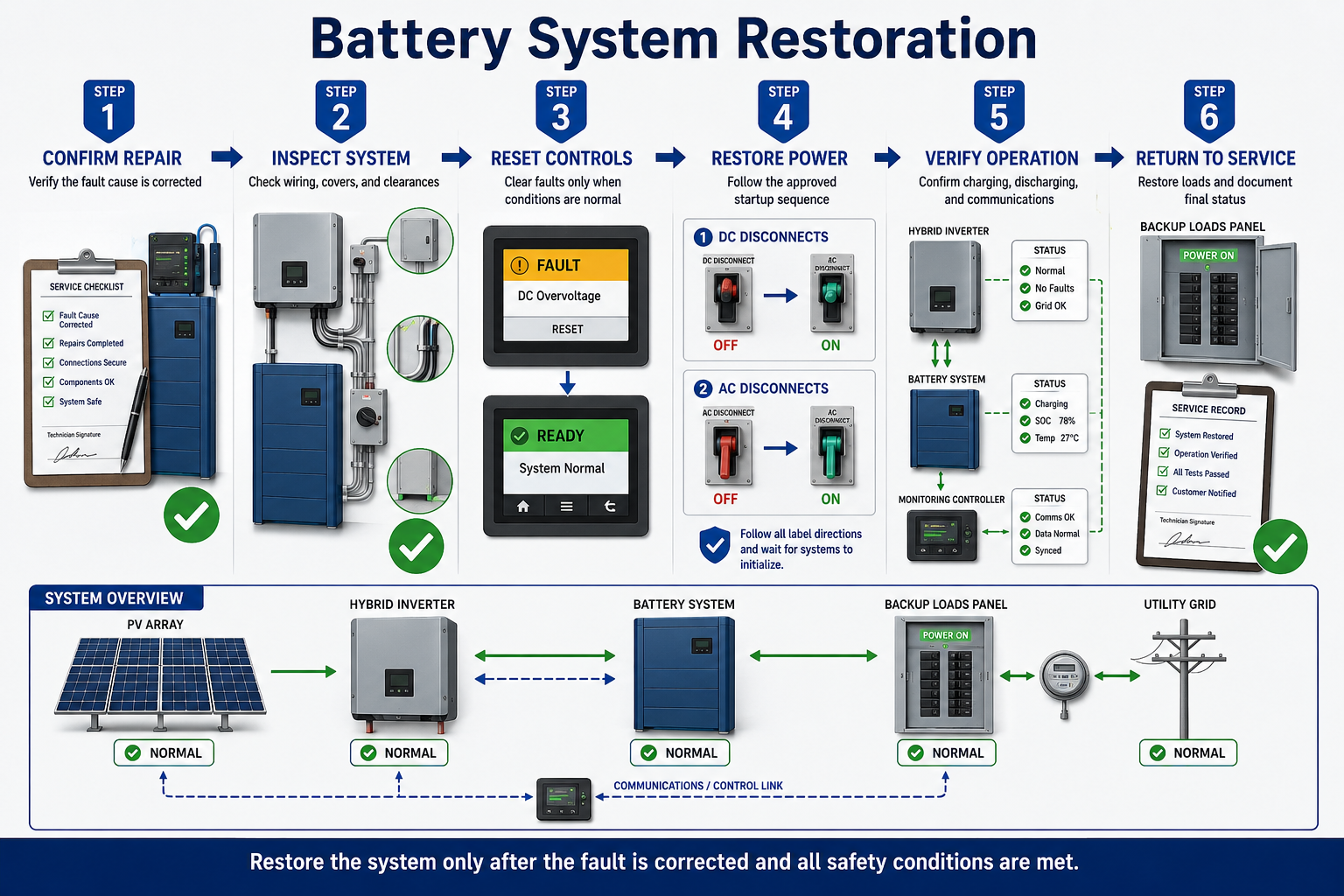
Follow the Manufacturer Procedure for the Installed System
Complete the Final Physical Inspection
Verify that the corrective work is complete and that the equipment is ready to return to service.
Restore Required Electrical Paths
Return disconnects and protective devices to the required condition in the sequence specified for the equipment.
Start the Equipment
Follow the manufacturer’s required startup procedure for the battery, inverter, transfer equipment, and associated controls.
Allow Initialization
Some equipment requires time for self-tests, communications discovery, grid qualification, battery checks, or other startup functions.
Verify Communications
Confirm that batteries, inverters, gateways, meters, transfer equipment, and other required devices are online.
Review Fault Status
Confirm that the original fault has cleared appropriately and that no new faults appeared during restoration.
Initialization Delays Can Be Normal
Inverters and battery equipment may intentionally delay operation while checking grid conditions, battery status, communications, internal self-tests, or other requirements.
A device that does not immediately begin charging or discharging after startup should not automatically be considered faulty. Determine the expected startup sequence and timing for the installed equipment.
Prove That the Complete System Works
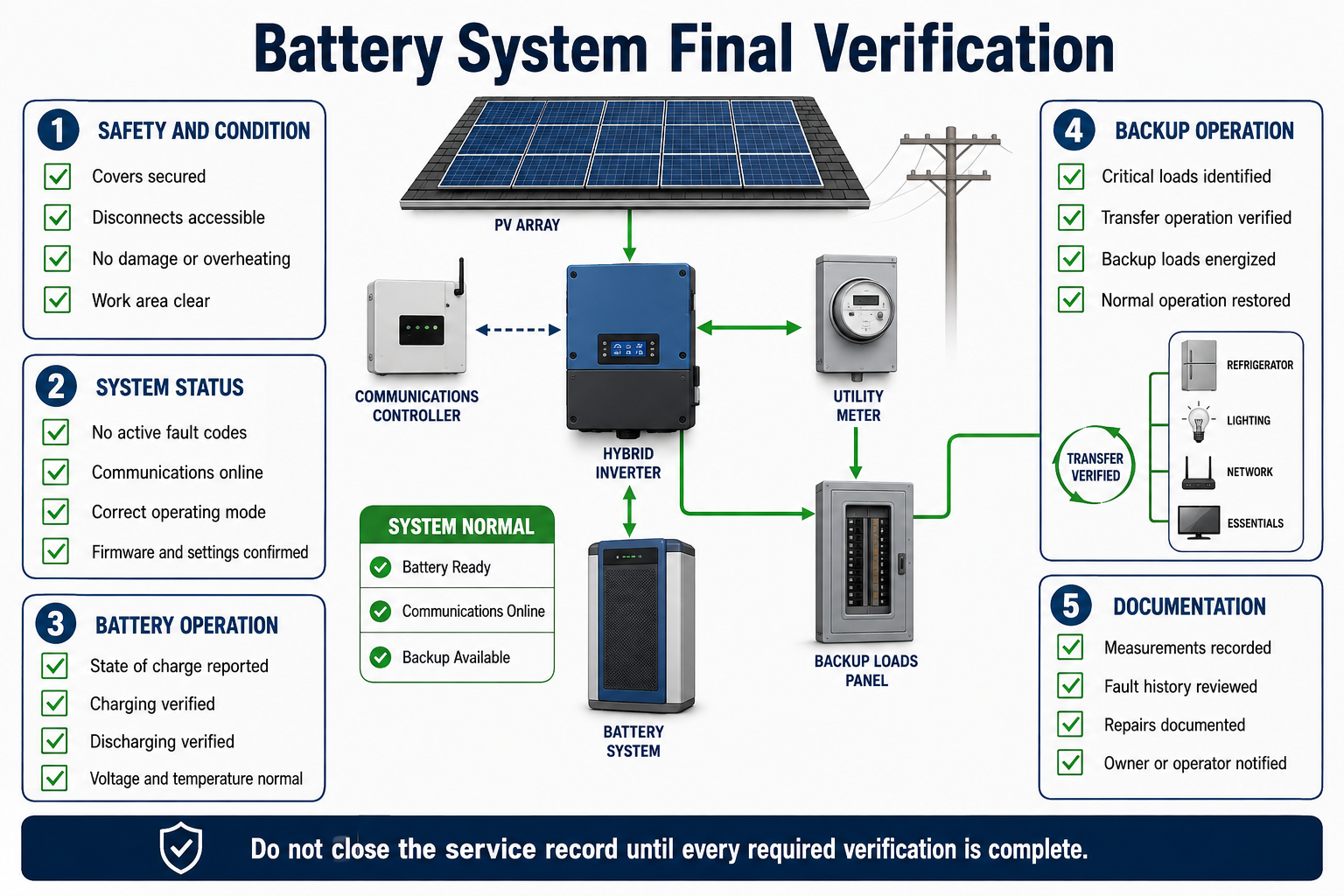
Restoration is not complete merely because fault indicators have disappeared. Verify the functions affected by the original complaint and confirm that the complete system operates as expected.
Check the Complete Equipment System
Confirm that the battery, inverter or power-conversion equipment, transfer equipment, gateway, metering, and other required devices report normal or expected status.
Check for active warnings or faults and verify that monitoring information agrees reasonably with actual system operation.
Confirm Energy Can Move Into the Battery
If operating conditions permit charging, verify that the system can transfer energy toward the battery. Confirm charging status and compare available monitoring information with appropriate field measurements when necessary.
If immediate charging cannot be commanded or expected under current conditions, document why and use another manufacturer-approved verification method.
Confirm Stored Energy Can Support the Intended Loads
Where the operating mode and manufacturer procedures permit, verify that battery energy can be discharged through the power-conversion equipment and delivered to the electrical system.
Confirm that the behavior agrees with the configured reserve, operating mode, and system power limits.
Every Required Device Should Be Present
Check the local interface or monitoring system and confirm that required batteries, inverters, meters, gateways, transfer equipment, and other monitored devices are communicating.
For a replaced device, verify that commissioning, pairing, addressing, serial-number registration, and system assignments are correct where applicable.
Power-Flow Information Should Make Sense
Compare displayed PV production, battery power, building load, and utility import or export with the actual operating condition.
If the battery is clearly charging but the monitoring system reports discharge, or utility import is displayed as export, investigate metering orientation and configuration rather than accepting the displayed values as normal.
Backup Operation Is a Separate Function
A battery can charge and discharge normally while connected to the utility and still have a problem with outage detection, transfer equipment, grid-forming operation, or backup distribution.
When permitted by the manufacturer procedure and site conditions, verify backup operation using the approved test method. Confirm the expected utility isolation, backup-source establishment, supported circuits, and return to normal operation afterward.
Important: Normal grid-connected battery operation does not by itself prove that backup operation works.
Return to the Reason for the Service Call
The most important final test is whether the original problem has been corrected.
If the complaint was no charging, verify charging. If it was no backup power, verify backup operation. If a device repeatedly disappeared from communications, verify stable communications. If the complaint involved unexpected shutdown, determine whether the condition that caused the shutdown has actually been corrected.
Some Problems Require Observation
Intermittent communications problems, thermal conditions, load-related shutdowns, and faults associated with particular states of charge may not be fully evaluated immediately after startup.
Where appropriate, review monitoring information after restoration or establish what operating condition should be observed to confirm that the repair remains successful.
Record What Was Found, What Was Done, and How It Was Verified
Original Complaint
Record the problem that initiated the service call.
Fault Information
Record relevant codes, messages, event history, and system status.
Diagnostic Results
Record the measurements and observations that established the cause.
Corrective Action
Document repairs, configuration changes, resets, component replacements, or other work performed.
Replacement Equipment
Record manufacturer, model, serial number, and other relevant information for replaced components.
Final Verification
Document charging, discharging, communications, backup operation, or other tests used to verify the completed work.
From Fault to Verified Restoration
Preserve the Evidence
Record fault codes, operating status, monitoring information, and physical conditions before resetting equipment.
Interpret the Fault
Use the correct manufacturer documentation to determine what condition the system detected.
Verify the Condition
Use visual inspection, electrical testing, communications diagnostics, and operating information to determine the actual cause.
Determine Component or System Failure
Decide whether the problem is isolated to one device or involves common equipment or controls.
Make the Service Decision
Determine whether the condition can be corrected in the field, requires component replacement, requires manufacturer support, or requires routine work to stop.
Correct the Root Cause
Repair the condition responsible for the failure rather than only clearing the resulting fault.
Restore the System
Follow the manufacturer-required restoration and startup sequence.
Verify Complete Operation
Confirm the relevant charging, discharging, communications, metering, and backup functions.
Document the Final Condition
Record the repair and the evidence demonstrating that the original complaint was corrected.
Faulted Equipment Can Present Conditions Different From Normal Operation
Battery energy-storage systems contain substantial stored energy, and fault conditions can involve electrical, thermal, chemical, fire, and mechanical hazards. Do not assume that a shutdown battery is electrically or internally energy-free.
Remain within the manufacturer-defined field-service scope. Do not bypass protective systems, defeat interlocks, open battery areas not intended for field service, or force faulted equipment back into operation. Conditions involving smoke, fire, significant swelling, venting, severe overheating, major physical damage, significant water exposure, or other potentially hazardous conditions require the appropriate stop-work and emergency response rather than routine troubleshooting.
What You Should Take From This Lesson
Record Faults Before Resetting
Preserve fault codes, operating status, and system conditions before changing the equipment state.
A Fault Code Is Evidence
Determine what condition produced the fault instead of assuming the reporting component must be replaced.
Use Manufacturer Documentation
Fault meanings, reset procedures, service boundaries, and restoration procedures are equipment-specific.
Distinguish Component From System Failures
One abnormal device may indicate a localized fault, while several simultaneous symptoms can point toward common equipment or controls.
Make the Service Decision After Diagnosis
Determine whether the condition requires repair, configuration correction, replacement, manufacturer support, or a stop-work response.
Correct the Root Cause
Do not replace equipment without determining whether another condition contributed to the failure.
Restore Methodically
Follow the required startup sequence and allow the equipment to complete normal initialization and communications checks.
Verify Every Relevant Function
Check charging, discharging, communications, metering, and backup operation as appropriate to the original complaint.
Verify the Original Complaint
The repair is complete only when the condition that initiated the service call has been shown to be corrected.
Battery Energy Storage Systems
You have now progressed from identifying battery-system architecture through power flow, safety and visual inspection, electrical testing, systematic troubleshooting, fault interpretation, service decisions, restoration, and final verification.
The battery section completes the PV Solar Systems course sequence from fundamental system operation through inspection, electrical diagnosis, repair, replacement, documentation, and battery energy-storage service.
Return to the Complete Course
Return to the PV Solar Systems landing page for Parts I through V and the complete technician training sequence.