Air-Cooled Condensers
An air-cooled condenser rejects heat from high-pressure refrigerant to the surrounding air.
Hot, high-pressure refrigerant vapor arrives at the condenser through the compressor discharge line. Air is moved across the condenser coil, heat transfers from the refrigerant to the air, and the refrigerant eventually condenses into a high-pressure liquid.
Air-cooled condensers are widely used in air-conditioning systems because outdoor air provides a readily available heat-rejection medium.
What You Will Learn
By the end of this lesson you should be able to:
Describe how heat moves from the refrigerant through the condenser tubing and fins into the surrounding air.
Recognize that forced airflow moves outdoor air through or across the condenser coil.
Describe how fins increase surface area and improve heat transfer to the air.
Recognize hot, high-pressure vapor entering and high-pressure liquid leaving.
Recognize that the refrigerant must condense at a temperature above the outdoor air temperature for heat to flow out of the condenser.
Identify the final portion of the condenser as the area where liquid refrigerant may be cooled below its condensing temperature.
How an Air-Cooled Condenser Works
An air-cooled condenser uses outdoor air to remove heat from the refrigerant.
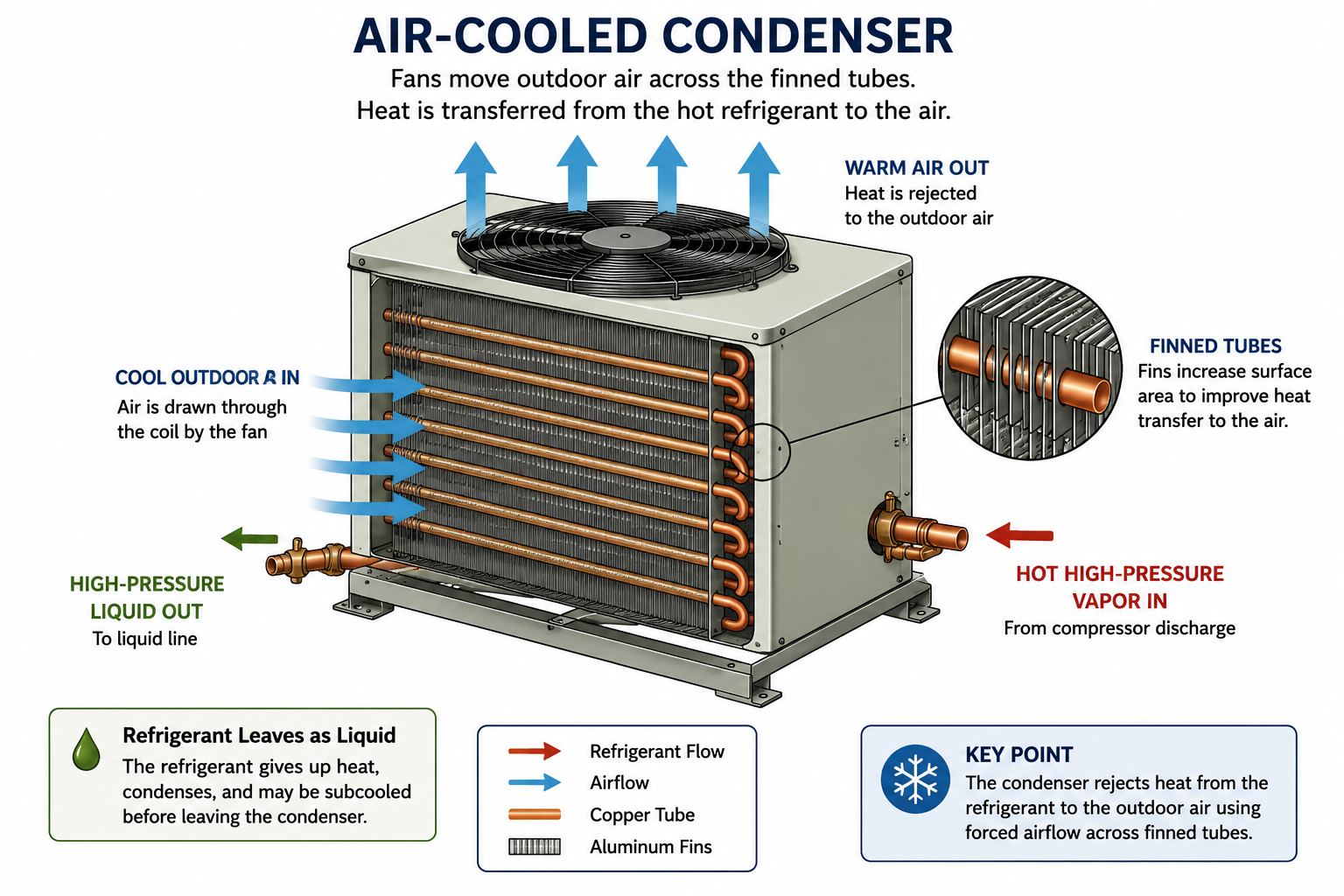
The source describes air-conditioning systems as primarily using forced-draft condensers. Fans or blowers move air through a coil, and fins attached to the condenser tubes increase the surface area available for heat transfer. :contentReference[oaicite:1]{index=1}
Technician Point
The red refrigerant line entering the condenser represents the compressor discharge line.
The compressor may be physically remote from the condenser. Refrigerant piping carries the hot, high-pressure vapor from the compressor to the condenser inlet.
Follow the Heat Through the Condenser
Heat must travel through several materials before it reaches the outdoor air.
Heat Is in the Refrigerant
Hot, high-pressure refrigerant vapor enters the condenser tubing from the compressor discharge line.
Heat Moves Through the Tubing
Heat transfers from the refrigerant through the metal wall of the condenser tube.
Heat Spreads Into the Fins
The fins increase the amount of metal surface exposed to the moving air.
Air Carries the Heat Away
Air moving across the coil absorbs heat from the tubing and fins and carries that heat away from the condenser.
Why Are Fins Added to the Condenser Coil?
Heat-transfer capacity depends partly on how much surface area is available to transfer heat to the air.
The source specifically notes that fins are attached to condenser tubing to provide additional surface area for heat transfer. :contentReference[oaicite:2]{index=2}
Tubing Alone
The refrigerant tube provides a relatively limited surface area for contact with outdoor air.
Finned Tubing
Metal fins attached to the tubing greatly increase the surface area that can transfer heat to the air.
More Surface Area = More Heat Transfer
The fins do not create cooling. They give the condenser a larger surface through which heat can move from the refrigerant to the air.
Why Is Forced Airflow Important?
Heat transfer depends on a continuous supply of air that is cooler than the refrigerant in the condenser.
Fans or blowers move outdoor air across the coil and remove the warmed air after it absorbs heat.
Cooler Air Enters
Outdoor air approaches the condenser at ambient temperature.
Warmer Air Leaves
After passing across the condenser coil, the air has absorbed heat and leaves the condenser warmer than it entered.
Airflow Is Part of the Heat-Rejection Process
If adequate air cannot move across the condenser coil, the condenser cannot reject heat normally.
Condensing Temperature Must Be Above Ambient Temperature
Heat naturally moves from a warmer substance to a cooler substance.
For an air-cooled condenser to reject heat to outdoor air, the refrigerant must be at a higher temperature than that outdoor air.
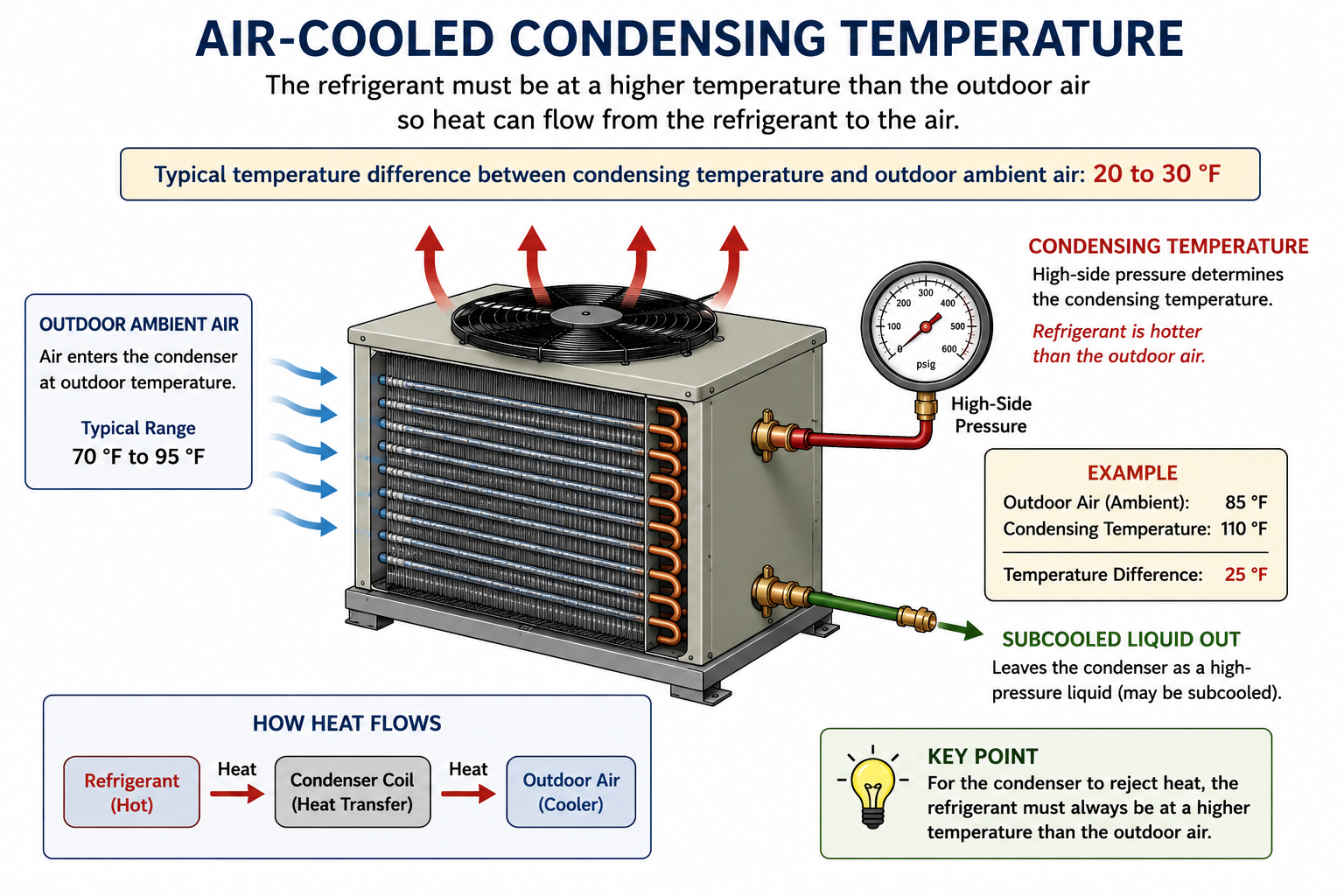
The source gives a normal temperature difference of approximately 20°F to 30°F between the refrigerant condensing temperature and ambient air for the air-cooled systems being discussed. :contentReference[oaicite:3]{index=3}
85°F
25°F
110°F
Source Lesson Reference
The 20–30°F difference is the normal range stated in this course’s source presentation. Actual condensing temperature depends on the specific system, operating conditions, airflow, coil condition, and equipment design.
How Do We Know the Condensing Temperature?
The source explains that condensing temperature is determined by converting condenser pressure into the corresponding refrigerant saturation temperature. :contentReference[oaicite:4]{index=4}
Determine the refrigerant pressure in the condenser.
Use the correct refrigerant pressure-temperature relationship.
The saturation temperature corresponding to condenser pressure is the condensing temperature.
Important
Condensing temperature is not simply the temperature of the metal condenser coil.
It is the saturation temperature corresponding to the refrigerant pressure while condensation is occurring.
What Happens to the Refrigerant?
As the refrigerant travels through the air-cooled condenser, heat continually leaves the refrigerant.
Hot, high-pressure superheated vapor enters through the compressor discharge line.
Sensible heat is removed as the refrigerant is desuperheated.
Latent heat is removed while refrigerant changes from vapor to liquid.
After all vapor has condensed, additional sensible heat may be removed from the liquid.
The high-pressure liquid may become subcooled before leaving the condenser.
The liquid refrigerant leaves the condenser and continues through the liquid line.
Where Does Subcooling Occur?
The source states that subcooling takes place in the last few passes of the condenser. :contentReference[oaicite:5]{index=5}
By this point, the refrigerant has already completely changed from vapor to liquid.
Additional heat removal lowers the liquid refrigerant temperature below the condensing temperature.
Next Lesson
The next lesson will examine condenser subcooling in detail, including how condensing temperature and liquid-line temperature are used to calculate it.
Condenser Airflow Affects System Operation
Because the air-cooled condenser depends on air to remove heat, anything that interferes with airflow can interfere with heat rejection.
Dirty Coil
Dirt and debris can reduce airflow and insulate the condenser surface from the surrounding air.
Fan Problem
A failed or incorrectly operating condenser fan can reduce the amount of air moving across the coil.
Restricted Airflow
Physical obstructions around the condenser can reduce the amount of outdoor air available for heat rejection.
Detailed condenser troubleshooting will be addressed later in the course.
Put the Concepts Together
An air-cooled condenser rejects refrigerant heat to outdoor air.
Fans or blowers move air across the condenser coil.
Fins increase the surface area available for heat transfer.
Hot, high-pressure vapor reaches the condenser through the compressor discharge line.
The compressor may be physically remote from the condenser.
The refrigerant condensing temperature must be above outdoor ambient temperature.
Condensing temperature is found from the refrigerant’s condenser pressure and pressure-temperature relationship.
Subcooling occurs after the refrigerant has completely condensed into liquid.
Can You Explain Air-Cooled Condenser Operation?
You should be able to answer these questions before continuing.
1. What medium receives heat from an air-cooled condenser?
2. What line carries hot refrigerant vapor from the compressor to the condenser?
3. Does the compressor have to be physically located next to the condenser?
4. Why are fins attached to condenser tubing?
5. Why are fans or blowers used?
6. What happens to the temperature of the air as it passes through the condenser?
7. Why must refrigerant condensing temperature be above ambient air temperature?
8. What normal condensing-temperature-to-ambient difference is given in the source lesson?
9. How is condensing temperature determined from condenser pressure?
10. Where in the condenser does the source say subcooling occurs?
What You Should Have Learned
Air-cooled condensers transfer heat from refrigerant to outdoor air.
Forced-draft condensers use fans or blowers to move air through the condenser coil.
Condenser fins increase heat-transfer surface area.
The compressor discharge line supplies hot, high-pressure refrigerant vapor to the condenser.
Refrigerant must be hotter than outdoor air for heat to leave the condenser.
The source lesson gives approximately 20–30°F as the normal difference between condensing temperature and ambient air for the systems being discussed.
Condensing temperature is determined from refrigerant pressure using the refrigerant pressure-temperature relationship.
Subcooling occurs in the final portion of the condenser after all refrigerant vapor has condensed.
Airflow Makes Heat Rejection Possible
The air-cooled condenser depends on three things working together:
Temperature Difference · Heat-Transfer Surface · Airflow
Hot refrigerant transfers heat through the condenser tubing and fins, and moving outdoor air carries that heat away from the refrigeration system.