Underground Wiring and Burial Requirements
Underground electrical installations require careful selection of wiring methods, conductor insulation, raceways, burial depth, physical protection, and environmental protection. NEC 300.5 establishes many of the core requirements for underground conductors, cables, and raceways.
For the NASCLA Electrical Contractor Exam, you should be able to use Table 300.5 to determine minimum cover, distinguish direct-burial cable from raceway installations, recognize that underground raceway interiors are wet locations, apply protection where wiring emerges from grade, and identify additional requirements for trenches, underground services, and conductors entering buildings.
Underground Does Not Mean Protected by Default
Placing electrical wiring below grade does not automatically make the installation safe or Code compliant. Underground wiring can be exposed to moisture, soil movement, corrosion, excavation, crushing, and physical damage where it enters or leaves the earth.
The NEC therefore regulates the wiring method, burial cover, conductor suitability, physical protection, backfill, splicing methods, building entry, and other conditions associated with underground installations.
There Is No Universal Burial Depth
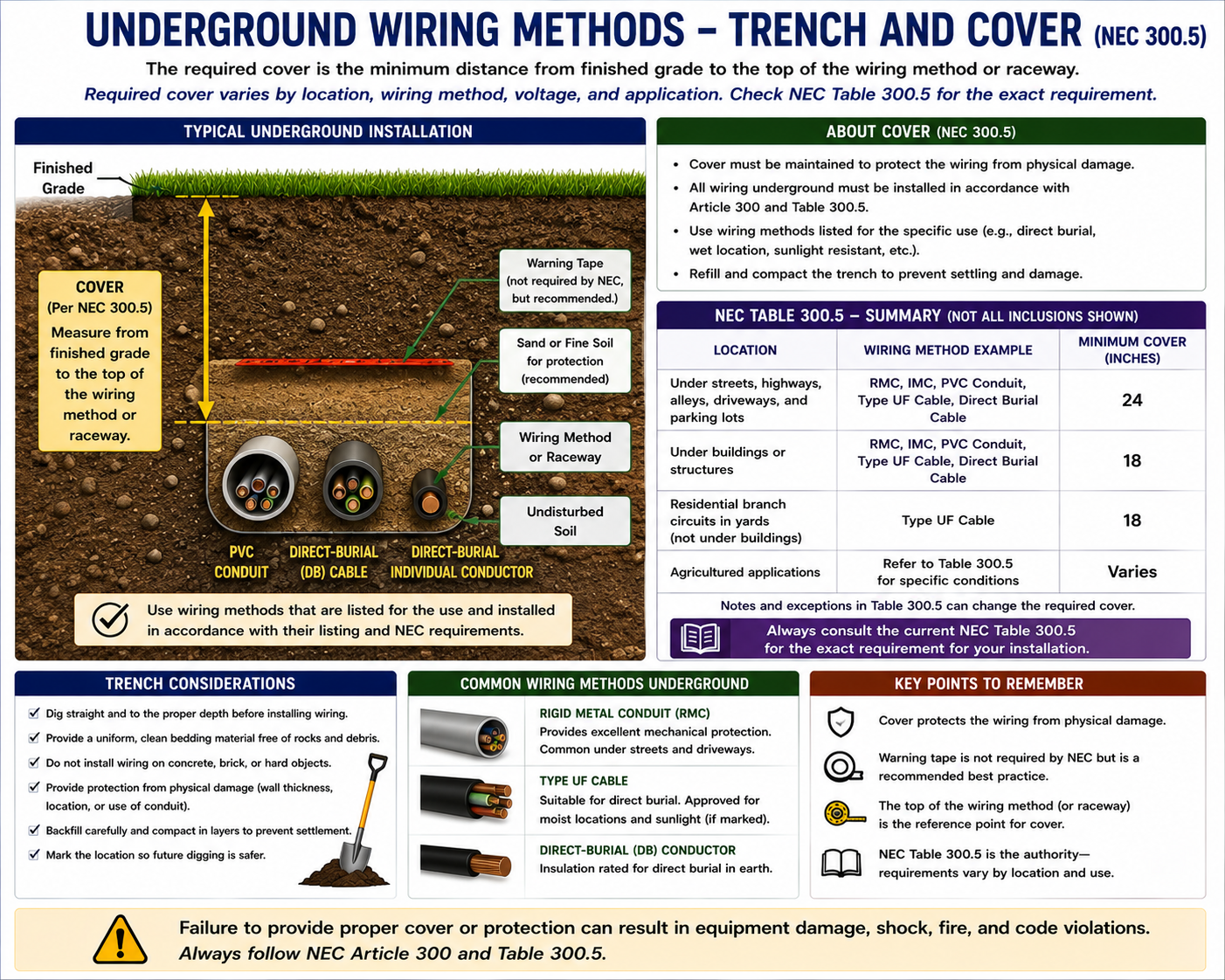
The NEC does not establish one burial depth that applies to every underground electrical installation. Minimum cover varies according to the wiring method, circuit characteristics, location, and other conditions listed in Table 300.5.
When an exam question asks how deep wiring must be buried, identify the exact row and column of Table 300.5 before selecting an answer.
What the Underground Rules Address
Minimum Cover
Determines how much earth, concrete, pavement, or other material must cover the underground wiring method.
Wet Locations
Requires conductors and cables installed in underground raceways and enclosures to be suitable for wet locations.
Physical Protection
Protects direct-buried conductors and cables where they emerge from grade, enter buildings, or are otherwise exposed to damage.
Trench Conditions
Addresses backfill, warning ribbon, grounding and bonding, splices, and other underground installation conditions.
Minimum Cover Requirements
Table 300.5 establishes minimum cover for underground cables, conductors, and raceways. The required amount depends on both the location of the installation and the type of wiring method or circuit.
Typical table columns distinguish direct-buried cables or conductors, rigid metal conduit or intermediate metal conduit, nonmetallic raceways listed for direct burial, certain residential branch circuits, and other specific circuit categories. :contentReference[oaicite:1]{index=1}
Measure From the Top of the Wiring Method
For Table 300.5, cover is measured as the shortest distance from the top surface of the underground cable or raceway to the finished grade or other finished surface above it.
Do not measure from the bottom of the trench unless the problem specifically asks for trench depth rather than minimum electrical cover. :contentReference[oaicite:2]{index=2}
Cover Is Not the Same as Trench Depth
If a raceway is 2 inches in outside diameter and requires 18 inches of cover, the bottom of the trench will normally be deeper than 18 inches because the cover is measured to the top of the raceway.
Always determine whether the question asks for minimum cover or total trench depth.
Read Across the Correct Row and Column
A Table 300.5 question usually requires two decisions. First identify the location, such as a residential property, driveway, parking area, or other installation condition. Then identify the wiring method or circuit category.
Identify the Location
Use the table row that matches the physical location and use of the area above the wiring.
Identify the Wiring Method
Determine whether the installation uses direct-burial cable, RMC, IMC, PVC, or another permitted wiring method.
Identify Special Circuit Conditions
Determine whether the circuit qualifies for one of the special table columns, such as a qualifying residential branch circuit.
Read the Intersection
The row and column intersection provides the minimum cover requirement.
Qualifying 120-Volt Residential Circuits
Table 300.5 contains a special column for residential branch circuits rated 120 volts or less, provided with GFCI protection and protected by overcurrent devices rated not more than 20 amperes.
Where all of the conditions in that table column are satisfied, a reduced minimum cover can apply compared with some other underground wiring methods. :contentReference[oaicite:3]{index=3}
All Conditions Must Be Satisfied
Do not select the residential reduced-cover column merely because the installation is at a dwelling. The circuit must meet the voltage, GFCI-protection, and maximum-overcurrent requirements specified by the table.
If any required condition is missing, use the column that actually matches the wiring method.
Direct-Burial Cable Is a Wiring Method
Some cable types are specifically listed for direct burial. Type UF is a common example, while certain MC and service-entrance cable constructions can also be identified for underground or direct-burial use.
A cable that is not listed for direct burial cannot simply be placed in the earth because it has a tough outer jacket.
Underground, Wet Location, and Direct Burial Are Different Concepts
A wiring method can be suitable for a wet location without being listed for direct burial. Likewise, a conductor may be wet-location rated and therefore suitable inside an underground raceway while still not being permitted for direct contact with earth.
Always check the complete marking and permitted-use requirements for the cable or conductor.
PVC, RMC, IMC, and Other Raceway Systems
Raceways listed or otherwise permitted for underground use can provide a protected path for conductors. Common examples include rigid PVC conduit, rigid metal conduit, and intermediate metal conduit when installed under their applicable Code provisions.
The minimum cover requirement can differ significantly between raceway types because the mechanical protection they provide is different.
Underground Raceway Interiors Are Wet
NEC 300.5(B) considers the interior of underground raceways and enclosures to be a wet location. The fact that the raceway is glued, threaded, sealed, or apparently dry does not change that classification.
Insulated conductors and cables installed inside underground raceways must therefore be listed for wet-location use in accordance with the applicable conductor requirements. :contentReference[oaicite:4]{index=4}
PVC Does Not Make NM Cable Acceptable Underground
Type NM cable is a dry-location wiring method. Installing it inside underground PVC conduit does not make the cable suitable for the wet location inside that raceway.
Use conductors or cables that are specifically suitable for wet locations. :contentReference[oaicite:5]{index=5}
Use the Correct Conductor Designation
Common individual conductors installed in underground raceways often carry wet-location ratings such as THWN-2 or XHHW-2. Conductors marked only for dry-location use are not acceptable merely because they are inside conduit.
Many modern conductors carry multiple ratings, such as THHN/THWN-2. The complete marking determines where the conductor can be installed.
Underground Wiring Beneath a Building
Underground cables and conductors installed under a building are generally required to be installed in a raceway that extends beyond the outside walls of the building, subject to the specific exceptions permitted by 300.5(C).
This requirement provides additional protection for wiring that would otherwise become inaccessible beneath the structure. :contentReference[oaicite:6]{index=6}
Protect Direct-Buried Wiring From Damage
Direct-buried conductors and cables must be protected from physical damage in accordance with 300.5(D). Particular attention is required where underground wiring emerges from grade, enters buildings, or passes through areas where mechanical damage is likely.
Protect Wiring Above Ground
Direct-buried conductors and cables that emerge from grade must be protected by an enclosure or raceway beginning at the required depth and extending upward to provide protection against physical damage.
For installations covered by the provision, protection extends to at least 8 feet above finished grade, and the required protective raceway or enclosure does not have to extend more than 18 inches below finished grade. :contentReference[oaicite:7]{index=7}
8 Feet Above — Maximum 18 Inches Below
A useful reference point for the emerging-from-grade rule is:
Protect to at least 8 ft above finished grade.
Protection is not required to extend more than 18 in. below finished grade.
Always verify the exact wiring method and table column involved before applying the rule.
Use a Raceway Suitable for the Exposure
Where underground conductors or cables are subject to physical damage as they emerge from the earth, the protective raceway must be suitable for that condition. Common methods can include RMC, IMC, Schedule 80 PVC, or an equivalent wiring method where permitted.
Thin or lightly constructed protection should not be assumed suitable merely because it encloses the cable. :contentReference[oaicite:8]{index=8}
Protect Conductors to the Point of Entrance
Underground conductors and cables entering a building must be protected from damage to the point where they enter the structure.
This rule is separate from the burial-cover requirement. A conductor can have correct underground cover and still require additional physical protection at the building entry. :contentReference[oaicite:9]{index=9}
Underground Service Conductors
Underground service conductors that are not encased in concrete and are buried 18 inches or more below grade require their location to be identified by a warning ribbon placed in the trench at least 12 inches above the underground installation.
This requirement helps reduce the risk of accidental contact during future excavation. :contentReference[oaicite:10]{index=10}
The Warning-Ribbon Rule Is Not Universal
Do not assume every underground branch circuit requires warning tape because warning tape is good field practice. The specific NEC requirement discussed here applies to the underground service-conductor condition described by 300.5(D)(3).
Do Not Damage the Wiring During Burial
Backfill material placed around underground wiring must not contain large rocks, sharp debris, paving material, corrosive material, or other substances that can damage the raceway, cable, or conductors.
Proper backfill is part of the electrical installation because mechanical damage can occur after the trench is closed if unsuitable material bears directly against the wiring method. :contentReference[oaicite:11]{index=11}
Underground Splices Must Be Suitable for the Environment
Splices and connections made in underground installations must be suitable for the wet conditions expected underground. Some direct-burial wiring methods can be spliced underground without a conventional junction box when the splice method complies with the applicable Code requirements.
Do not assume an ordinary interior wire connector is acceptable simply because the splice will be covered with tape or placed inside a handhole. :contentReference[oaicite:12]{index=12}
Control Moisture Movement
Underground raceways can transport moisture, condensation, or water toward equipment and enclosures. Where moisture entering through a raceway could contact live parts, the raceway must be sealed as required by the applicable NEC provisions.
The purpose of sealing is not to redefine the raceway interior as dry. Underground raceways remain wet locations even when seals are installed. :contentReference[oaicite:13]{index=13}
Sealed Does Not Mean Dry Location
A sealed underground raceway is still treated as a wet location. Select conductor insulation for the environmental classification, not for the appearance of the installation.
Allow for Movement at Grade Transitions
Underground raceways can move because of settlement, frost, soil expansion, thermal movement, or movement between the earth and a building or equipment foundation.
Raceway systems should be installed with fittings, expansion provisions, or other methods required by the applicable raceway article so movement does not crack fittings, pull apart joints, or damage conductors.
Consider Corrosion Protection
Metal raceways installed underground or in contact with soil, concrete, moisture, or corrosive environments must be suitable for those conditions and protected against corrosion where required.
Do not assume that a raceway is protected from corrosion simply because it is metallic or because it is buried.
Underground Does Not Change the Fault-Current Path
Underground electrical installations still require an effective equipment-grounding and bonding path where required. Earth itself is not used as the normal effective ground-fault current path for clearing faults.
Where a nonmetallic raceway such as PVC is used, the installation generally requires an equipment grounding conductor with the circuit conductors unless another permitted grounding method is provided.
Soil Is Not the Equipment Grounding Conductor
A grounding electrode or contact with earth does not replace the equipment grounding conductor or other effective bonding path required to return ground-fault current to the source.
This distinction remains just as important in underground installations as it is in above-ground wiring.
Coordinate the Entire Underground Installation
Underground work should be planned before excavation begins. The electrical contractor needs to know the wiring method, required cover, raceway size, conductor type, building-entry point, physical-protection method, and any other utilities sharing or crossing the trench.
Excavating first and selecting the wiring method later can result in an installation that is too shallow or unsuitable for the intended environment.
Residential Feeder to a Detached Building
An exam problem may describe a feeder or branch circuit from a dwelling to a detached garage, shed, pump, or other equipment. Do not immediately choose a burial depth from memory.
Identify the Circuit
Determine voltage, overcurrent rating, GFCI protection, and whether the circuit qualifies for a special Table 300.5 column.
Identify the Wiring Method
Determine whether the problem specifies UF cable, PVC, RMC, IMC, or another permitted underground method.
Identify the Location Above
Determine whether the route passes under lawn, driveway, parking area, building, or another table location.
Use Table 300.5
Find the intersection of the correct row and column and use that minimum cover value.
Check Additional Rules
Evaluate wet-location conductor ratings, physical protection, building entry, grounding, and other requirements separately.
Burial Depth Is Only One Part of the Question
A circuit can have the correct cover and still violate the NEC because the conductor insulation is not wet-location rated, the cable is not listed for direct burial, the wiring is not protected where it emerges from grade, or the grounding method is inadequate.
Start at 300.5, Then Move to the Wiring-Method Article
For most underground-installation questions, begin with Article 300.5 and Table 300.5. Once you determine the general underground requirements, move to the specific cable or raceway article for permitted uses, support, fittings, corrosion protection, and installation details.
UF Cable
Article 340.
PVC Conduit
Article 352.
RMC
Article 344.
IMC
Article 342.
MC Cable
Article 330.
SE and USE
Article 338.
Code Locations to Know
300.5
General requirements for underground installations.
300.5(A)
Minimum cover requirements and reference to Table 300.5.
Table 300.5
Minimum cover for underground cables, conductors, raceways, and qualifying circuit types.
300.5(B)
Underground raceways and enclosures are wet locations.
300.5(C)
Underground cables and conductors installed under buildings.
300.5(D)
Protection from damage for underground conductors and cables.
300.5(D)(1)
Protection where direct-buried conductors and cables emerge from grade.
300.5(D)(2)
Protection of conductors entering buildings.
300.5(D)(3)
Warning-ribbon requirements for certain underground service conductors.
300.5(F)
Backfill requirements for underground wiring.
310.10(C)
Wet-location suitability of insulated conductors and cables.
Use a Five-Part Underground Checklist
Wiring Method
Is the cable or raceway permitted underground or for direct burial?
Cover
What minimum cover does Table 300.5 require for this location and circuit?
Wet-Location Suitability
Are all conductors, cables, splices, and connections suitable for the underground wet environment?
Physical Protection
Is the wiring protected where it emerges from grade, enters the building, or is otherwise exposed to damage?
Additional Conditions
Check backfill, warning ribbon, corrosion protection, grounding, raceway sealing, and movement provisions as applicable.
Key Points to Remember
- NEC 300.5 contains many of the primary requirements for underground electrical installations.
- There is no single universal burial depth for all underground wiring.
- Minimum cover is determined using Table 300.5.
- Cover is measured from the top of the cable or raceway to the finished grade or surface.
- Trench depth and electrical cover are not necessarily the same dimension.
- The required cover depends on both the installation location and the wiring method or circuit type.
- Certain qualifying residential branch circuits can use a special Table 300.5 column when all required conditions are satisfied.
- Direct-burial cable must be specifically suitable for direct burial.
- Wet-location suitability and direct-burial suitability are not the same thing.
- The interior of an underground raceway or enclosure is considered a wet location.
- Conductors and cables installed in underground raceways must be suitable for wet locations.
- Installing NM cable inside PVC conduit does not make NM cable suitable for underground use.
- Underground cables and conductors installed under buildings are generally required to be in raceway, subject to the specific exceptions of 300.5(C).
- Direct-buried conductors and cables must be protected against physical damage.
- Wiring emerging from grade can require protection to at least 8 feet above finished grade.
- The required protective raceway does not have to extend more than 18 inches below finished grade under the applicable emerging-from-grade rule.
- Conductors entering buildings must be protected to the point of entrance.
- Certain underground service conductors require warning ribbon placed in the trench above the installation.
- Backfill must not contain material that can damage underground cables, conductors, or raceways.
- Underground splices and connections must be suitable for the wet environment.
- Sealing a raceway does not change an underground raceway from a wet location to a dry location.
- Metal raceways underground may require corrosion protection.
- Earth is not a substitute for the required equipment-grounding and bonding path.
- The best exam method is to identify wiring method, cover, wet-location suitability, physical protection, and additional underground requirements separately.
Lesson 54 — Wet, Damp, Hazardous, and Corrosive Locations
The final lesson in Part V examines how environmental conditions affect wiring-method selection. You will distinguish dry, damp, and wet locations; review conductor and enclosure suitability; examine corrosion protection; introduce hazardous classified locations; and learn how to avoid confusing environmental exposure with hazardous-location classification.