Gas/Electric Package Units
A gas/electric package unit combines mechanical air conditioning, gas heating, and the equipment needed to move building air in a single outdoor cabinet. Instead of dividing the cooling system between an outdoor condensing unit and separate indoor equipment, the major assemblies are packaged together and connected to the building through supply and return ductwork.
These systems are common in residential and light-commercial applications and are frequently installed on rooftops or concrete pads. For the technician, the important first step is learning to recognize the packaged configuration and distinguish the building airflow, condenser airflow, and combustion airflow associated with the unit.
Learning Objectives
Recognize a Gas/Electric Package Unit
Identify the physical characteristics that distinguish a gas/electric package unit from conventional split equipment and other packaged systems.
Identify the Building Connections
Recognize the supply duct, return duct, electrical service, gas supply, condensate drain, and combustion exhaust associated with a typical gas/electric package unit.
Follow the Three Air Paths
Distinguish conditioned building airflow from outdoor condenser airflow and combustion airflow through the heating section.
Understand Cooling and Heating Operation
Explain why the same packaged cabinet can provide mechanical refrigeration cooling during one operating mode and gas heat during another.
Cooling and Heating Equipment in One Cabinet
In Lesson 1, we divided air-conditioning equipment into several basic configurations. A gas/electric package unit belongs to the packaged category because the major cooling, heating, and air-moving equipment is assembled within one cabinet rather than being divided between separate indoor and outdoor units.
The term gas/electric describes the two energy sources used by the equipment. Mechanical refrigeration provides cooling and is electrically powered, while the heating section burns a fuel gas to provide heat. Depending on the installation, the gas may be natural gas or another fuel approved for the particular equipment.
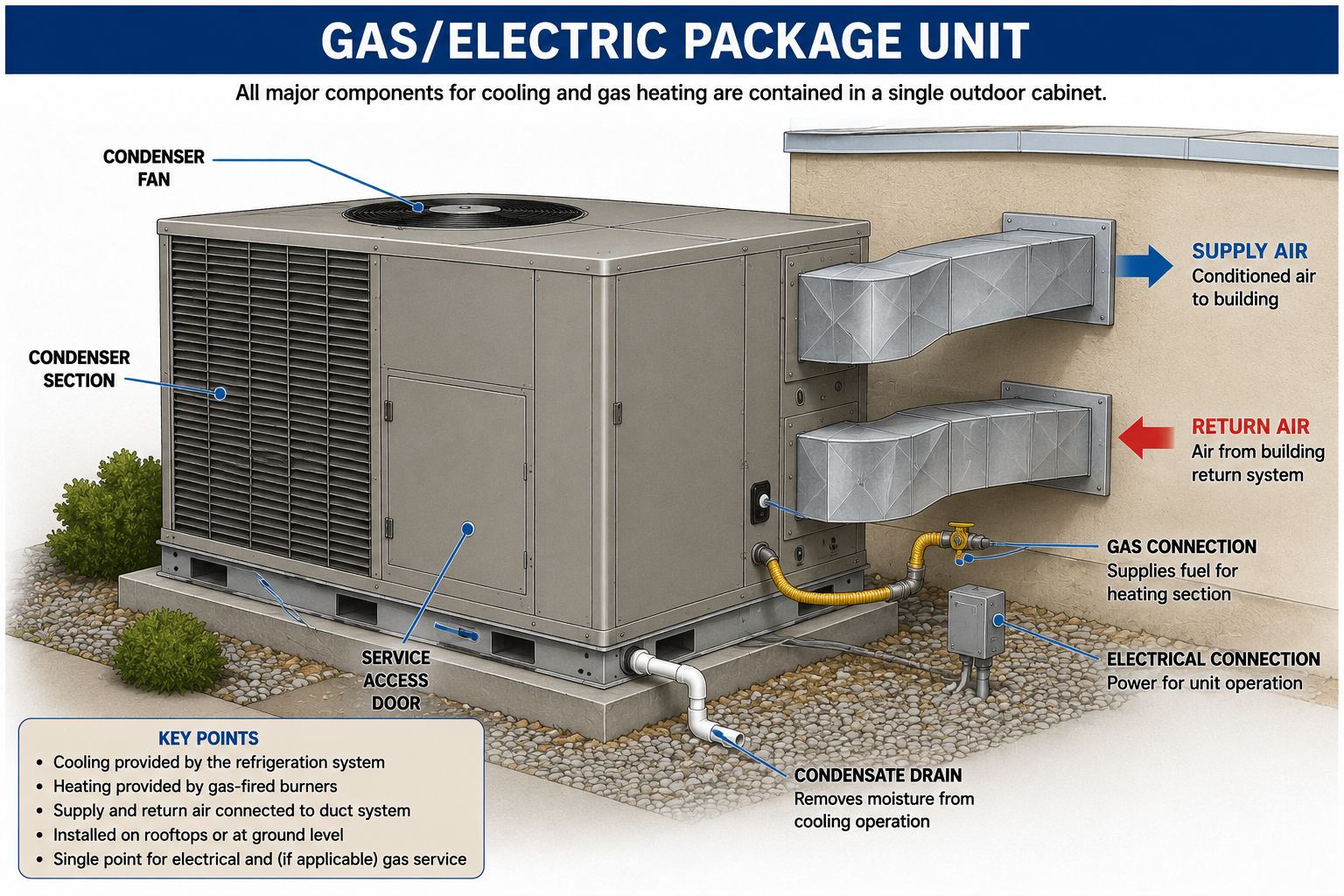
Rooftop or Ground-Mounted Equipment
Gas/electric package units may be installed on a roof or at ground level. Rooftop installations are especially common in light-commercial buildings, where the unit can connect through a roof curb or other duct arrangement to the building below. Ground-mounted units may connect to ductwork through the side or bottom of the cabinet depending on the equipment and installation.
Rooftop Installation
The packaged unit is installed on the roof and normally connects to the building’s supply and return duct system through a roof curb or other approved duct arrangement.
Ground Installation
The packaged unit is installed outdoors at ground level, typically on a suitable pad or support, with ductwork connecting the unit to the building.
Package Unit and RTU Are Not Exact Synonyms
RTU means rooftop unit. Many gas/electric package units are RTUs because they are installed on roofs, but a packaged unit installed at ground level is still a packaged unit. Its location has changed, not its basic equipment configuration.
What Connects the Package Unit to the Building?
One advantage of recognizing a packaged system is that many of its external connections provide immediate clues about what type of equipment you are examining. Instead of looking for a refrigerant line set running to separate indoor equipment, look for the ducts and utilities serving the outdoor cabinet.
Return Duct
Air from the conditioned building travels through the return duct and enters the package unit to be filtered, cooled or heated, and recirculated.
Supply Duct
After the air has been conditioned, the supply duct carries it from the package unit back into the building’s air-distribution system.
Gas Supply
The gas connection supplies fuel to the heating section. Its presence is one of the most useful external clues that a packaged unit contains gas heat.
Electrical Service
Electrical power operates the refrigeration equipment, fans, blower, controls, ignition system, and other electrical components within the unit.
Condensate Drain
Moisture removed from the building air during cooling collects at the evaporator section and must be drained from the equipment.
Combustion Exhaust
When the gas heating section operates, combustion products must be discharged outdoors through the venting arrangement provided by the equipment.
Not All Air Moving Through the Unit Goes Into the Building
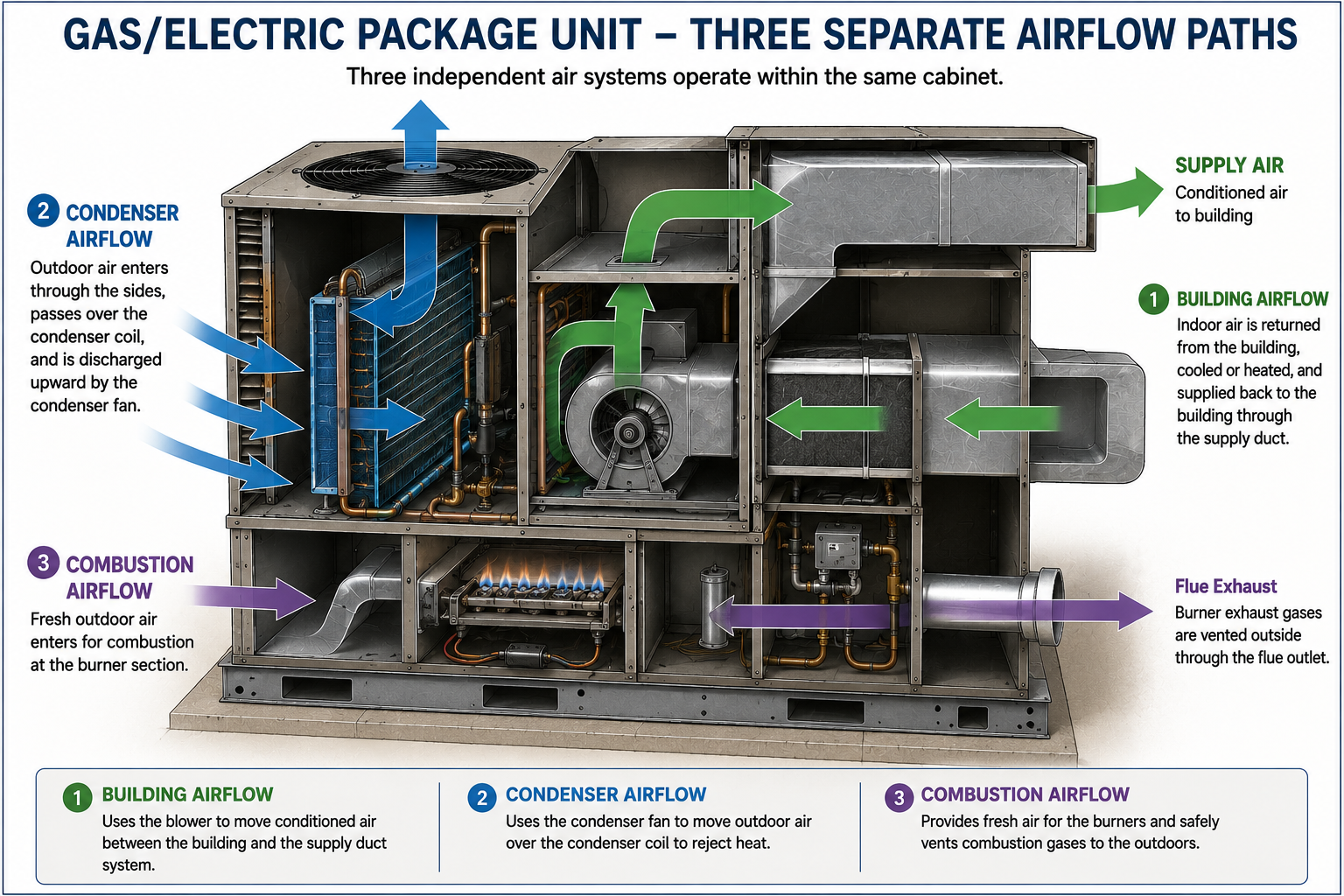
A gas/electric package unit may have several fans and openings in the same cabinet, which can initially make its airflow appear complicated. The arrangement becomes much easier to understand when the air is divided into three separate paths: building air, condenser air, and combustion air.
Building Air
Return air enters from the building, passes through the appropriate conditioning section, and is moved by the blower into the supply duct for delivery back to the occupied space.
Condenser Air
Outdoor air moves across the condenser coil and carries heat from the refrigeration system to the outdoor environment. This air does not normally enter the conditioned building.
Combustion Air and Exhaust
During gas heating operation, air supports combustion in the heating section and the resulting combustion products are discharged outdoors. This airflow remains separate from the building supply air.
Do Not Confuse the Air Streams
The air passing through the condenser and the air associated with combustion are not the conditioned supply air delivered to the building. Understanding which openings belong to each airflow path is important when inspecting, servicing, and troubleshooting packaged equipment.
Mechanical Refrigeration Provides Cooling
During a call for cooling, the package unit operates as the mechanical refrigeration system already studied elsewhere in this course. The evaporator absorbs heat from the building air and the condenser rejects that heat to the outdoor environment.
The important difference in this lesson is physical arrangement. Instead of having an indoor evaporator connected by a field-installed line set to an outdoor condensing unit, both sides of the refrigeration system are contained within the packaged equipment.
Return air from the building passes through the cooling section, where heat and moisture can be removed. The blower then moves the conditioned air into the supply duct and back into the building.
Use What You Already Know
The refrigeration cycle has not changed simply because the equipment is packaged in one cabinet. For a detailed review of refrigerant flow and heat transfer, see The Basic Refrigeration Cycle.
The Gas Heating Section Provides Heat
During a call for gas heat, the mechanical cooling system is normally not being used to provide the heating. Fuel is burned in the heating section and heat from combustion is transferred through the furnace heat exchanger to the building air.
The supply blower moves building air across the outside surfaces of the heat exchanger. The heated air then enters the supply duct and is distributed through the building.
Combustion gases remain separated from the conditioned air by the heat exchanger and are discharged outdoors through the unit’s venting system. This separation is fundamental to safe gas-fired heating equipment.
What Should You Look For?
Technicians should develop the habit of identifying equipment before beginning service. Several visual clues can quickly indicate that an outdoor cabinet is a gas/electric package unit rather than a conventional split-system condensing unit.
Large Outdoor Cabinet
The cabinet is generally larger than a typical residential split-system condensing unit because it contains both indoor-side and outdoor-side equipment.
Supply and Return Ducts
Duct connections running directly between the outdoor cabinet and the building strongly indicate packaged equipment.
Gas Connection
A fuel-gas connection to the cabinet indicates that the equipment contains a gas-fired heating section.
Combustion Vent
Look for the manufacturer’s combustion-air and exhaust arrangement associated with the gas heating section.
Condenser Fan and Coil
The outdoor condenser section remains visible as part of the cabinet and operates much like the condenser section previously studied.
No Field Line Set to Indoor Equipment
A conventional packaged unit does not require the long field-installed refrigerant line set used to connect the indoor and outdoor sections of a conventional split system.
Avoid These Identification Mistakes
“Every Package Unit Is an RTU”
Incorrect. A rooftop unit is installed on a roof. Packaged equipment can also be installed at ground level.
“The Outdoor Fan Supplies Building Air”
Incorrect. The condenser fan moves outdoor air through the condenser section. A separate blower moves conditioned building air through the duct system.
“Gas Heat Means the Air Conditioner Is Gas Powered”
Incorrect. The gas provides heating. The refrigeration equipment and air-moving components are electrically operated.
“Combustion Air Mixes With Supply Air”
Incorrect. Combustion products must remain separated from the conditioned building air and be safely discharged outdoors.
Review Questions
1. Why is this equipment called a gas/electric package unit?
Answer: The major heating, cooling, and air-moving equipment is packaged within one cabinet. Gas is used for the heating section, while electricity operates the mechanical refrigeration system and other electrical equipment.
2. Does a gas/electric package unit normally require a refrigerant line set connecting it to a separate indoor evaporator?
Answer: No. The major refrigeration components are contained within the packaged cabinet, so a conventional field-installed line set between separate indoor and outdoor equipment is not required.
3. What two duct connections normally connect a package unit to the conditioned building?
Answer: The return duct brings building air to the unit and the supply duct carries conditioned air back into the building.
4. What are the three separate air paths discussed in this lesson?
Answer: Conditioned building airflow, outdoor condenser airflow, and combustion airflow associated with the gas heating section.
5. Does condenser air normally enter the building as conditioned supply air?
Answer: No. Outdoor condenser air passes through the condenser section to remove heat from the refrigeration system and is discharged back outdoors.
6. What are two external clues that a packaged unit contains gas heat?
Answer: A fuel-gas connection and the combustion venting or exhaust arrangement are two important clues.
7. Is every gas/electric package unit a rooftop unit?
Answer: No. Many are installed on roofs, but packaged equipment can also be installed at ground level.
8. During cooling operation, is the refrigeration cycle fundamentally different from the cycle used by a conventional split air conditioner?
Answer: No. The same basic vapor-compression refrigeration principles apply. The major difference is that the equipment is physically packaged together rather than divided between indoor and outdoor units.
Lesson 2 Summary
- A gas/electric package unit combines mechanical air conditioning, gas heating, and air-moving equipment within one outdoor cabinet.
- Gas/electric package units may be installed on rooftops or at ground level.
- The package unit connects to the conditioned building through supply and return ductwork.
- A gas supply serves the heating section, while electrical power operates the refrigeration equipment, fans, blower, controls, and other electrical components.
- The equipment has separate conditioned-air, condenser-air, and combustion-air paths.
- Outdoor condenser air does not normally enter the conditioned building.
- Combustion products must remain separated from the conditioned building air and be discharged outdoors.
- During cooling, the unit uses the same basic mechanical refrigeration principles previously studied in this course.
- During gas heating, the heating section transfers heat from combustion to the building air through a heat exchanger.
- A conventional gas/electric package unit does not require the field-installed refrigerant line set used between the indoor and outdoor sections of a conventional split system.
- Supply and return ducts, a gas connection, combustion venting, and the single large outdoor cabinet are useful clues when identifying gas/electric packaged equipment.