Understanding Air-Conditioning System Configurations
The basic refrigeration cycle can be assembled into several different equipment configurations. Some systems place the major equipment in a single outdoor cabinet, while others divide the system between indoor and outdoor equipment. Some use a central duct system to distribute conditioned air, while ductless systems deliver air directly to individual spaces.
This lesson introduces the major system configurations technicians commonly encounter. The goal is not to reteach the refrigeration cycle or individual components, but to learn how previously studied components are arranged into complete air-conditioning systems and how those systems can be identified in the field.
Learning Objectives
Recognize Packaged Systems
Identify systems in which the cooling, air-moving, and heating equipment is contained within a single outdoor cabinet.
Recognize Split Systems
Identify systems that divide the refrigeration equipment between an outdoor unit and indoor equipment connected by refrigerant piping.
Recognize Ductless Systems
Explain how a ductless mini-split is still a split refrigeration system even though it does not use a conventional central duct system.
Distinguish Evaporative Cooling
Recognize that an evaporative cooler uses water evaporation rather than a vapor-compression refrigeration system to provide cooling.
The Same Components Can Be Arranged in Different Ways
Earlier sections of this course examined the refrigeration cycle, refrigeration theory, evaporators, condensers, compressors, metering devices, and refrigerant line sets. Those concepts do not change simply because the equipment cabinet or installation looks different.
If you need to review how the refrigeration cycle operates, return to The Basic Refrigeration Cycle. For pressure, temperature, heat transfer, superheat, subcooling, and related principles, review Refrigeration Theory.
This section takes the next step. Instead of concentrating on what an individual component does, we will look at how those components are physically arranged into the equipment technicians install, maintain, diagnose, and service.
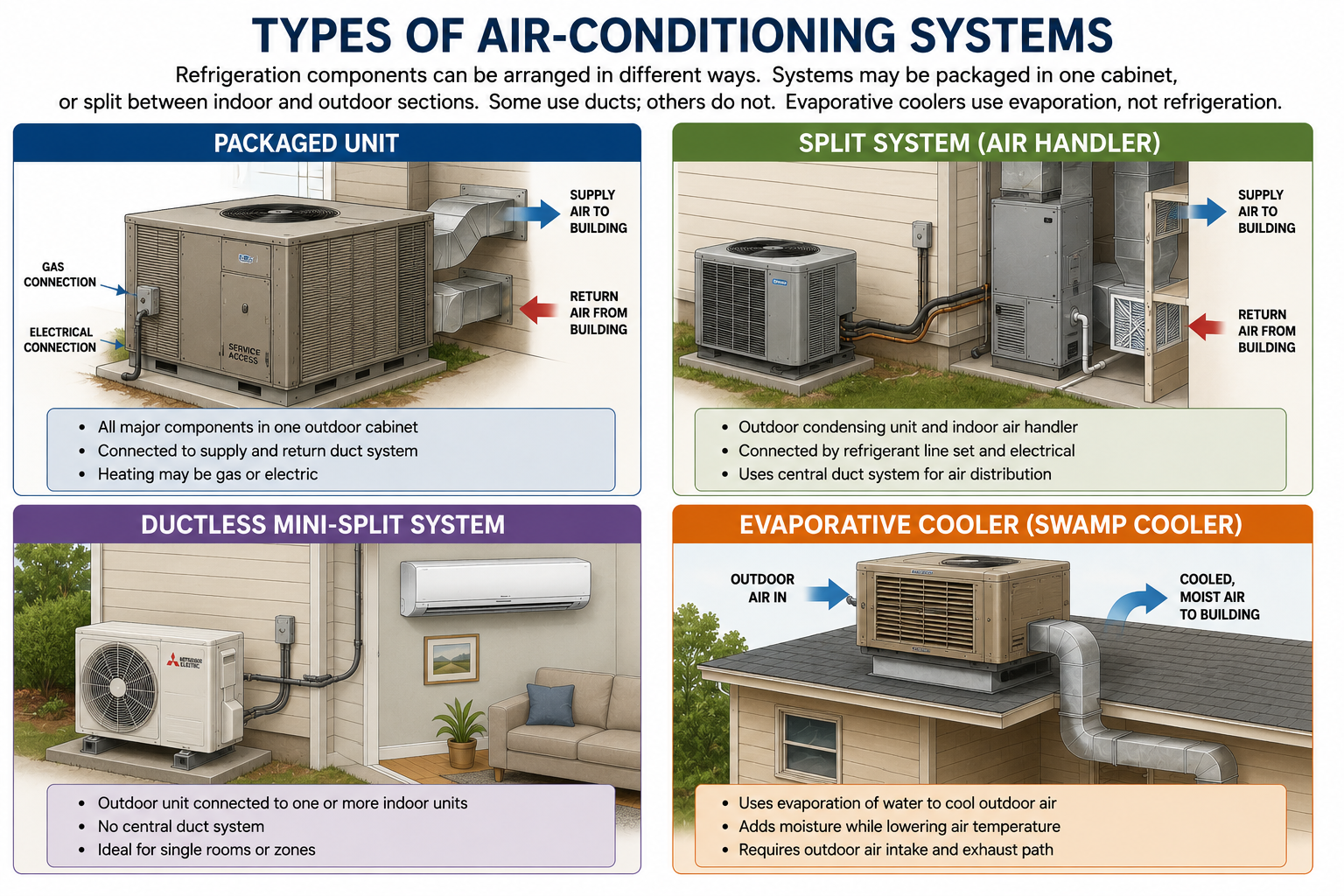
One Cabinet Contains the Major Equipment
A packaged air-conditioning system places the major cooling and air-moving assemblies in a single cabinet. Depending on the type of package unit, the cabinet may also contain gas heating equipment, electric heating equipment, or heat-pump components.
Package units are commonly installed outdoors. They may be mounted at ground level or installed on a roof, depending on the building and equipment application. Supply and return ducts connect the packaged equipment to the conditioned building.
One Main Equipment Cabinet
Unlike a conventional split system, the cooling system does not have a separate indoor evaporator cabinet connected to a remote outdoor condensing unit.
Supply and Return Ducts
Conditioned air leaves the package unit through the supply duct while air from the building returns through the return duct.
Outdoor Installation
The equipment is normally located outside the conditioned space, commonly at ground level or on the building roof.
Several Heating Arrangements
A packaged system may use gas heat, electric resistance heat, or a heat-pump configuration depending on the equipment design.
Packaged Does Not Automatically Mean Rooftop
Many commercial packaged units are installed on roofs and are commonly called rooftop units or RTUs. Packaged equipment can also be installed at ground level, so the term packaged unit describes the equipment configuration rather than its exact mounting location.
The Indoor and Outdoor Equipment Are Separated
A conventional split air-conditioning system divides the refrigeration system between outdoor and indoor equipment. The outdoor condensing unit is connected to an indoor evaporator section by a refrigerant line set.
The indoor portion may be an air handler containing the evaporator coil and blower, or the evaporator coil may be installed with a separate furnace. In either arrangement, the indoor equipment connects to the building’s supply and return duct system.
Outdoor Equipment
The outdoor portion contains the condensing equipment and connects to the indoor section through the refrigerant line set.
Indoor Equipment
The indoor portion contains the evaporator coil and the equipment needed to move conditioned air through the building.
Duct Distribution
Return air is brought back to the indoor equipment, conditioned, and then delivered through the supply duct system.
The Outdoor Unit Is Not the Entire Air Conditioner
When working with a split system, the outdoor condensing unit is only one portion of the complete air-conditioning system. The indoor evaporator section, refrigerant piping, air-moving equipment, controls, and duct system all work together as a complete installation.
A Split System Without Conventional Central Ductwork
A ductless mini-split also separates the refrigeration system into indoor and outdoor equipment. The outdoor unit connects to one or more indoor units through refrigerant piping, electrical or communication wiring, and condensate drainage as required by the installation.
The major difference is air distribution. Instead of using a central supply and return duct system, an indoor mini-split unit conditions air within the room or zone where it is installed.
Single-Zone
One outdoor unit serves one indoor unit and normally conditions one room or defined zone.
Multi-Zone
One outdoor unit can serve multiple indoor units, allowing separate rooms or zones to have individual air-distribution equipment.
Several Indoor Styles
Indoor equipment may include high-wall units, ceiling cassettes, floor-mounted units, or concealed ducted units depending on the application.
Still a Split System
The term ductless describes the air-distribution arrangement. The refrigeration system itself is still divided between indoor and outdoor equipment.
A Different Method of Cooling
Evaporative coolers, commonly called swamp coolers, belong in this discussion because technicians encounter them as building cooling equipment, but they operate differently from the refrigeration-based systems introduced above.
A direct evaporative cooler brings outdoor air through wetted evaporative media. Some of the water evaporates into the moving air, absorbing heat and reducing the air temperature while increasing its moisture content. The cooled outdoor air is then delivered into the building.
An Evaporative Cooler Is Not a Refrigeration System
A conventional evaporative cooler does not use a compressor, condenser, metering device, evaporator refrigeration coil, or refrigerant line set. Cooling is produced by water evaporation rather than by the vapor-compression refrigeration cycle.
Evaporative cooling is most useful in hot, dry climates where outdoor air has greater capacity to accept additional moisture. We will examine evaporative cooler construction, airflow, climate limitations, water circulation, and maintenance later in this section.
Start by Looking at the Equipment Arrangement
When approaching unfamiliar equipment, do not begin by guessing what individual internal components are doing. First look at the physical arrangement of the complete system. A few basic observations can usually place the equipment into the correct general category.
One Outdoor Cabinet With Ducts?
A large outdoor cabinet connected directly to the building’s supply and return ducts is a strong indication of packaged equipment.
Outdoor Unit Plus Indoor Ducted Equipment?
An outdoor condensing unit connected by refrigerant piping to an indoor air handler or furnace/coil assembly indicates a conventional split system.
Outdoor Unit Plus Wall or Ceiling Heads?
Small refrigerant piping connecting an outdoor unit to one or more room-mounted indoor units indicates a mini-split or multi-split configuration.
Water Supply and Evaporative Media?
A cabinet using wetted media, a water supply, and a blower without a refrigeration circuit indicates an evaporative cooling system.
Four Basic Arrangements
| System Type | Equipment Arrangement | Air Distribution | Indoor/Outdoor Refrigerant Connection |
|---|---|---|---|
| Packaged | Major equipment contained in one outdoor cabinet | Central supply and return ducts | No field-installed line set between separate indoor and outdoor units |
| Conventional Split | Outdoor condensing unit plus indoor air handler or furnace/coil | Central supply and return ducts | Yes |
| Ductless Mini-Split | Outdoor unit plus one or more indoor units | Directly into individual rooms or zones | Yes |
| Evaporative Cooler | Evaporative media, water system, and blower contained in the cooler | Direct discharge or duct distribution depending on installation | No refrigerant circuit |
Use the Existing Course Material
This section intentionally does not repeat the detailed operation of compressors, condensers, evaporators, metering devices, refrigerant piping, or refrigeration theory. Those subjects are already covered elsewhere in the Air Conditioning & Refrigeration course.
Basic Refrigeration Cycle
Review the sequence of compression, condensation, pressure reduction, evaporation, heat absorption, and heat rejection.
Refrigeration Theory
Review heat, pressure, saturation, pressure-temperature relationships, superheat, subcooling, and other principles behind system operation.
Air Conditioning & Refrigeration
Return to the main course section for lessons covering evaporators, condensers, compressors, metering devices, line sets, and related topics.
Review Questions
1. What is the basic difference between a packaged system and a conventional split system?
Answer: A packaged system contains its major cooling and air-moving assemblies in one outdoor cabinet, while a conventional split system divides the equipment between outdoor and indoor sections connected by refrigerant piping.
2. Is a ductless mini-split considered a split system?
Answer: Yes. The refrigeration equipment is split between indoor and outdoor units. The term ductless refers primarily to the way conditioned air is distributed rather than to the arrangement of the refrigeration circuit.
3. What indoor equipment might be used with a conventional split-system outdoor condensing unit?
Answer: Common arrangements include an indoor air handler or an evaporator coil installed with a furnace.
4. How can you quickly recognize many packaged systems?
Answer: Look for a single outdoor cabinet connected directly to the building’s supply and return duct system.
5. What makes an evaporative cooler fundamentally different from the other systems introduced in this lesson?
Answer: An evaporative cooler uses the evaporation of water to cool air rather than using a vapor-compression refrigeration circuit.
6. Why are we not reviewing the operation of the compressor, condenser, metering device, and evaporator in detail here?
Answer: Those components and their operation were covered in earlier Air Conditioning & Refrigeration lessons. This section focuses on recognizing how the components are arranged into complete systems.
Lesson 1 Summary
- Air-conditioning equipment can be arranged in several different physical configurations while using the same basic refrigeration principles.
- A packaged system places its major cooling and air-moving equipment in one outdoor cabinet.
- A conventional split system separates the outdoor condensing equipment from the indoor evaporator and air-moving equipment.
- A split system may use an indoor air handler or an evaporator coil installed with a furnace.
- A ductless mini-split is still a split refrigeration system even though it does not use conventional central ductwork.
- A single-zone mini-split serves one zone, while a multi-zone system can serve multiple indoor zones.
- Evaporative cooling uses water evaporation rather than a vapor-compression refrigeration circuit.
- Identifying the equipment arrangement is often the fastest first step when determining what type of system you are examining.
- The detailed operation of refrigeration components is covered in the earlier Air Conditioning & Refrigeration course material and does not need to be relearned for each system configuration.