Refrigerant Flammability and A2L Safety
For many years, HVAC/R technicians commonly worked with refrigerants classified as A1, meaning lower toxicity and no flame propagation under the test conditions used by the refrigerant safety standard. The transition toward lower-GWP refrigerants has introduced more refrigerants classified as A2L, which have lower toxicity but do have measurable flammability characteristics.
A2L refrigerants are not handled exactly like traditional A1 refrigerants, but they also should not be treated as though they have the same flammability characteristics as highly flammable A3 refrigerants such as propane. Safe service requires understanding the ASHRAE safety classification, the conditions necessary for ignition, the importance of controlling refrigerant concentration and ignition sources, and the equipment and procedures approved for the refrigerant being serviced.
Learning Objectives
Read Refrigerant Safety Classifications
Explain how the letters and numbers in ASHRAE refrigerant safety classifications describe toxicity and flammability characteristics.
Understand Flammable Concentration
Explain Lower Flammability Limit and Upper Flammability Limit and why a refrigerant must be within a particular concentration range to propagate flame.
Compare A1, A2L, and A3 Refrigerants
Recognize the important differences between refrigerants with no flame propagation, lower-flammability A2L refrigerants, and highly flammable A3 refrigerants.
Service A2L Equipment Safely
Apply service practices that control refrigerant release, ventilation, ignition sources, tools, recovery equipment, and other hazards when working with A2L systems.
Two Characters Describe Two Different Hazards
Refrigerants are assigned safety classifications under ANSI/ASHRAE Standard 34. The classification combines a letter describing toxicity with a number describing flammability. These classifications allow technicians, engineers, manufacturers, and code officials to communicate important refrigerant safety characteristics in a compact form.
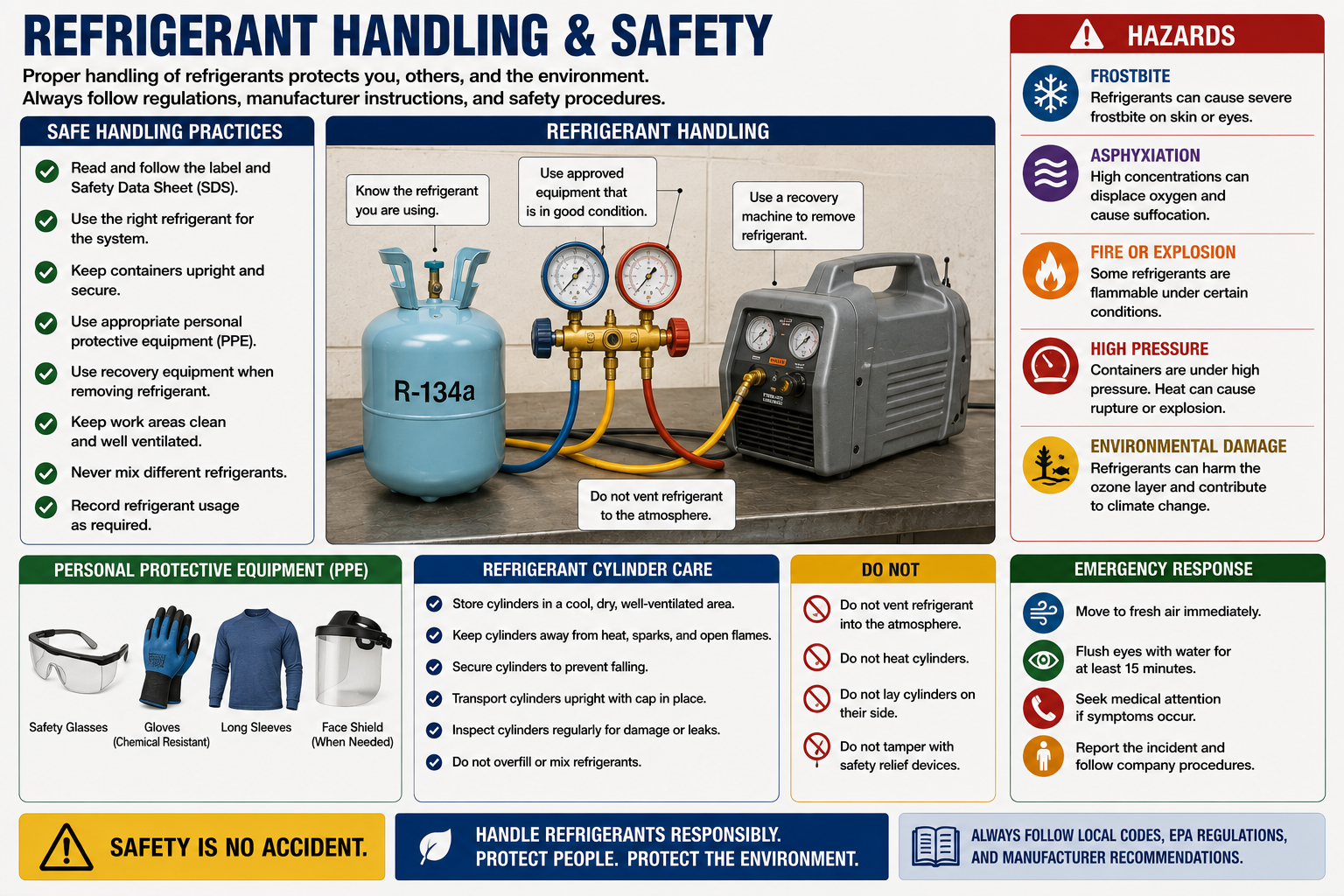
Class A — Lower Toxicity
The letter A identifies the lower-toxicity classification under the Standard 34 system. It does not mean that unlimited exposure is safe or that the refrigerant cannot displace oxygen.
Class B — Higher Toxicity
The letter B identifies the higher-toxicity classification. Refrigerants in this group require additional attention to exposure limits, leak detection, ventilation, system design, and emergency procedures.
Class 1 — No Flame Propagation
Class 1 refrigerants do not propagate a flame when tested under the conditions specified by the classification standard.
Class 2L — Lower Flammability
Class 2L is a subclass of Class 2 for refrigerants with lower flammability and low burning velocity. Many refrigerants introduced for lower-GWP air-conditioning applications fall into this category.
Class 2 — Flammable
Class 2 refrigerants have greater flammability characteristics than the 2L subclass while remaining below the highly flammable Class 3 classification.
Class 3 — Higher Flammability
Class 3 identifies highly flammable refrigerants. Hydrocarbon refrigerants such as propane and isobutane are common HVAC/R examples.
What Does A2L Actually Mean?
An A2L refrigerant combines the lower-toxicity Class A designation with the lower-flammability 2L subclass. The designation does not mean that the refrigerant cannot burn. It means that its flammability characteristics fall within the 2L criteria established by the safety classification standard.
A2L refrigerants generally require a higher concentration and a more capable ignition source to produce sustained flame propagation than highly flammable A3 refrigerants. Their flame propagation also occurs more slowly. These characteristics reduce the likelihood and severity of ignition compared with more highly flammable refrigerants, but they do not eliminate the possibility.
A2L Does Not Mean Nonflammable
Never use the slower-burning characteristics of an A2L refrigerant as a reason to ignore ignition sources or ventilation. A2L refrigerant can burn when the refrigerant-air mixture is within its flammable range and a sufficient ignition source is present.
Likewise, the term mildly flammable is commonly used to describe A2L refrigerants, but technicians should understand what the classification actually represents rather than treating the word “mildly” as permission to relax service precautions.
Fuel, Air, and an Ignition Source Must Come Together
For refrigerant vapor to propagate flame, the concentration of refrigerant in air must fall within a particular range. A mixture containing too little refrigerant does not have enough fuel to support flame propagation. A mixture containing too much refrigerant may contain insufficient oxygen to propagate flame under the specified test conditions.
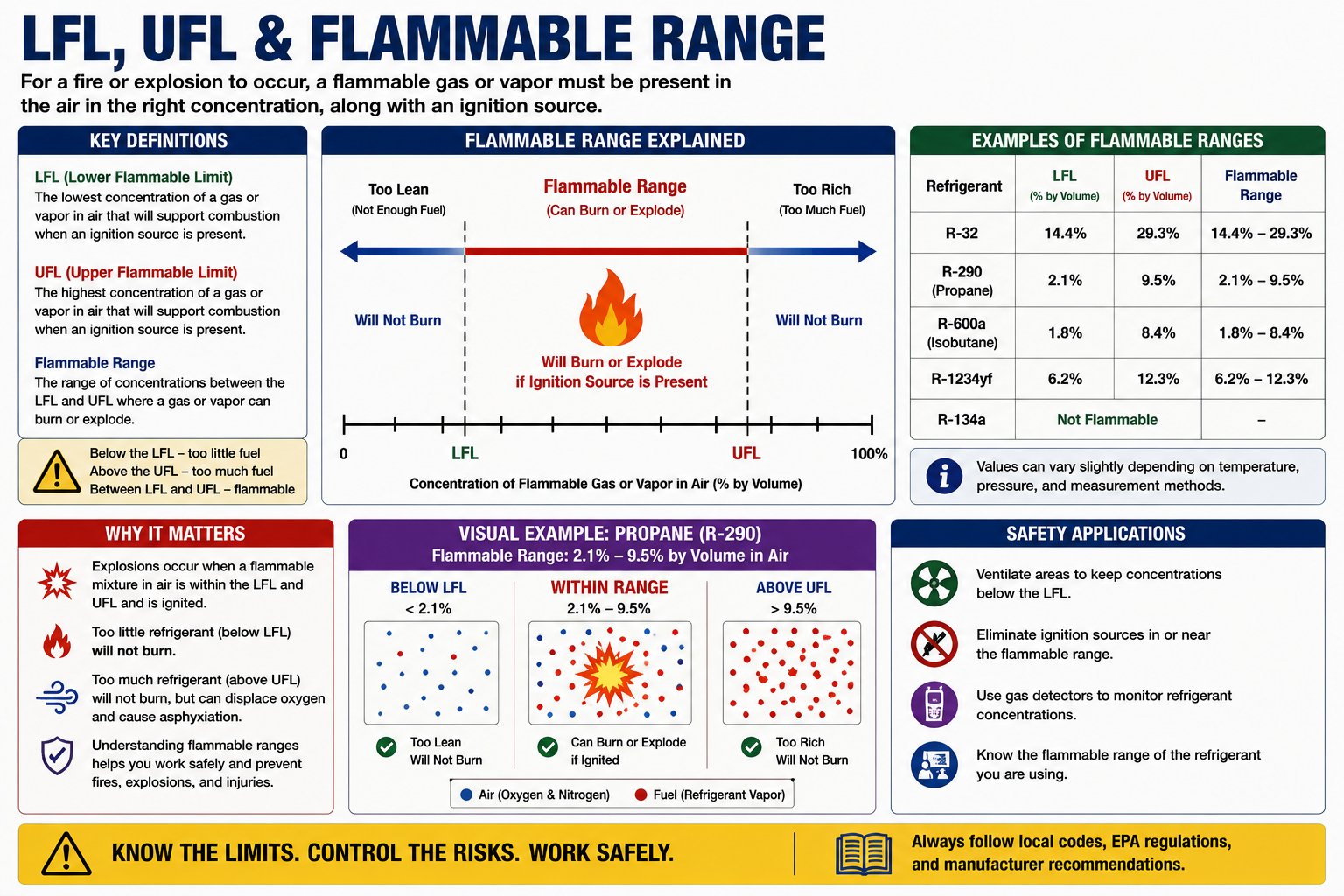
Below the LFL
The mixture is too lean to propagate flame under the specified conditions because the refrigerant concentration is below the Lower Flammability Limit.
Between LFL and UFL
The refrigerant-air mixture is within its flammable range. If a sufficient ignition source is introduced, flame propagation may occur.
Above the UFL
The mixture is too rich to propagate flame under the specified test conditions. This condition should never be considered safe because dilution with air can move the mixture back through the flammable range.
“Too Rich to Burn” Does Not Mean Safe
A refrigerant-rich space can become flammable as fresh air enters and dilutes the refrigerant. It may also present serious oxygen-displacement and exposure hazards. Never enter or work in a refrigerant-rich atmosphere simply because the concentration may be above the UFL.
Preventing Ignition Means Controlling the Conditions
Fire requires a suitable fuel concentration, sufficient oxygen, and an ignition source capable of initiating combustion. In A2L service work, the technician’s goal is to prevent those conditions from developing together.
Control the Refrigerant
Prevent unnecessary releases, repair leaks, use proper recovery procedures, and keep the refrigerant contained whenever possible.
Provide Ventilation
Ventilation reduces the possibility that leaked refrigerant will accumulate to a flammable concentration in the work area.
Control Ignition Sources
Remove or control open flames, smoking materials, sparks, hot surfaces, electrical arcs, and other potential ignition sources as required for the service operation.
Monitor When Required
Use appropriate refrigerant or combustible-gas detection when required by the equipment instructions, workplace procedure, code, or hazard assessment.
These Refrigerants Are Not Interchangeable Safety Categories
The transition to A2L refrigerants has created confusion because technicians may hear that an A2L refrigerant is “flammable” and assume it behaves like propane, or hear that it is only “mildly flammable” and assume normal A1 procedures require no changes. Neither assumption is correct.
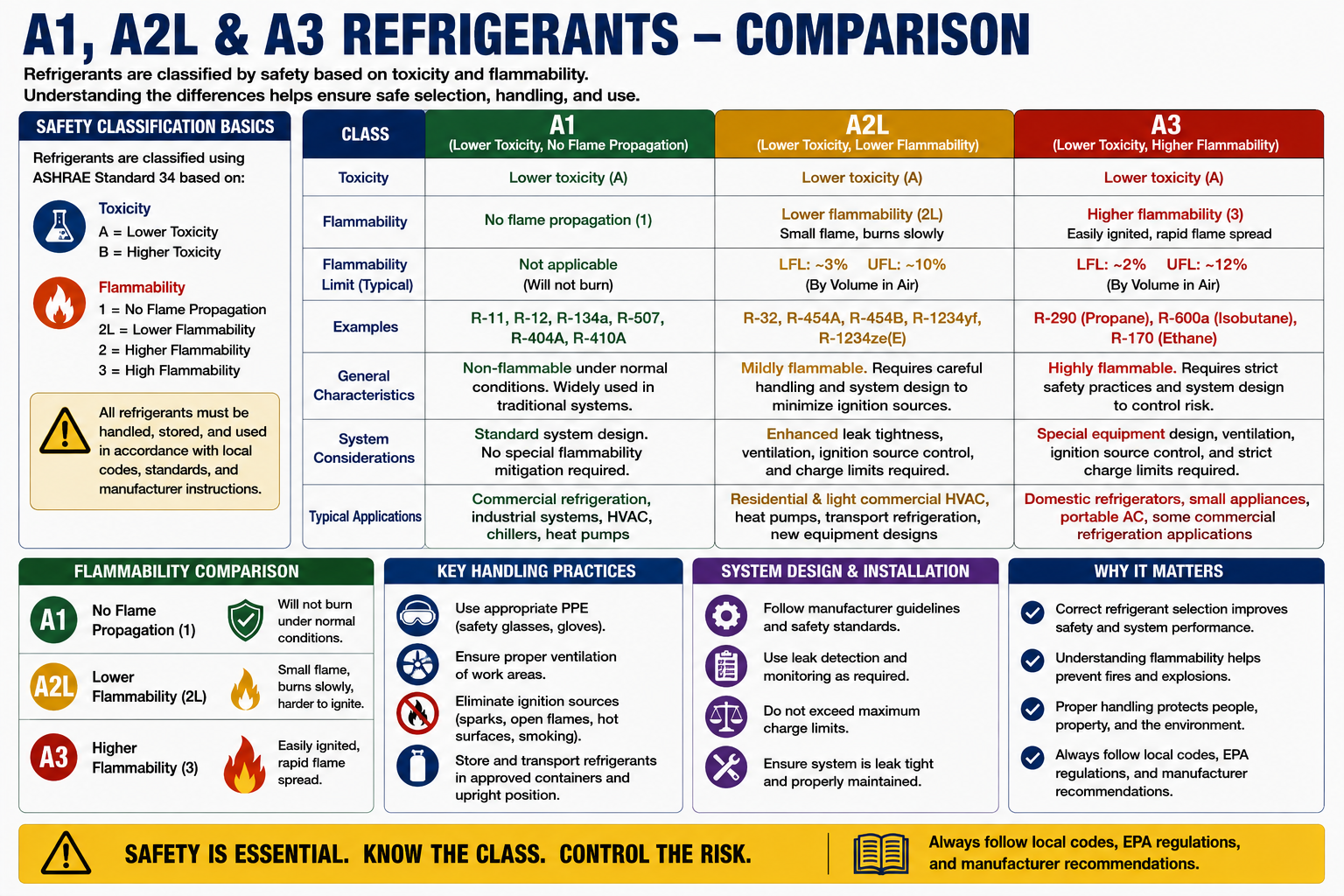
| Classification | Toxicity Classification | Flammability Characteristic | Examples |
|---|---|---|---|
| A1 | Lower toxicity | No flame propagation under the classification test conditions | Many traditional HVAC/R refrigerants |
| A2L | Lower toxicity | Lower flammability with low burning velocity | R-32, R-454B and several HFO or HFO-containing refrigerants |
| A3 | Lower toxicity | Higher flammability | R-290 propane and R-600a isobutane |
Safety Classification Does Not Determine System Compatibility
Two refrigerants can share the same safety classification and still have very different pressures, capacities, temperature glide, lubricant requirements, charge limits, or equipment requirements. Safety classification is only one part of refrigerant selection.
Why Technicians Are Seeing More A2Ls
The industry’s transition toward refrigerants with lower Global Warming Potential has increased the use of A2L refrigerants in air-conditioning and refrigeration equipment. Refrigerants such as R-32 and R-454B can provide substantially lower climate impact than some higher-GWP refrigerants they replace, but their flammability classification requires equipment and service procedures designed for that characteristic.
This is an important engineering tradeoff. Refrigerant selection involves environmental impact, energy efficiency, operating pressure, capacity, toxicity, flammability, equipment design, codes, and other considerations rather than a single property.
Never Retrofit an A1 System to an A2L Refrigerant Without Approval
A system designed for an A1 refrigerant should not be charged with an A2L refrigerant merely because pressure or performance characteristics appear similar. Equipment intended for A2L refrigerants incorporates design, component, labeling, charge, control, and safety provisions appropriate to the refrigerant. Follow manufacturer requirements and applicable regulations and codes.
An Ignition Source Is More Than an Open Flame
Technicians naturally recognize a torch or cigarette as an ignition source, but other equipment may also produce enough energy to ignite a flammable refrigerant-air mixture under the right conditions.
Open Flames
Brazing torches, matches, lighters, pilot flames, and other open flames must be controlled when flammable refrigerant may be present.
Electrical Arcing
Switches, relays, contactors, motors, damaged wiring, and some electrical tools can produce arcs or sparks during operation.
Hot Surfaces
Heating elements, engines, lamps, exhaust components, and other hot surfaces may become relevant ignition hazards depending on their temperature and the refrigerant involved.
Service Tools
Tools and equipment used around A2L refrigerants must be appropriate for the intended operation and must comply with equipment-manufacturer and applicable safety requirements.
The Service Procedure Must Match the Refrigerant
Technicians servicing A2L equipment should begin by positively identifying the refrigerant and confirming that tools and procedures are suitable for that refrigerant. Service equipment designed only for older A1 systems should not automatically be assumed appropriate for A2L work.
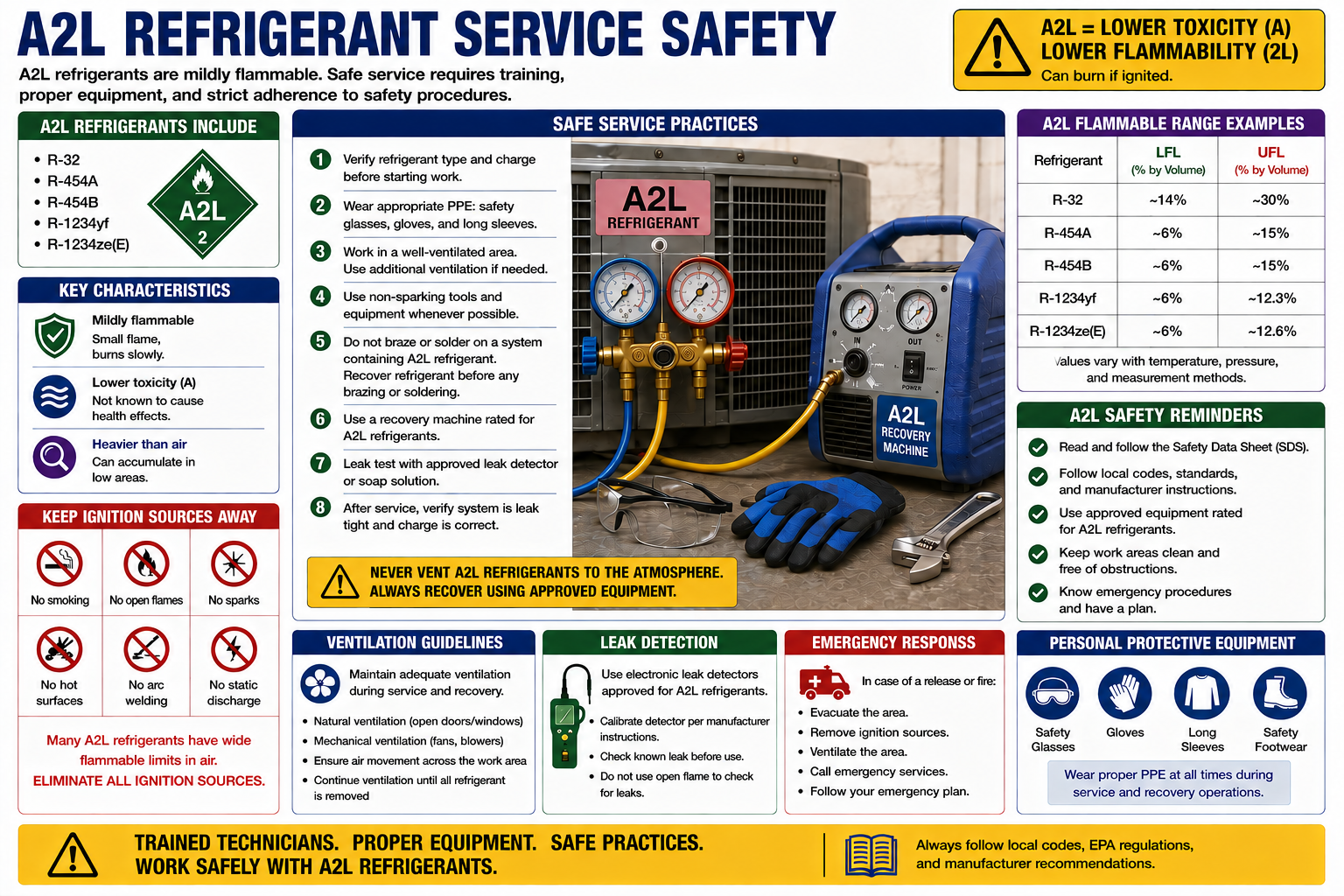
Identify the Refrigerant
Confirm the refrigerant from the equipment nameplate and service information before opening the refrigeration circuit or connecting service equipment.
Review the Work Area
Identify potential ignition sources, ventilation conditions, low areas, enclosed spaces, and other conditions that could allow a leaked refrigerant concentration to increase.
Use Appropriate Equipment
Use recovery machines, vacuum pumps, leak detectors, electrical tools, hoses, cylinders, and other equipment that are approved or otherwise suitable for the refrigerant and procedure.
Control Ignition Sources
Remove or control ignition sources as required before deliberately opening a system or performing work that could release refrigerant.
Recover Before Opening
Recover refrigerant using appropriate equipment and procedures rather than intentionally releasing refrigerant into the work area.
Verify Before Applying Heat
Before brazing or using another high-temperature process, follow the equipment manufacturer’s procedure for refrigerant removal, isolation, purging, ventilation, and verification that the work can be performed safely.
Do Not Assume Older Equipment Is A2L-Compatible
A recovery machine contains electrical components and moves refrigerant vapor through the machine. A vacuum pump uses a motor and electrical components while exhausting gases removed from the system. Leak detectors, power tools, and other equipment can also contain potential ignition sources.
For that reason, technicians should use equipment identified by its manufacturer as suitable for the refrigerant and application. A tool being physically capable of connecting to an A2L system does not prove that it is approved for A2L service.
A Hose Connection Is Not a Safety Approval
If a hose or fitting connects successfully, that tells you only that the connection fits. It does not establish that the recovery machine, vacuum pump, leak detector, gauge set, cylinder, or other equipment is electrically, mechanically, or chemically suitable for the refrigerant.
Part VI will examine recovery equipment in detail, including recovery equipment specifically intended for A2L refrigerants.
Prevent the Refrigerant From Reaching a Flammable Concentration
Ventilation is one of the most important controls during service because it can prevent released refrigerant from accumulating. Work-area ventilation should be appropriate for the refrigerant, amount of refrigerant that could be released, equipment location, and service procedure.
Leak-detection equipment can provide another layer of protection. The detector must be capable of detecting the refrigerant being serviced and must be used according to the manufacturer’s instructions. Detection equipment designed for one refrigerant family or one hazard should not automatically be assumed suitable for another.
Do Not Confuse Leak Detection With Flammable-Gas Monitoring
A refrigerant leak detector may be designed primarily to locate small refrigerant leaks, while an atmospheric or combustible-gas monitor may be designed to evaluate hazardous concentrations in an area. Select the instrument according to the question you need it to answer.
Applying a Torch Requires Additional Preparation
Brazing introduces an obvious ignition source and very high temperatures. Before applying a torch to A2L equipment, the refrigerant must be properly removed or isolated as required by the manufacturer and applicable procedures. The work area must also be evaluated for refrigerant that may have escaped or accumulated outside the system.
Flowing nitrogen while brazing is commonly used to reduce internal oxidation of copper tubing, but nitrogen flow does not replace refrigerant recovery, leak control, ventilation, or verification that a flammable refrigerant-air mixture is not present around the work.
Never Use a Flame to Look for a Refrigerant Leak
An open flame is not an acceptable refrigerant leak-detection method. With flammable refrigerants it introduces an ignition source, and with halogenated refrigerants extreme heat or flame can also create hazardous decomposition products.
A2L Safety Begins With the Appliance, Not Just the Technician
Equipment designed for an A2L refrigerant may use refrigerant-charge limitations, airflow requirements, leak-detection systems, control strategies, component-location requirements, protected electrical components, warning labels, or other engineering measures depending on the application.
Those protections are part of the equipment design and must not be defeated during installation or service. Replacing components with unapproved substitutes, changing controls, exceeding the specified refrigerant charge, or altering required airflow can interfere with safety features incorporated into the system.
Several Different Requirements May Apply
A2L refrigerant safety is governed by more than one type of requirement. ASHRAE Standard 34 provides refrigerant designations and safety classifications. Refrigeration safety standards and building or mechanical codes address how refrigerants may be used in equipment and occupied spaces. EPA’s SNAP program determines acceptable substitutes and may establish use conditions for particular applications. OSHA workplace-safety requirements may also apply to technicians and employers.
EPA Section 608 continues to regulate refrigerant handling and emissions where applicable. The fact that a refrigerant is flammable does not eliminate the requirement to properly recover it rather than intentionally releasing it during service.
Do Not Treat the EPA Exam as the Entire Safety Code
Section 608 certification establishes important refrigerant-handling knowledge, but safe A2L work also requires equipment-specific training, manufacturer instructions, applicable mechanical and building codes, refrigerant safety standards, workplace procedures, and proper tools.
Avoid Dangerous Shortcuts
“A2L Is Basically Nonflammable”
Incorrect. An A2L refrigerant has measurable flammability and can propagate flame under appropriate conditions.
“A2L Is Basically Propane”
Incorrect. A2L and A3 refrigerants belong to different flammability classifications and have substantially different combustion characteristics.
“My Old Recovery Machine Still Runs”
Mechanical operation does not prove suitability. Verify that service equipment is approved or specified for the refrigerant and procedure.
“The Room Is Large Enough”
Do not assume room volume alone prevents a hazardous concentration. Consider the possible release, ventilation, refrigerant properties, room geometry, and equipment instructions.
“No Odor Means No Leak”
Human senses are not reliable refrigerant concentration instruments. Use appropriate leak detection or atmospheric monitoring when required.
“Close Enough Is Good Enough”
Do not substitute refrigerants, components, service tools, or procedures based solely on apparent similarity. Follow approved application information.
What You Need to Remember
- ASHRAE refrigerant safety classifications describe both toxicity and flammability.
- A identifies the lower-toxicity classification and B identifies the higher-toxicity classification.
- Class 1 refrigerants do not propagate flame under the classification test conditions.
- Class 2L is a lower-flammability subclass characterized by low burning velocity.
- Class 3 refrigerants are highly flammable.
- A2L does not mean nonflammable.
- The Lower Flammability Limit (LFL) is the lower concentration boundary at which flame propagation can occur under specified conditions.
- The Upper Flammability Limit (UFL) is the upper concentration boundary of the flammable range under specified conditions.
- A mixture above the UFL is not safe because dilution with air can move it back through the flammable range.
- Safe A2L service requires controlling refrigerant releases, ventilation, ignition sources, and service equipment.
- A2L equipment must be serviced using tools and procedures appropriate for the refrigerant and equipment.
- Do not charge an A1 system with an A2L refrigerant unless the equipment is specifically designed or approved for that refrigerant and the conversion is permitted.
- Never use an open flame to search for a refrigerant leak.
- Recover refrigerant properly before opening the refrigeration circuit or performing service that requires refrigerant removal.
- Section 608 requirements, refrigerant safety classifications, equipment standards, building codes, and workplace-safety requirements serve different purposes.
Review Questions
1. What does the letter A mean in an A2L refrigerant classification?
Answer: A indicates the lower-toxicity classification under the ASHRAE refrigerant safety classification system. It does not mean that exposure is harmless or that the refrigerant cannot displace oxygen.
2. What does 2L mean?
Answer: 2L is the lower-flammability subclass of Class 2 and identifies refrigerants with low burning velocity under the classification criteria.
3. Does A2L mean the refrigerant cannot burn?
Answer: No. An A2L refrigerant can propagate flame when its concentration is within the flammable range and a sufficient ignition source is present.
4. What is the Lower Flammability Limit?
Answer: The LFL is the lower refrigerant concentration in air at which flame propagation can occur under specified test conditions. Below that concentration, the mixture is too lean to propagate flame under those conditions.
5. Is an atmosphere above the Upper Flammability Limit safe?
Answer: No. A refrigerant-rich atmosphere may present oxygen-displacement and exposure hazards, and mixing with fresh air can move the concentration back through the flammable range.
6. How does an A2L refrigerant differ from an A3 refrigerant?
Answer: Both may be classified as lower toxicity, but they have different flammability classifications. A2L refrigerants have lower flammability and low burning velocity, while A3 refrigerants such as propane and isobutane are classified as highly flammable.
7. Can an older recovery machine automatically be used with an A2L refrigerant if the hoses fit?
Answer: No. Physical connection does not establish safety approval. The recovery machine and other service equipment must be suitable for the refrigerant and intended operation.
8. Why is ventilation important when servicing A2L equipment?
Answer: Ventilation helps prevent released refrigerant from accumulating to hazardous concentrations and reduces both flammability and exposure risks.
Lesson 30 Summary
- ASHRAE refrigerant safety classifications combine a toxicity letter with a flammability number.
- Class A identifies lower toxicity, while Class B identifies higher toxicity within the classification system.
- Class 1 refrigerants do not propagate flame under the classification test conditions.
- Class 2L refrigerants have lower flammability and low burning velocity.
- Class 3 refrigerants are highly flammable and include refrigerants such as propane and isobutane.
- A2L refrigerants must not be treated as either nonflammable A1 refrigerants or highly flammable A3 refrigerants.
- Refrigerant-air mixtures have a flammable concentration range bounded by the LFL and UFL.
- An atmosphere above the UFL is not safe because dilution with air can move it through the flammable range.
- Ignition prevention involves controlling refrigerant concentration, ventilation, ignition sources, and service procedures.
- A2L service equipment must be appropriate for the refrigerant and intended operation.
- Equipment designed for A2L refrigerants may incorporate charge limitations, controls, airflow requirements, detection systems, labels, and other engineered safeguards.
- A2L refrigerants must not be installed in equipment that was not designed or approved for them.
- Refrigerant recovery requirements continue to apply when servicing flammable refrigerants.
- Safe A2L work requires Section 608 knowledge together with manufacturer instructions, appropriate tools, codes, standards, and workplace-safety procedures.