Stratospheric Ozone and Ozone Depletion
Refrigerants made modern air conditioning and refrigeration possible, but some of the earliest widely used refrigerants produced an environmental problem that was not understood when they were introduced. Chlorine-containing refrigerants such as CFCs and HCFCs can contribute to destruction of the Earth’s protective stratospheric ozone layer when they are released into the atmosphere.
Understanding the ozone layer, the chemistry of ozone depletion, and Ozone Depletion Potential (ODP) explains why refrigerants such as R-12 and R-22 were phased out and why preventing refrigerant releases is an important part of responsible HVAC/R service.
Learning Objectives
Locate the Ozone Layer
Distinguish between the troposphere and stratosphere and identify where most atmospheric ozone is concentrated.
Explain Ozone Protection
Describe how stratospheric ozone absorbs harmful ultraviolet radiation before it reaches the Earth’s surface.
Explain Ozone Depletion
Describe how chlorine released from CFC and HCFC refrigerants can participate in chemical reactions that destroy ozone molecules.
Understand ODP
Use Ozone Depletion Potential to compare the relative effect different refrigerants can have on stratospheric ozone.
Where Is the Ozone Layer?
The Earth’s atmosphere is divided into several layers. The layer closest to the surface is the troposphere. This is where people live, weather occurs, and most ordinary human activity takes place.
Above the troposphere is the stratosphere. The stratosphere begins at approximately 10 kilometers (6 miles) above the Earth’s surface and extends to approximately 50 kilometers (31 miles). Most atmospheric ozone is concentrated within the stratosphere, primarily about 15 to 30 kilometers (9 to 18 miles) above the surface.
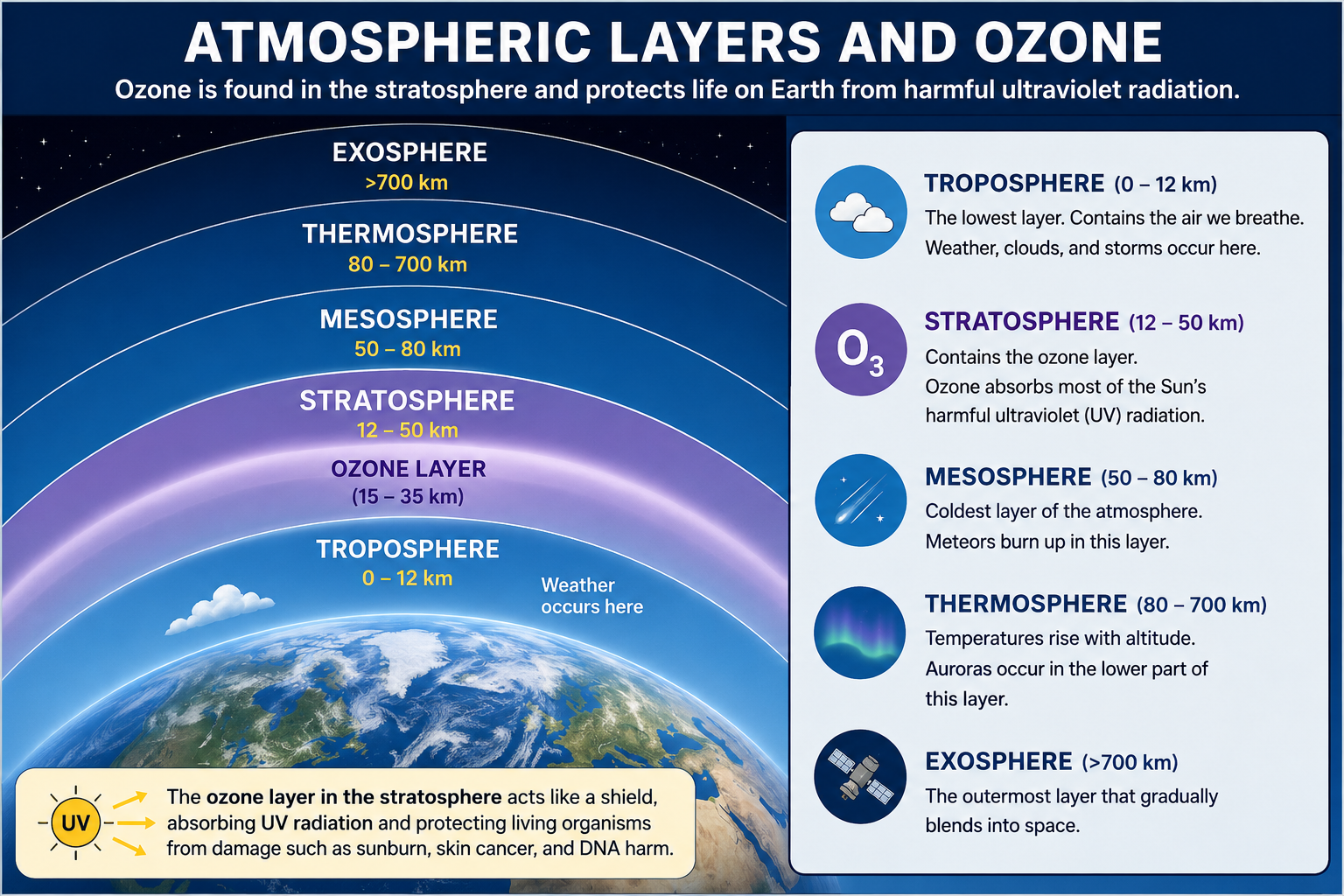
Ozone Exists in Different Parts of the Atmosphere
Ozone is not automatically beneficial simply because it is ozone. Stratospheric ozone protects life by absorbing ultraviolet radiation. Ozone near the Earth’s surface is a component of photochemical smog and can be harmful to human health and vegetation. Location matters.
Why the Ozone Layer Matters
Ozone is a molecule consisting of three oxygen atoms, written chemically as O3. Ozone molecules in the stratosphere are continually being created and destroyed through natural processes.
The importance of the ozone layer comes from its ability to absorb ultraviolet radiation from the sun. In particular, the ozone layer absorbs much of the harmful UV-B radiation that would otherwise reach the Earth’s surface.
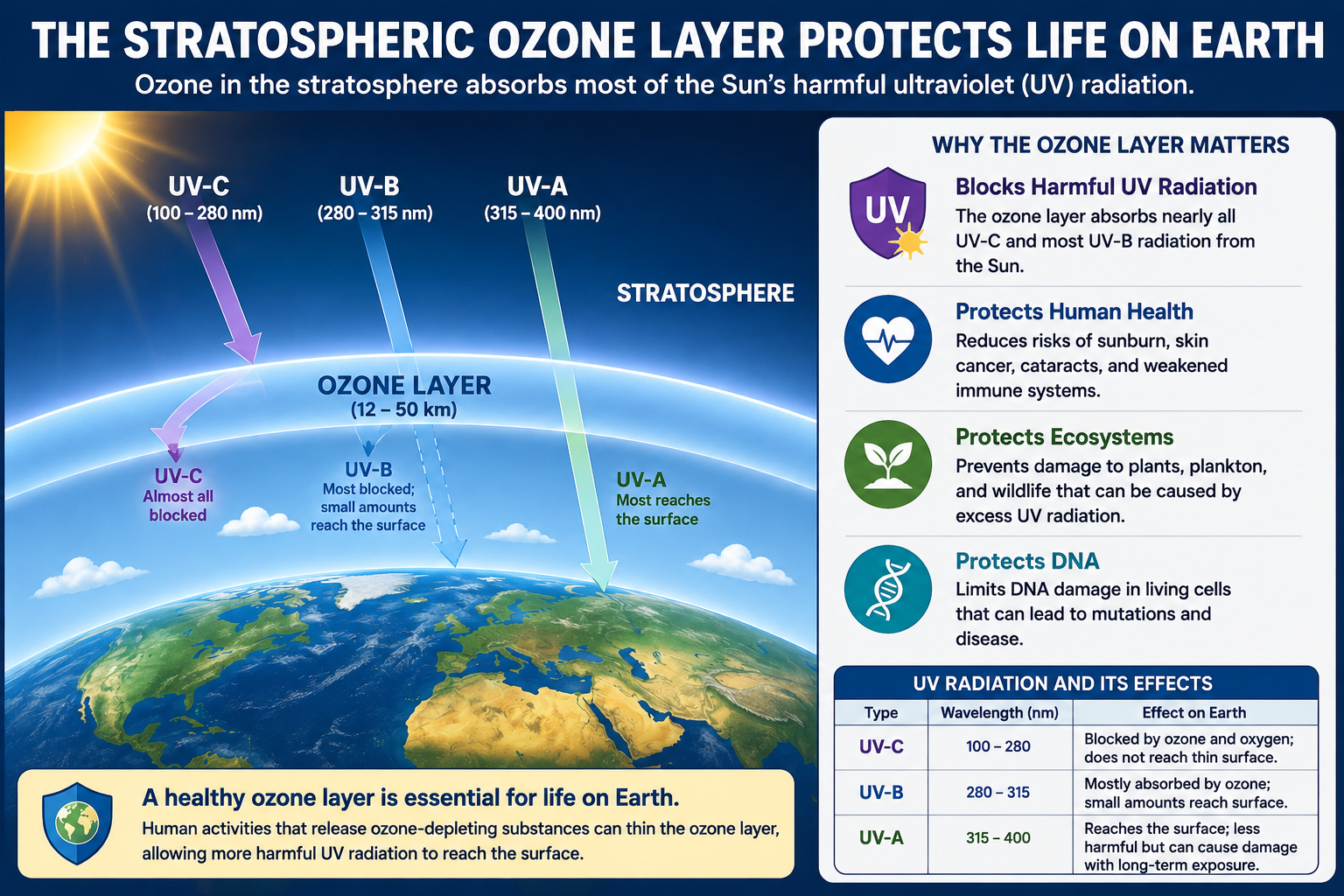
Increased UV-B exposure is associated with harmful effects including increased risk of skin cancer and cataracts and damage to crops, marine organisms, and some materials. Protecting the ozone layer therefore has consequences far beyond the refrigeration industry.
How Refrigerants Became Part of the Problem
Many early refrigerants were selected because they were stable, effective, nonflammable, and relatively easy to use. That chemical stability, however, contributed to an environmental problem that became apparent decades later.
Chlorofluorocarbons (CFCs), such as R-12, contain chlorine, fluorine, and carbon. They are sufficiently stable in the lower atmosphere that released molecules can remain intact long enough to eventually reach the stratosphere.
Hydrochlorofluorocarbons (HCFCs), such as R-22, also contain chlorine. The addition of hydrogen makes HCFCs less stable in the lower atmosphere than CFCs, so a greater portion breaks down before reaching the stratosphere. Consequently, HCFCs generally have lower ozone depletion potential than CFCs, but they are still ozone-depleting substances.
CFC Refrigerants
Example: R-12
Contain chlorine and have significant ozone depletion potential. CFCs were among the first refrigerant groups targeted for phaseout.
HCFC Refrigerants
Example: R-22
Contain chlorine but generally have lower ODP than CFCs. HCFCs were used as transitional refrigerants and were placed on a later phaseout schedule.
HFC Refrigerants
Example: R-134a
Contain no chlorine or bromine and therefore have an ODP of zero. Some HFCs, however, have substantial global warming potential, which is a different environmental issue covered in Lesson 21.
How Chlorine Destroys Ozone
When a chlorine-containing refrigerant reaches the stratosphere, intense ultraviolet radiation can break the molecule apart and release a chlorine atom. That chlorine can then participate in reactions that convert ozone into ordinary molecular oxygen.
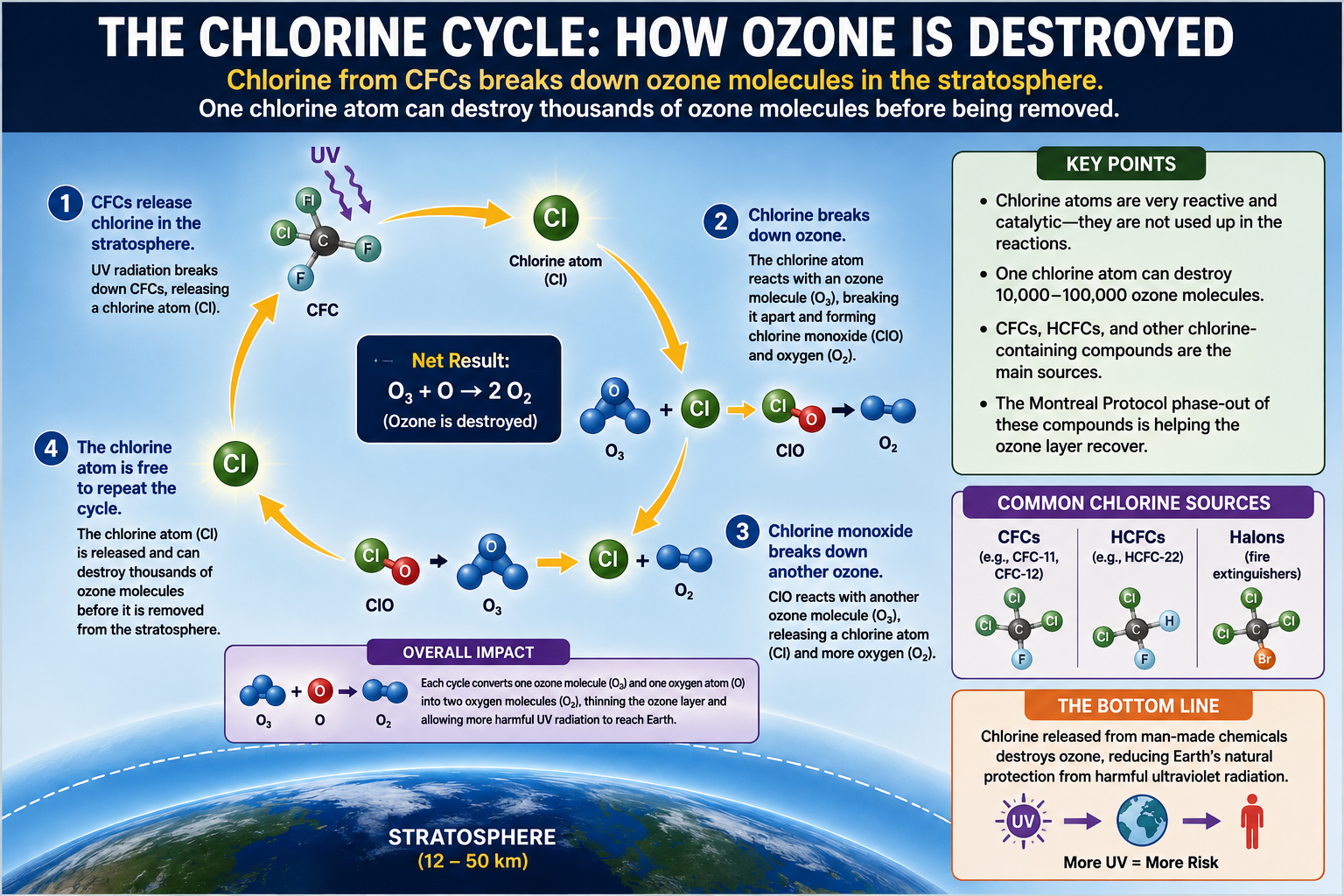
Refrigerant Is Released
A chlorine-containing ozone-depleting substance escapes into the atmosphere.
It Reaches the Stratosphere
Stable ODS molecules can survive long enough in the lower atmosphere to eventually migrate into the stratosphere.
UV Releases Chlorine
Strong ultraviolet radiation breaks the molecule apart and frees a chlorine atom.
Ozone Is Destroyed
The chlorine reacts with ozone and participates in a cycle that converts ozone into ordinary oxygen.
The chlorine atom is not necessarily consumed by a single reaction. It can be regenerated and continue participating in additional ozone-destroying reactions. EPA notes that a single chlorine atom can destroy more than 100,000 ozone molecules before eventually being removed from the stratosphere.
Why a Small Refrigerant Release Matters
A refrigerant leak does not have to occur near the ozone layer to cause a problem. Ozone-depleting substances released at ground level can remain in the atmosphere long enough to be transported into the stratosphere.
Comparing Refrigerants with ODP
Ozone Depletion Potential (ODP) is a relative measure of a substance’s ability to damage the stratospheric ozone layer. The reference substance is CFC-11, which is assigned an ODP of 1.0.
A substance with a lower ODP has less ozone-depleting effect per unit mass than the reference substance. An ODP of zero indicates that the substance is not considered to deplete stratospheric ozone.
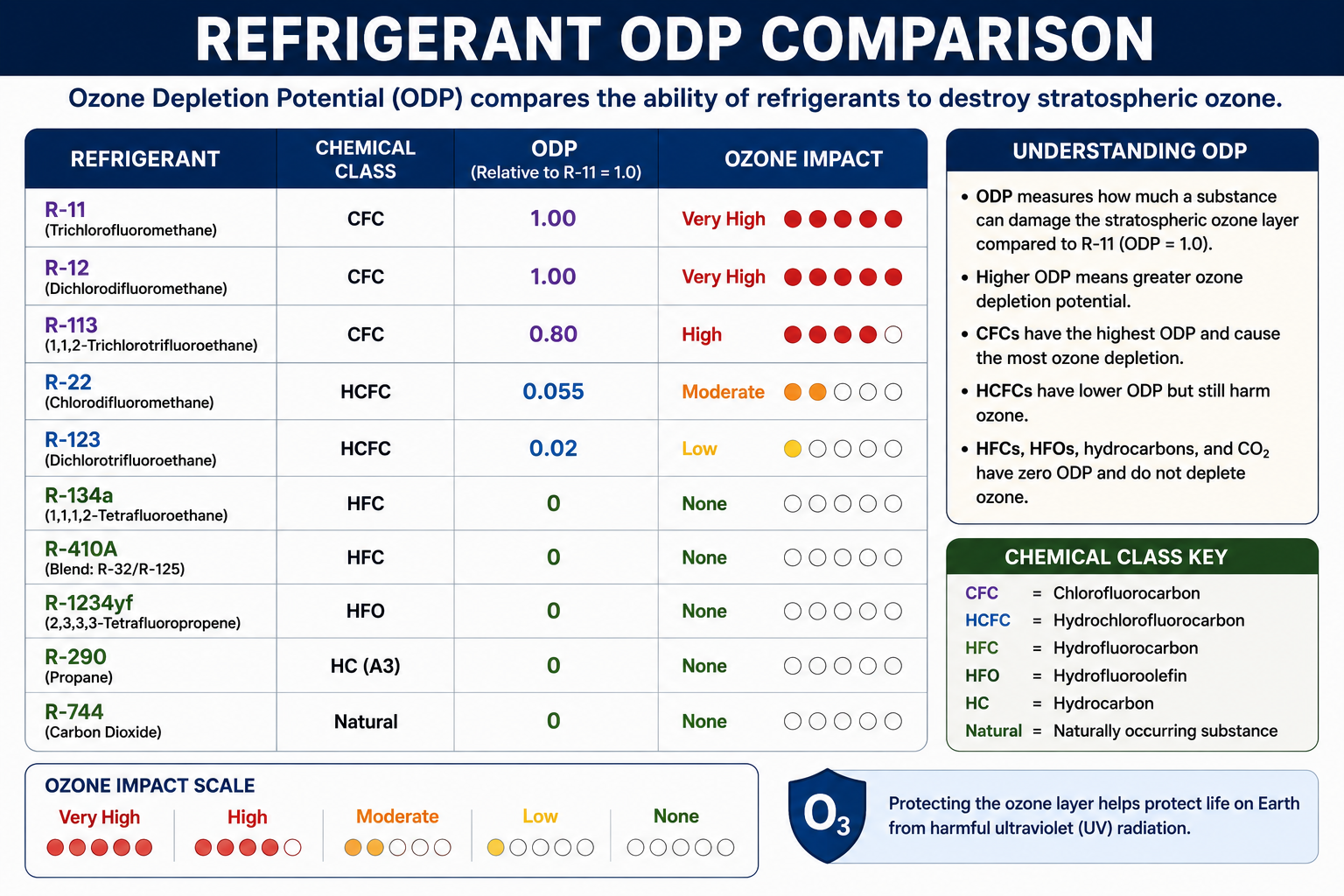
| Refrigerant / Family | Chlorine? | Typical ODP Relationship | Ozone Effect |
|---|---|---|---|
| CFCs such as R-12 | Yes | High compared with later refrigerant families | Ozone depleting |
| HCFCs such as R-22 | Yes | Lower than CFCs, but greater than zero | Ozone depleting |
| HFCs such as R-134a | No | 0 | No ozone depletion |
| HFOs | No | 0 | No ozone depletion |
| R-290, R-600a, R-717, R-744 | No | 0 | No ozone depletion |
Why CFCs and HCFCs Were Phased Out
Once the connection between chlorine-containing compounds and stratospheric ozone depletion became established, international and national policies were developed to reduce the production and consumption of ozone-depleting substances.
CFCs were targeted first because of their relatively high ozone depletion potential. HCFCs were later used as transitional replacements because they generally presented a smaller ozone-depletion threat than CFCs, but because HCFCs still contain chlorine and still have an ODP greater than zero, they were also scheduled for phaseout.
In the United States, the Clean Air Act and EPA regulations implement requirements for controlling ozone-depleting substances. The Montreal Protocol established the international framework for phasing down and phasing out controlled ozone-depleting substances.
Phaseout Does Not Mean Every Existing System Immediately Disappears
A production or import phaseout is different from an immediate prohibition on operating every existing appliance. Older equipment can remain in service under applicable rules, and recovered, recycled, or reclaimed refrigerant may continue to be important for servicing legacy equipment. This is why technicians still encounter refrigerants such as R-22.
Preventing Refrigerant Releases
The environmental history of refrigerants is directly connected to modern HVAC/R service practices. Refrigerant should be treated as a controlled working fluid rather than something that can simply be released when equipment is opened or repaired.
Section 608 of the Clean Air Act establishes requirements for technicians servicing stationary refrigeration and air-conditioning equipment. Proper recovery, recycling, leak prevention, equipment use, and refrigerant handling reduce releases of refrigerants to the atmosphere.
Prevent Leaks
Use proper installation and service procedures and repair leaks when required.
Recover Refrigerant
Use appropriate recovery procedures rather than intentionally venting refrigerant during service.
Use Low-Loss Practices
Minimize refrigerant released when connecting, disconnecting, recovering, charging, or servicing equipment.
Manage Recovered Refrigerant
Keep refrigerants properly identified and prevent contamination so they can be recycled, reclaimed, or otherwise properly managed.
What You Need to Remember
Expect the Core exam material to distinguish among CFCs, HCFCs, and HFCs and their effects on stratospheric ozone.
- CFCs contain chlorine and generally have greater ODP than HCFC refrigerants.
- HCFCs also contain chlorine and therefore still have an ODP greater than zero.
- HFCs contain no chlorine or bromine and have an ODP of zero.
- R-12 is a CFC.
- R-22 is an HCFC.
- R-134a is an HFC.
- Chlorine released in the stratosphere can repeatedly participate in reactions that destroy ozone.
- Stratospheric ozone protects the Earth by absorbing harmful ultraviolet radiation.
- ODP and GWP are not the same measurement.
Review Questions
1. Where is most atmospheric ozone concentrated?
Answer: In the stratosphere, primarily about 15 to 30 kilometers (9 to 18 miles) above the Earth’s surface.
2. Why is stratospheric ozone important?
Answer: It absorbs a significant portion of harmful ultraviolet radiation, particularly UV-B, before that radiation reaches the Earth’s surface.
3. Why can CFC refrigerants damage the ozone layer?
Answer: CFCs contain chlorine. When CFC molecules reach the stratosphere, ultraviolet radiation can release chlorine atoms that participate in reactions that destroy ozone.
4. Does R-22 have zero ODP?
Answer: No. R-22 is an HCFC and contains chlorine. Its ODP is lower than that of many CFCs, but it is greater than zero.
5. Does an ODP of zero mean a refrigerant has no environmental impact?
Answer: No. ODP addresses ozone depletion only. A refrigerant with zero ODP may still have significant global warming potential or other environmental, safety, or application considerations.
Lesson 20 Summary
- Most atmospheric ozone is concentrated in the stratosphere.
- Stratospheric ozone absorbs harmful ultraviolet radiation and helps protect life at the Earth’s surface.
- CFC and HCFC refrigerants contain chlorine and can contribute to stratospheric ozone depletion.
- Ultraviolet radiation can break down ozone-depleting substances in the stratosphere and release chlorine.
- A chlorine atom can participate repeatedly in ozone-destroying reactions.
- Ozone Depletion Potential compares the relative ozone-depleting effect of substances using CFC-11 as the reference at ODP 1.0.
- CFCs generally have higher ODP than HCFCs.
- HFCs, HFOs, hydrocarbons, ammonia, and carbon dioxide do not contain chlorine or bromine and have zero ODP.
- ODP and GWP measure different environmental effects.
- The environmental effects of chlorine-containing refrigerants led to international and U.S. controls and the transition away from CFCs and HCFCs.
- Proper refrigerant recovery and service practices help prevent refrigerant releases to the atmosphere.