Comparing Common Refrigerants
No single refrigerant characteristic tells a technician everything needed to service a refrigeration system safely and correctly. Refrigerants differ in chemical family, safety classification, operating pressure, environmental impact, lubricant compatibility, temperature glide, application, and required service procedures.
This lesson brings together the refrigerants studied throughout Part II. Rather than introducing another refrigerant, we will compare the major refrigerants side by side and develop a systematic approach for identifying an unfamiliar system before connecting gauges, opening the refrigeration circuit, adding refrigerant, or beginning a repair.
What You Will Learn
After completing this lesson, you should be able to:
Compare Refrigerant Families
Distinguish among CFC, HCFC, HFC, HFO, hydrocarbon, ammonia, and carbon dioxide refrigerants.
Compare Safety Classifications
Recognize the importance of A1, A2L, A3, and B2L refrigerant safety classifications.
Compare Operating Pressures
Understand why pressure characteristics affect equipment construction, service tools, diagnosis, and technician safety.
Compare Environmental Characteristics
Distinguish ozone depletion potential from global warming potential and recognize the major refrigerant transitions.
Compare Lubricant Requirements
Recognize that refrigerant identification alone may not determine the correct compressor lubricant.
Make Safe Service Decisions
Use refrigerant identification, equipment information, safety classification, pressure rating, and manufacturer requirements before beginning service.
Refrigerants Are a Collection of Tradeoffs
Throughout Part II, we have seen that there is no single refrigerant that is ideal for every refrigeration application.
A refrigerant may have excellent thermodynamic properties but unacceptable environmental characteristics. Another may have extremely low GWP but introduce flammability. Another may provide excellent industrial performance but present significant toxicity or material-compatibility concerns. Still another may be nonflammable and environmentally attractive but operate at extremely high pressure.
Refrigerant selection is always a balance among performance, environmental impact, safety, pressure, equipment design, materials, cost, application, and serviceability.
Putting the Major Refrigerants Side by Side
The refrigerants studied in Part II represent several generations of refrigeration technology and a wide range of applications.
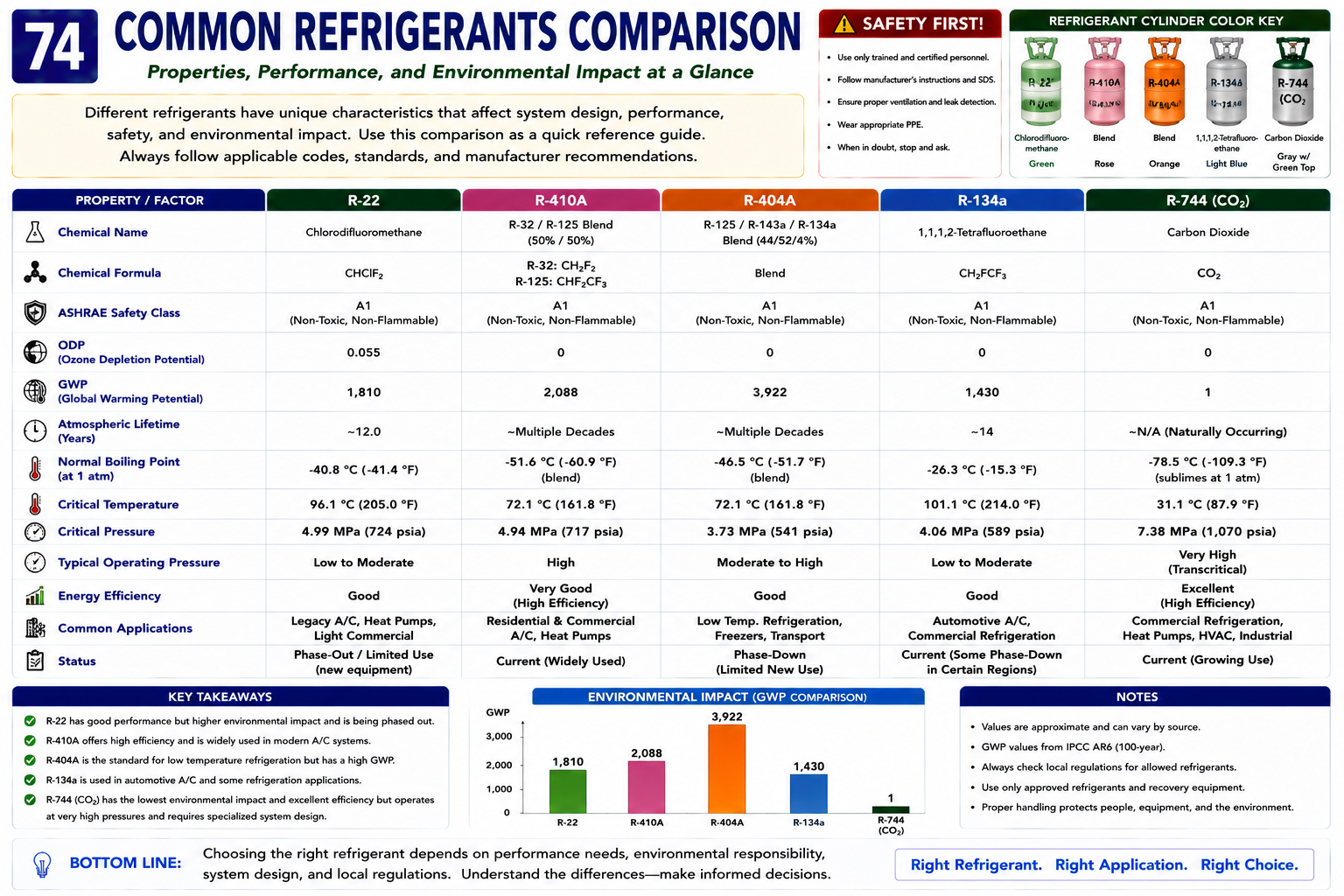
| Refrigerant | Family / Type | Safety Class | Common Association |
|---|---|---|---|
| R-12 | CFC | A1 | Legacy refrigeration and air conditioning |
| R-22 | HCFC | A1 | Legacy residential/light-commercial HVAC and refrigeration |
| R-134a | HFC | A1 | Refrigeration, chillers, and legacy MVAC |
| R-404A / R-507A | HFC blends | A1 | Commercial low- and medium-temperature refrigeration |
| R-407C | HFC blend | A1 | Air conditioning and R-22 transition applications |
| R-410A | HFC blend | A1 | Residential and light-commercial air conditioning |
| R-32 | HFC | A2L | Modern air conditioning and blend component |
| R-454B | HFC/HFO blend | A2L | Newer residential/light-commercial air conditioning |
| R-1234yf / R-1234ze(E) | HFO | A2L | Low-GWP refrigeration, air conditioning, chillers, and blends |
| R-290 / R-600a | Hydrocarbon | A3 | Self-contained commercial and household refrigeration |
| R-717 | Ammonia | B2L | Industrial refrigeration |
| R-744 | Carbon dioxide | A1 | Commercial and industrial CO₂ refrigeration |
The Refrigerant Number Does Not Tell You the Hazard
Before servicing equipment, the technician must know more than the refrigerant designation. The refrigerant’s safety classification identifies important toxicity and flammability characteristics.
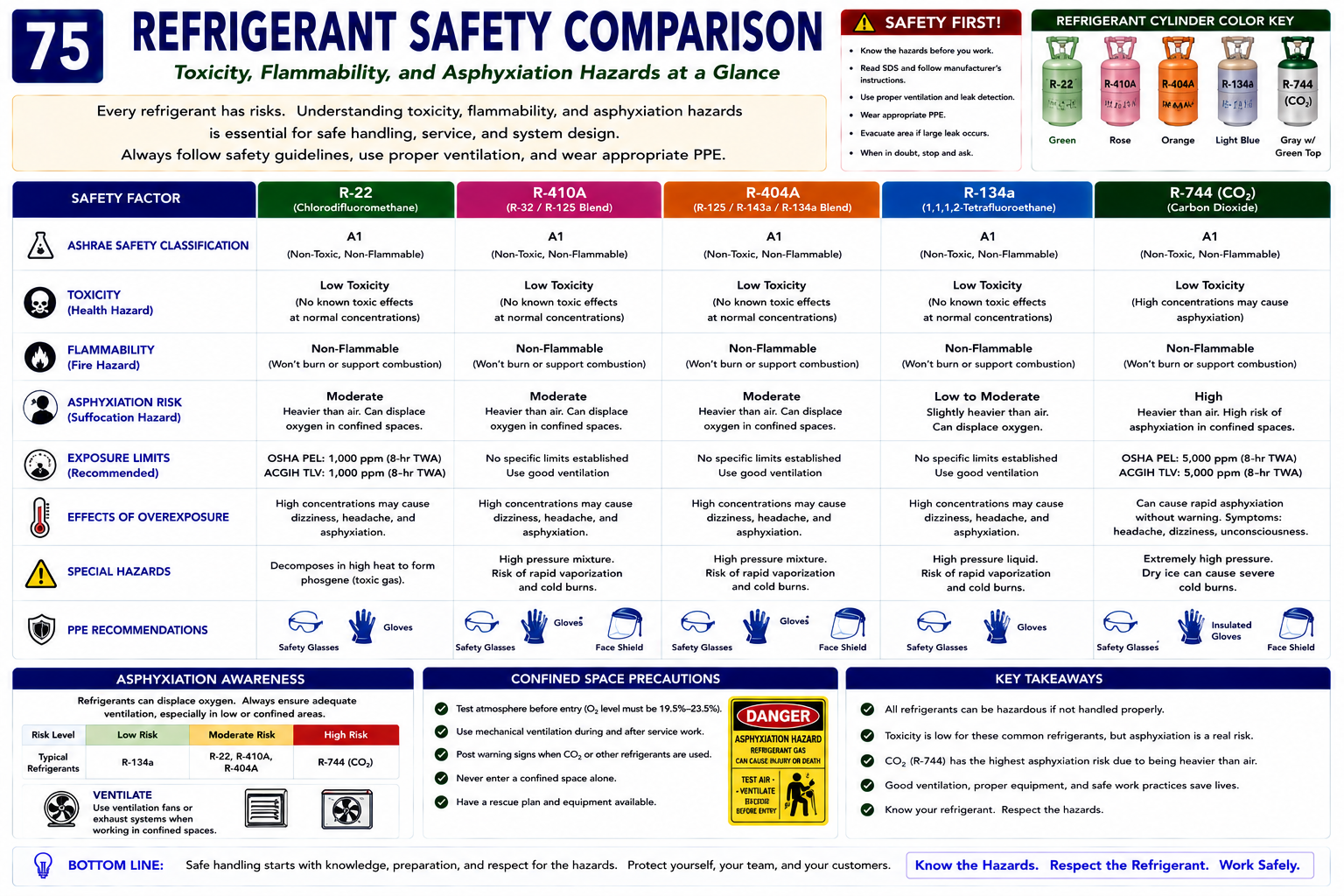
| Classification | General Characteristic | Examples | Major Service Concern |
|---|---|---|---|
| A1 | Lower toxicity, no flame propagation under classification test conditions | R-134a, R-404A, R-407C, R-410A, R-744 | Pressure, displacement of air, cold injury, refrigerant-specific hazards |
| A2L | Lower toxicity, lower flammability with low burning velocity | R-32, R-454B, R-1234yf, R-1234ze(E) | Ignition control, ventilation, compatible tools and procedures |
| A3 | Lower toxicity, higher flammability | R-290, R-600a | Strong ignition control, charge limitations, specialized procedures |
| B2L | Higher toxicity, lower flammability | R-717 ammonia | Toxic exposure, chemical burns, ventilation, emergency response |
A1 does not mean harmless, A2L does not mean highly flammable, and A3 does not mean the refrigerant cannot be used safely. The classification identifies hazards that must be addressed through equipment design and proper service procedures.
Pressure Characteristics Vary Dramatically
Technicians sometimes describe refrigerants as low-pressure or high-pressure refrigerants, but actual system pressure depends on refrigerant temperature, system design, operating condition, and where the measurement is taken.
The most important service lesson is that refrigerants can operate in very different pressure ranges. Tools and components must be selected accordingly.
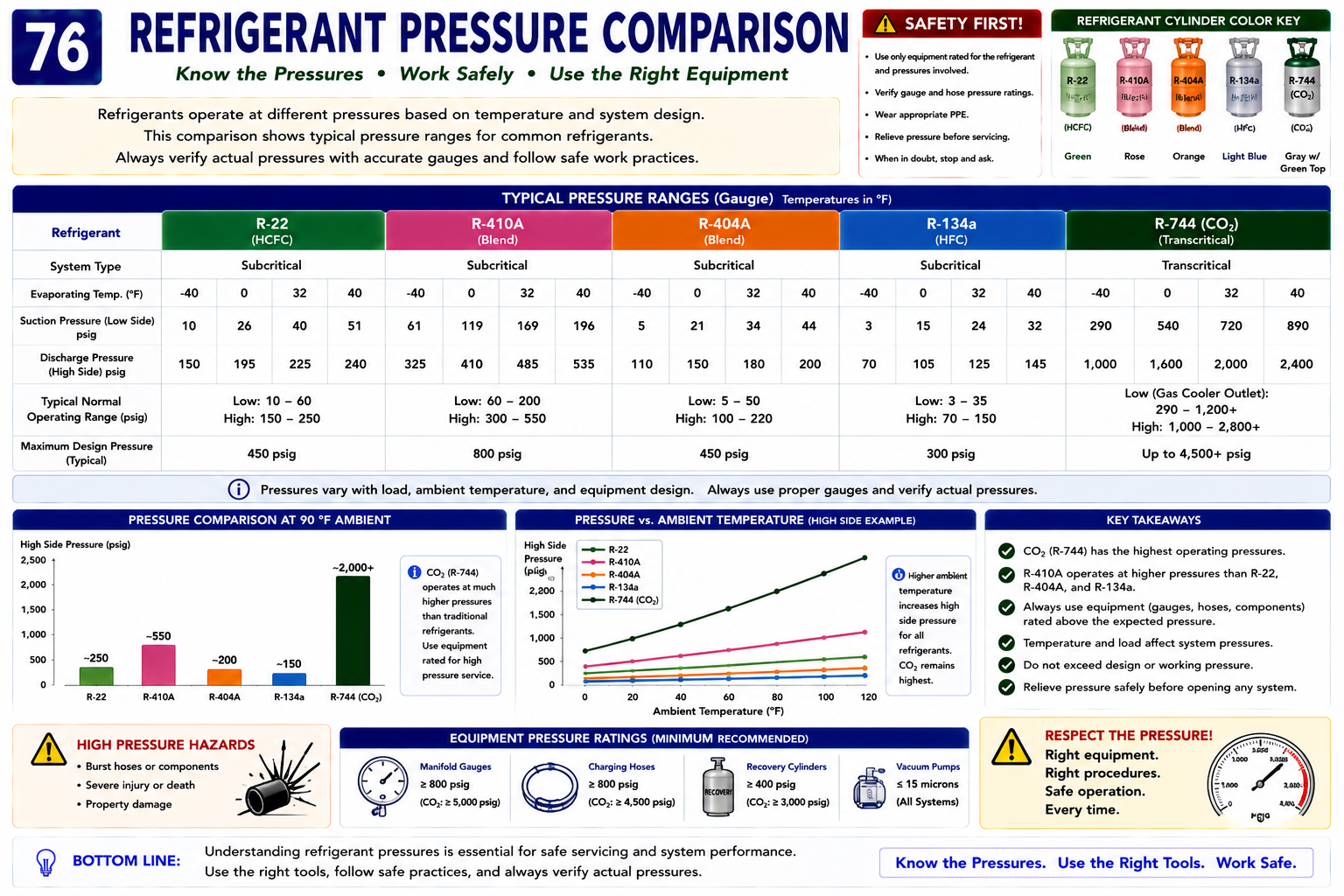
Never memorize a single pressure and call it the normal pressure for a refrigerant. Saturation pressure changes with temperature, and operating pressures also depend on load and system conditions.
Higher Pressure Requires Appropriately Rated Equipment
The transition from R-22 to R-410A demonstrated why service tools cannot automatically be transferred from one refrigerant to another. R-410A operates at substantially higher pressures than R-22, requiring suitable gauges, hoses, recovery equipment, and components.
R-744 takes this requirement much further. Transcritical CO₂ equipment can operate at pressures far beyond those encountered in conventional comfort-cooling systems.
Before connecting any pressure-containing service tool, verify that its working-pressure rating is appropriate for the refrigerant and the portion of the system being serviced.
ODP and GWP Measure Different Environmental Effects
Ozone depletion potential measures a substance’s potential contribution to destruction of stratospheric ozone. Global warming potential compares the climate effect of a greenhouse gas with carbon dioxide over a specified time period.
The transition from one refrigerant generation to another has therefore addressed different environmental concerns.
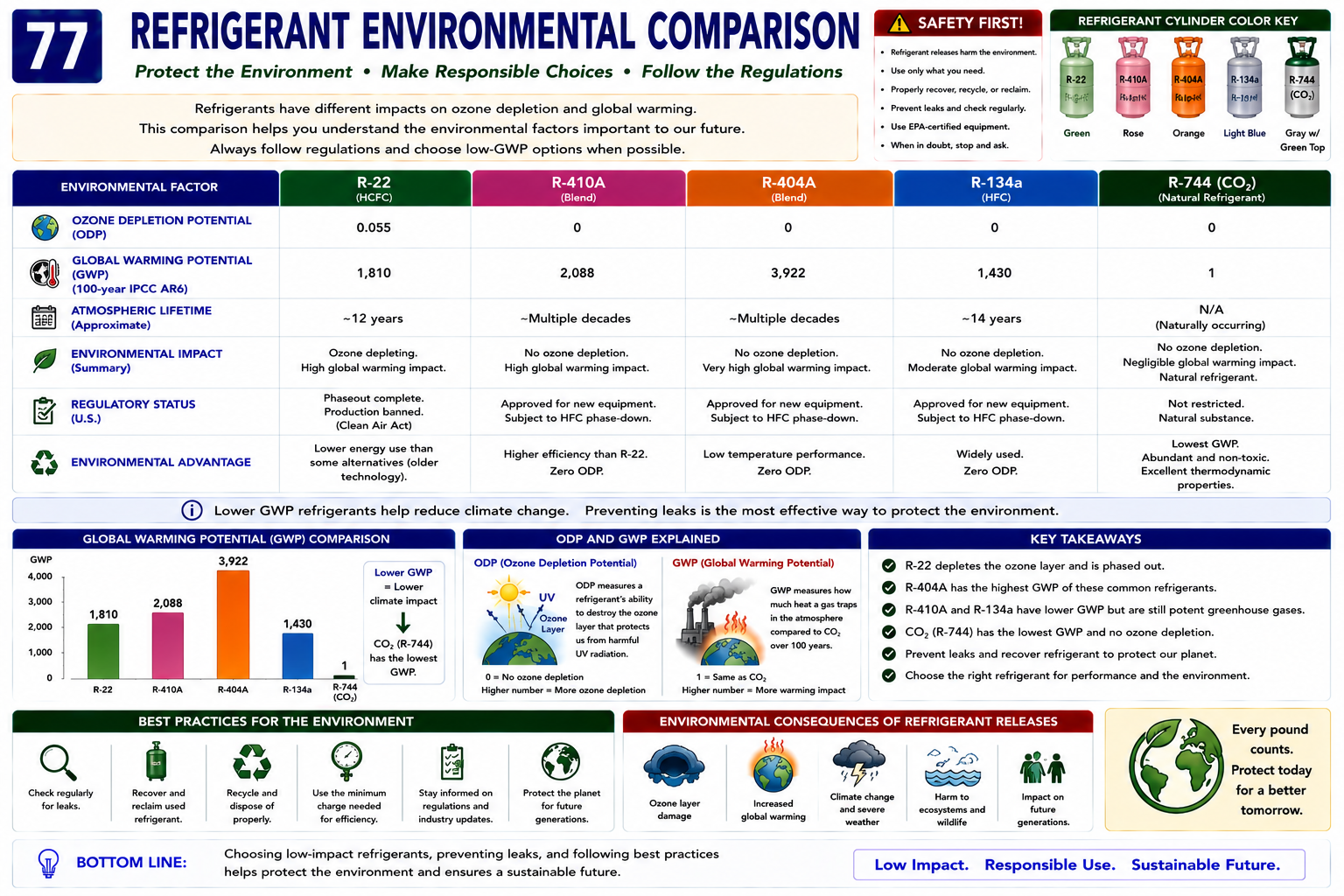
CFCs
High ozone-depletion concern led to phaseout.
HCFCs
Lower but still significant ozone impact made them transitional refrigerants.
HFCs
Eliminated ozone depletion but several widely used HFCs and HFC blends have high GWP.
Lower-GWP Refrigerants
HFOs, lower-GWP blends, hydrocarbons, ammonia, and CO₂ reduce direct climate impact but introduce other design and safety considerations.
The Numbers Differ by Orders of Magnitude
Current EPA Technology Transitions reference values illustrate how dramatically refrigerant GWP can vary.
| Refrigerant | EPA Reference GWP | General Perspective |
|---|---|---|
| R-404A | 3,922 | Very high |
| R-507A | 3,985 | Very high |
| R-410A | 2,088 | High |
| R-407C | 1,774 | High |
| R-134a | 1,430 | High |
| R-32 | 675 | Lower than many legacy HFCs, but still an HFC |
| R-454B | 465 | Substantially below R-410A |
| R-290 | 3.3 | Very low |
| R-1234yf | 1 | Very low |
| R-1234ze(E) | 1 | Very low |
| R-600a | 1 | Very low |
| R-717 | 1 | Very low |
| R-744 | 1 | Reference gas |
Published GWP values can differ because regulatory programs and references may use different scientific assessment reports or calculation methods. When a regulatory limit depends on GWP, use the value specified by the applicable regulation rather than substituting a value from another table.
Environmental and Safety Characteristics Must Be Evaluated Separately
Some of the refrigerants with the lowest GWP values studied in Part II also require some of the greatest changes in service practice.
R-290
Extremely low GWP, but A3 higher flammability.
R-600a
Extremely low GWP, but A3 higher flammability.
R-717
Extremely low direct climate impact, but higher toxicity and B2L classification.
R-744
GWP 1 and A1, but extremely high pressure and unique phase behavior.
Environmental impact, toxicity, flammability, and operating pressure are separate refrigerant characteristics.
Composition Changes Service Procedures
A technician should determine whether the refrigerant is a single-component refrigerant, an azeotropic or near-azeotropic blend, or a zeotropic blend.
| Type | Examples | Service Significance |
|---|---|---|
| Single Component | R-22, R-32, R-134a, R-290, R-600a, R-717, R-744 | One saturation temperature at a given saturation pressure. |
| Near-Azeotropic Blend | R-410A | Very small temperature glide in ordinary service. |
| Zeotropic Blend | R-407C, R-454B | Bubble and dew temperatures must be considered; liquid charging is normally required. |
For a zeotropic blend, use the correct bubble or dew value for the measurement being made and charge the refrigerant according to the manufacturer’s specified procedure.
Glide Matters During Diagnosis
Zeotropic refrigerant blends change temperature as they evaporate or condense at essentially constant pressure. This difference between bubble-point and dew-point temperatures is called temperature glide.
Using the wrong saturation temperature can produce an incorrect superheat or subcooling calculation.
Superheat
For a zeotropic blend, the dew-point temperature is generally used when evaluating evaporator outlet superheat.
Subcooling
For a zeotropic blend, the bubble-point temperature is generally used when evaluating condenser outlet subcooling.
The Refrigerant and Compressor Must Work With the Oil
Lubricant compatibility is an essential part of refrigeration-system design. The oil must lubricate the compressor while also behaving appropriately with the refrigerant throughout the system.
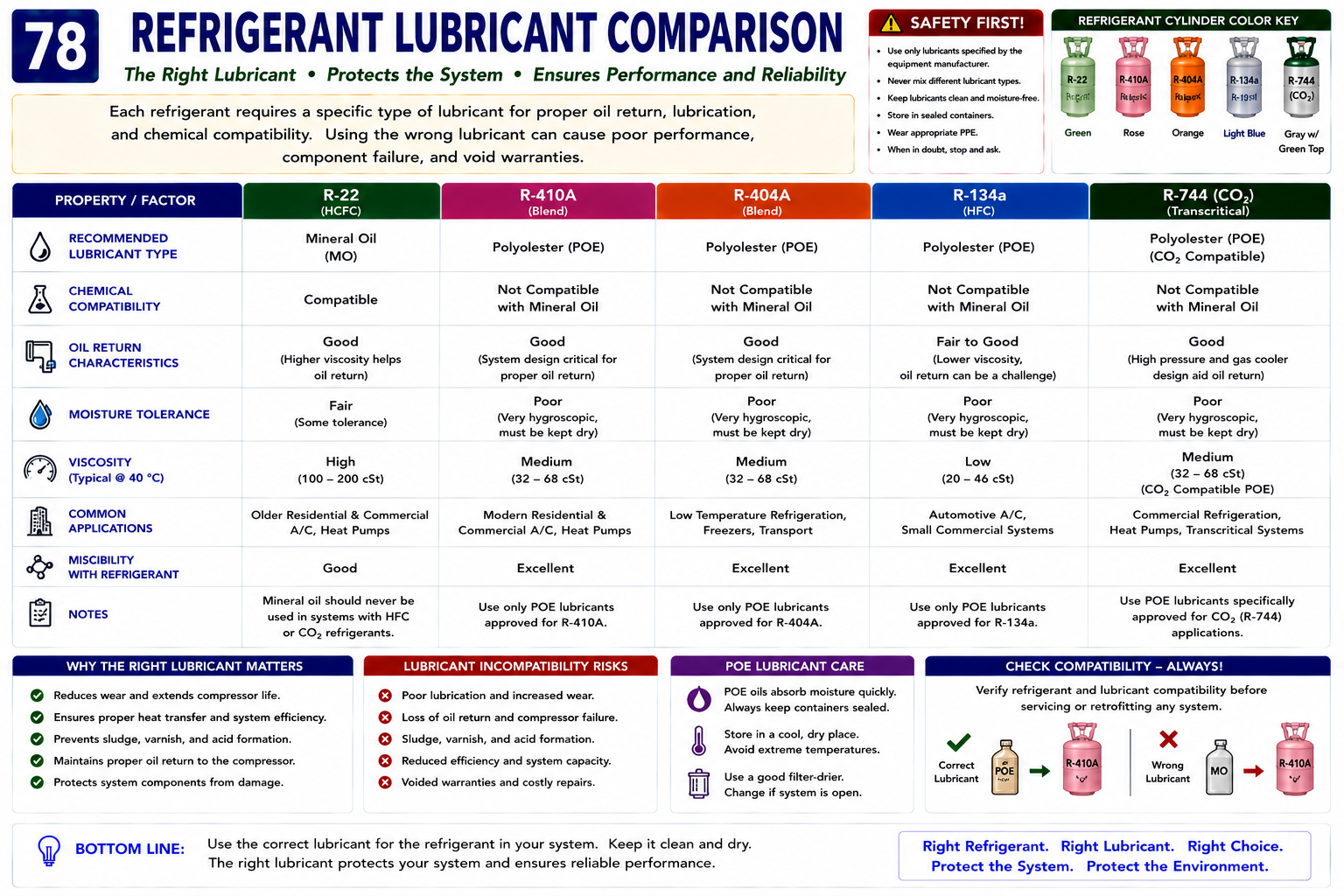
| Refrigerant / Family | Lubricant Commonly Encountered | Important Note |
|---|---|---|
| Legacy R-12 / R-22 systems | Mineral oil or other equipment-specific lubricant | Depends on equipment and retrofit history. |
| Many HFC systems | POE | POE is highly hygroscopic. |
| R-410A systems | Commonly POE | Use compressor manufacturer’s specified oil. |
| R-32 / R-454B systems | Equipment-specific synthetic lubricant | Do not assume all A2L systems use identical oil. |
| R-1234yf | Application-specific | Automotive and stationary systems may have different lubricant requirements. |
| R-290 / R-600a | Equipment-specific | Several lubricant types may be compatible depending on compressor design. |
| R-717 | Ammonia-system-specific lubricant | Oil behavior and separation are important system-design considerations. |
| R-744 | POE, PAG, PVE, or other specified lubricant | CO₂ systems are highly equipment-specific. |
Never choose compressor oil from a generic refrigerant chart when the equipment manufacturer’s lubricant specification is available.
The Nameplate Comes Before the Gauges
One of the most important habits a technician can develop is identifying the refrigerant before beginning refrigeration-system service.
Equipment appearance is not reliable. Two nearly identical condensing units may use refrigerants with different pressures, safety classifications, lubricants, fittings, tools, and service procedures.
Read the Nameplate
Identify the refrigerant and factory charge.
Check Service Labels
Determine whether the system has been retrofitted or otherwise modified.
Identify Safety Class
Determine whether flammability, toxicity, or unusual pressure hazards affect the service procedure.
Verify Tools and Procedure
Confirm pressure ratings, refrigerant compatibility, recovery equipment, leak detector, charging method, and manufacturer instructions.
Stop and Identify Before You Connect
A systematic decision process helps prevent many of the most serious refrigerant service errors.
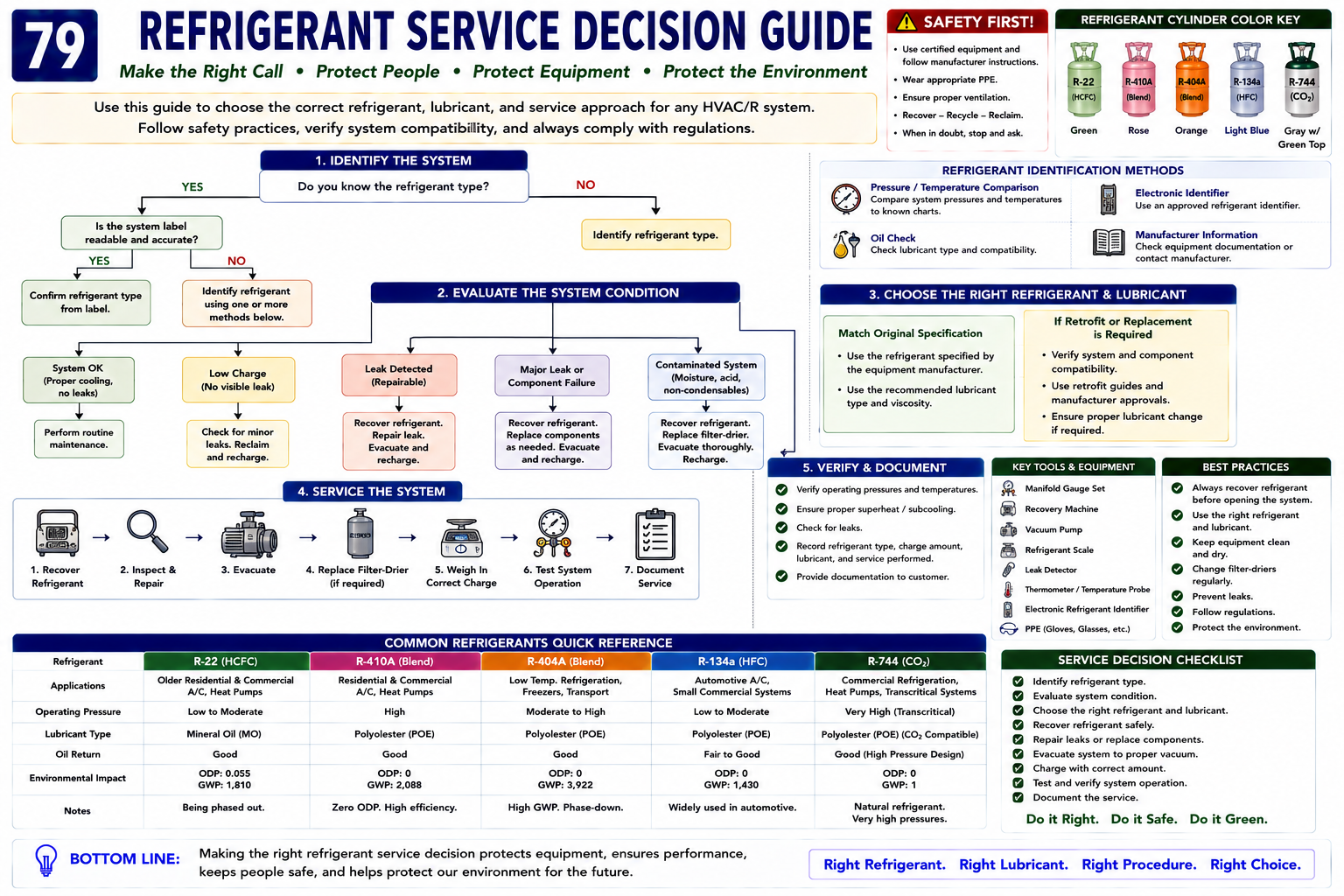
Before asking “What should the pressure be?” first ask “What refrigerant is in this equipment?”
Identify the Refrigerant
Read the equipment nameplate and service labels. Do not identify refrigerant solely from fitting size, equipment age, compressor model, cylinder color, or expected pressure.
If system history creates reasonable doubt about refrigerant identity, treat the refrigerant as unknown until it can be properly identified. Do not contaminate known refrigerant or recovery cylinders with an unidentified refrigerant mixture.
Determine the Safety Classification
Knowing whether the refrigerant is A1, A2L, A3, B2L, or another classification affects work-area preparation and service procedures.
A1
Still evaluate pressure, ventilation, cold injury, and refrigerant-specific hazards.
A2L
Add lower-flammability precautions, ignition-source control, and compatible service equipment.
A3
Higher flammability requires particularly careful ignition control and hydrocarbon-specific procedures.
B2L
Higher toxicity makes exposure control, detection, ventilation, PPE, and emergency procedures especially important.
Verify Pressure Ratings
Determine the expected system pressures and verify that gauges, hoses, recovery equipment, valves, fittings, and other service equipment are appropriately rated.
A tool that is safe on R-22 may not be suitable for R-410A. A tool suitable for R-410A may be completely inappropriate for high-pressure R-744 service.
Determine Whether the Refrigerant Is a Blend
If the refrigerant is a zeotropic blend, identify the correct bubble- and dew-point information and follow the specified charging procedure.
This is particularly important with refrigerants such as R-407C and R-454B.
Verify the Lubricant
Do not assume that refrigerant identity alone determines the oil. Check the compressor and equipment manufacturer’s lubricant specification, particularly when equipment has been retrofitted or repaired.
Check the Manufacturer’s Service Information
Modern refrigeration equipment may have refrigerant-specific procedures for recovery, evacuation, charging, leak testing, brazing, component replacement, software configuration, and commissioning.
Technical documentation is not a substitute for technician knowledge. It is part of professional technician knowledge.
Prepare the Work Area
Evaluate ventilation, ignition sources, refrigerant accumulation, access, electrical hazards, pressure hazards, hot work, and any special procedures required for the refrigerant.
The correct work-area preparation for R-410A may be very different from that required for R-290, R-717, or R-744.
Then Begin Diagnosis
Only after the refrigerant, equipment, safety requirements, and service tools have been identified should the technician begin interpreting system pressures and temperatures.
A pressure reading without refrigerant identity and refrigerant temperature has limited diagnostic value.
Do Not Depend on Cylinder Color Alone
Historically, refrigerant cylinders were often associated with particular refrigerant colors. Modern industry practice has moved toward standardized cylinder appearance rather than assigning a unique cylinder color to every refrigerant.
Technicians should therefore identify refrigerant from the cylinder label and markings, not from color alone.
Read the cylinder label. Never assume the contents of a refrigerant cylinder solely from its paint color.
Keep Refrigerants Identifiable
Adding one refrigerant to a system containing another does not create a legitimate replacement refrigerant. It creates an uncontrolled mixture with uncertain pressure-temperature characteristics, lubricant behavior, capacity, flammability, and recovery requirements.
Never mix refrigerants in a refrigeration system or recovery cylinder unless the mixture is an established manufactured refrigerant blend being handled according to its specifications.
A Refrigerant Retrofit Is an Engineering Procedure
A legitimate retrofit may require more than recovering one refrigerant and charging another. Depending on the equipment and replacement refrigerant, a retrofit can involve lubricant changes, seals, metering devices, controls, pressure settings, labels, filter driers, charging procedures, and performance verification.
“Drop-in replacement” should never be interpreted as permission to ignore the replacement refrigerant manufacturer’s retrofit instructions or the original equipment requirements.
Refrigerant Acceptability Depends on the End Use
EPA’s Significant New Alternatives Policy program evaluates substitutes for specific end uses. A refrigerant may be acceptable in one refrigeration application, acceptable with use conditions in another, or unacceptable in another.
This is especially important with flammable refrigerants, where equipment design, charge quantity, installation requirements, and applicable safety standards can be part of the use conditions.
Do not ask only “Is this refrigerant SNAP approved?” Ask “What is its current SNAP status for this specific end use, and what use conditions apply?”
Technicians Will Service Multiple Generations for Years
New lower-GWP refrigerants do not make older equipment disappear. Technicians will continue encountering R-22 systems, R-134a equipment, R-404A refrigeration, R-410A air conditioning, newer A2L systems, hydrocarbons, ammonia, CO₂, and other refrigerants throughout their careers.
Professional competence therefore requires understanding both legacy and current refrigerants rather than learning only the newest refrigerant entering the market.
The technician’s job is not to memorize one refrigerant. It is to know how to identify the refrigerant and determine the correct information and procedures for the system being serviced.
The Refrigerants You Should Recognize
R-12 and R-22
Legacy chlorine-containing refrigerants important for understanding ozone depletion and refrigerant phaseout.
R-134a
A1 HFC used extensively in refrigeration, chillers, and legacy automotive applications.
R-404A and R-507A
High-GWP A1 refrigerants historically important in commercial refrigeration.
R-407C
A1 zeotropic HFC blend with significant temperature glide.
R-410A
High-pressure A1 HFC blend widely used in residential and light-commercial air conditioning.
R-32
Single-component A2L HFC with lower GWP than R-410A and important use in modern air conditioning and blends.
R-454B
A2L zeotropic R-32/R-1234yf blend used as a lower-GWP alternative in new air-conditioning equipment.
R-1234yf and R-1234ze(E)
A2L HFO refrigerants with extremely low GWP.
R-290 and R-600a
A3 hydrocarbon refrigerants with extremely low GWP and significant flammability considerations.
R-717
B2L ammonia refrigerant with excellent industrial performance and important toxicity and material-compatibility considerations.
R-744
A1 carbon dioxide refrigerant with GWP 1, extremely high operating pressure, and subcritical/transcritical operating characteristics.
Part II Comprehensive Review
- What two major environmental measurements are commonly used when comparing refrigerants?
- What is the difference between ODP and GWP?
- Which refrigerant family includes R-22?
- Which refrigerant family includes R-134a?
- Which safety classification applies to R-410A?
- Which safety classification applies to R-32 and R-454B?
- Which safety classification applies to R-290 and R-600a?
- Which refrigerant studied in Part II is classified B2L?
- What refrigerant is designated R-744?
- Why does R-744 require service tools designed for unusually high pressure?
- Which refrigerants studied in Part II are important examples of HFO refrigerants?
- What is temperature glide?
- Which saturation value is generally used for superheat with a zeotropic blend?
- Which saturation value is generally used for subcooling with a zeotropic blend?
- Why should refrigerant cylinder color not be used as the sole method of refrigerant identification?
- Why should refrigerants not be mixed in a system or recovery cylinder?
- Does a low GWP automatically mean a refrigerant presents little service hazard?
- Why should the equipment nameplate be checked before gauges are connected?
- Why must the lubricant specification be verified rather than assumed?
- What should a technician determine before beginning service on an unfamiliar refrigeration system?
Part II — Refrigerant Profiles
Refrigerants Are Different
Refrigerant number, chemical family, pressure, environmental characteristics, safety classification, and application all matter.
Safety Classification Matters
A1, A2L, A3, and B2L refrigerants require different hazard assessments and service procedures.
Pressure Matters
Service equipment must be appropriately rated for the refrigerant and the portion of the system being serviced.
Composition Matters
Single-component refrigerants and zeotropic blends require different interpretation of saturation temperatures and charging practices.
Environmental Measures Are Separate
ODP and GWP describe different environmental effects and should not be confused.
Lubricant Matters
The correct oil is determined by the equipment and compressor requirements, not by assumption.
Application Matters
A refrigerant suitable for one application may be inappropriate or prohibited in another.
Identification Comes First
Safe professional service begins by identifying the refrigerant and understanding the equipment before connecting tools or opening the system.