Superheat and Subcooling
Superheat and subcooling describe how far refrigerant temperature has moved away from saturation after a phase change is complete. These two measurements are among the most useful tools in refrigeration service because they help describe the actual condition of refrigerant inside the system.
Superheat applies to vapor that has been heated above its saturation temperature. Subcooling applies to liquid that has been cooled below its saturation temperature. Both require a pressure measurement, a saturation temperature, and an actual line-temperature measurement.
What You Will Learn
By the end of this lesson you should be able to:
Define superheat.
Explain the difference between saturation temperature and actual vapor temperature.
Define subcooling.
Explain the difference between saturation temperature and actual liquid temperature.
Calculate superheat.
Use actual vapor temperature and the correct vapor-side saturation temperature.
Calculate subcooling.
Use the correct liquid-side saturation temperature and actual liquid temperature.
Distinguish evaporator and total superheat.
Recognize that superheat depends on where the temperature is measured.
Apply bubble and dew references.
Use dew point for superheat and bubble point for subcooling when separate values apply.
Moving Away From Saturation
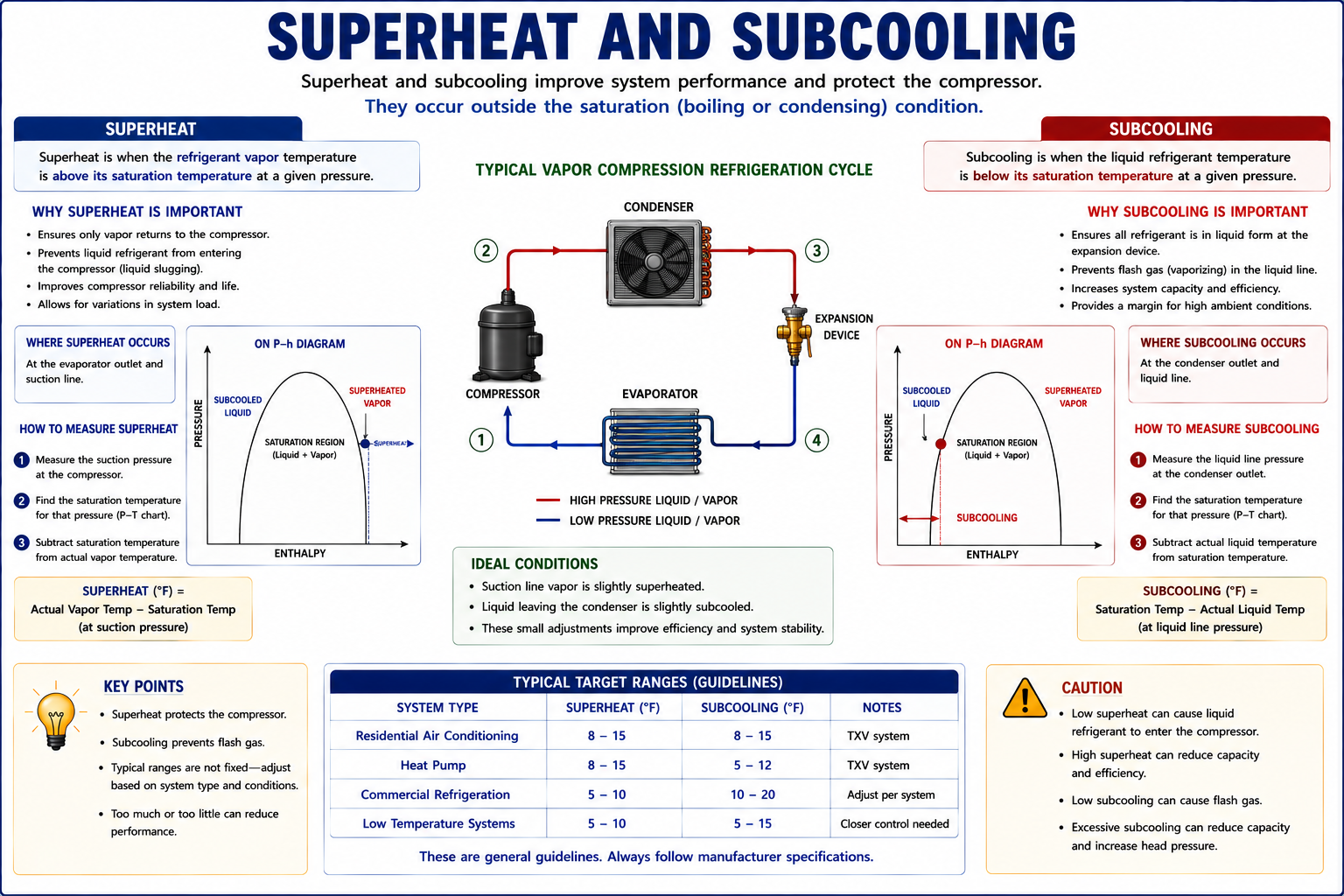
Vapor Above Saturation
Once all liquid refrigerant has vaporized, additional heat raises the vapor temperature above its saturation temperature.
Liquid Below Saturation
Once all vapor has condensed into liquid, additional heat removal lowers the liquid temperature below its saturation temperature.
Superheat begins only after the last liquid has vaporized. Subcooling begins only after the last vapor has condensed into liquid.
Heating Vapor Above Saturation Temperature
At saturation, refrigerant may contain both liquid and vapor. Once all liquid has evaporated, further heat transfer can raise the temperature of the vapor without changing its state.
Liquid and vapor are both present.
The last liquid has just evaporated.
Additional heat raises vapor temperature above saturation.
Positive superheat indicates that the refrigerant at the measurement point is above its vapor-side saturation temperature.
Actual Vapor Temperature Minus Saturation Temperature
Suction pressure corresponds to a saturation temperature of 40°F. The suction-line temperature at the same location is 52°F.
Superheat = 52°F − 40°F
For an accurate superheat calculation, the pressure used to determine saturation temperature should represent refrigerant pressure at or very near the temperature-measurement point.
Superheat at the Evaporator Outlet
Evaporator superheat is measured near the evaporator outlet and indicates how much the refrigerant vapor has been heated above saturation before leaving the evaporator.
Refrigerant typically enters as a low-pressure mixture of liquid and vapor.
Liquid refrigerant absorbs latent heat and boils.
Vapor leaves with measurable evaporator superheat.
Do not assume one universal evaporator-superheat value for every system. Metering-device type, load, manufacturer specifications, and operating conditions all matter.
Superheat at the Compressor Inlet
Refrigerant vapor can gain additional sensible heat while traveling through the suction line between the evaporator and compressor.
Evaporator Superheat
Measured near the evaporator outlet.
Suction-Line Heat Gain
Additional heat absorbed between the evaporator and compressor.
Total Superheat
Measured near the compressor inlet.
Evaporator superheat and total superheat are not automatically the same measurement. Always know where the temperature and pressure are being taken.
Protecting the Compressor From Liquid Refrigerant
Most compressors used in conventional vapor-compression systems are designed to compress vapor rather than liquid refrigerant.
Vapor Reaches the Compressor
Appropriate superheat helps confirm that liquid has completed vaporization before reaching the compressor.
Liquid Refrigerant Returns
Liquid floodback can dilute compressor oil and contribute to mechanical damage.
Excessive superheat can indicate that the evaporator is being underfed or that refrigerant vapor is absorbing too much additional heat. Superheat must be evaluated in context rather than simply maximized.
Cooling Liquid Below Saturation Temperature
Condensation changes refrigerant vapor into liquid. Once all vapor has condensed, additional heat removal lowers the temperature of the liquid below its saturation temperature.
Vapor and liquid are both present.
The last vapor has just condensed.
Additional heat removal lowers liquid temperature below saturation.
Positive subcooling indicates that the refrigerant at the measurement point is below its liquid-side saturation temperature.
Saturation Temperature Minus Actual Liquid Temperature
High-side pressure corresponds to a saturation temperature of 110°F. The measured liquid-line temperature is 98°F.
Subcooling = 110°F − 98°F
Subcooling calculations require a representative liquid-line temperature and a pressure that represents the refrigerant at approximately the same location.
Delivering Solid Liquid to the Metering Device
The metering device is generally intended to receive liquid refrigerant. Adequate subcooling helps ensure that refrigerant remains liquid as it travels through the liquid line.
Condenser Outlet
Liquid refrigerant leaves the condenser below saturation temperature.
Liquid Line
Subcooling provides some protection against unwanted flashing caused by heat gain or pressure drop.
Metering Device
A solid column of liquid arrives for proper refrigerant feeding.
If refrigerant begins vaporizing in the liquid line before reaching the metering device, the device may not receive the solid liquid supply expected by the system design.
Use the Correct Saturation Reference for Refrigerant Blends
Lesson 7 introduced temperature glide and the distinction between bubble point and dew point for zeotropic refrigerant blends.
Use Dew Point
Dew point represents the vapor-side saturation condition and is normally the appropriate saturation reference for superheat calculations.
Use Bubble Point
Bubble point represents the liquid-side saturation condition and is normally the appropriate saturation reference for subcooling calculations.
Superheat and Subcooling Require Two Independent Measurements
Measure Pressure
Use pressure to determine the appropriate refrigerant saturation temperature.
Measure Actual Temperature
Clamp a temperature probe securely to the appropriate refrigerant line.
Compare the Values
Subtract in the correct direction to calculate superheat or subcooling.
Interpret the Result
Compare the result with manufacturer data and the complete set of system operating conditions.
Good Temperature Measurements Matter
A poor temperature measurement can produce a poor superheat or subcooling calculation even when the pressure measurement is correct.
Clean the Pipe Surface
Good probe contact improves measurement accuracy.
Secure the Probe
The sensor should make firm contact with the tubing rather than hanging loosely.
Shield From Ambient Influence
Outdoor air, direct sunlight, or hot equipment surfaces can influence the sensor.
Allow the Reading to Stabilize
Do not record a value before the probe and system have had time to stabilize.
Pressure Drop Can Affect the Calculation
Refrigerant pressure is not necessarily identical at every point in the piping. Pressure can decrease as refrigerant flows through coils, fittings, tubing, and vertical rises.
When precision matters, especially across long line sets or significant vertical distances, the pressure used for a superheat or subcooling calculation should represent the refrigerant pressure where the temperature is being measured.
Superheat and Subcooling Are Not Interchangeable Charging Methods
Equipment manufacturers specify how refrigerant charge should be verified. The appropriate method depends on equipment design, metering device, operating conditions, and manufacturer instructions.
Superheat May Be Used
Many fixed-orifice systems use a target-superheat method that also accounts for indoor and outdoor operating conditions.
Subcooling May Be Used
Many systems with actively controlled evaporator feeding use manufacturer-specified subcooling as the primary charge-verification method.
Do not choose a charging method solely because a system has a suction line and liquid line. Use the charging procedure and target specified by the equipment manufacturer.
Superheat and Subcooling Must Be Interpreted Together
One reading rarely proves a diagnosis. Superheat and subcooling are most useful when combined with airflow, saturation temperatures, ambient conditions, load, temperature splits, electrical measurements, and equipment specifications.
High Superheat
May indicate an underfed evaporator, but the cause could involve charge, restriction, metering-device operation, load, or airflow.
Low Superheat
May indicate excessive evaporator feeding or low load and can raise concern about liquid refrigerant returning toward the compressor.
High Subcooling
Can indicate additional liquid refrigerant stored in the condenser, but must be interpreted with the rest of the system.
Low Subcooling
Can indicate insufficient liquid refrigerant at the condenser outlet or other system conditions affecting liquid formation.
A high or low superheat or subcooling reading describes a refrigerant condition. It does not by itself identify the failed component or prove that refrigerant charge is incorrect.
Airflow Problems Can Change Refrigerant Readings
Evaporator heat load depends heavily on airflow. A dirty filter, dirty coil, incorrect blower speed, duct restriction, or failed blower can change refrigerant pressures and superheat.
Reduced Airflow
Reduced Evaporator Heat Load
Refrigerant Conditions Change
Airflow should be evaluated before adjusting charge whenever airflow could be contributing to abnormal system readings.
Avoid These Superheat and Subcooling Errors
“Superheat is the suction-line temperature.”
No. Superheat is the difference between actual vapor temperature and the appropriate saturation temperature.
“Subcooling is the liquid-line temperature.”
No. Subcooling is the difference between saturation temperature and actual liquid temperature.
“More superheat is always safer.”
Excessive superheat can indicate poor evaporator feeding and can increase compressor discharge temperature.
“More subcooling is always better.”
Subcooling should be compared with manufacturer specifications rather than simply maximized.
“One superheat value works for every system.”
Target values depend on equipment design, metering method, operating conditions, and manufacturer requirements.
“Superheat or subcooling alone tells me the charge.”
These measurements must be interpreted with the complete system condition and the specified charging procedure.
Can You Calculate and Interpret Refrigerant Condition?
- What is superheat?
- When does superheat begin?
- What is the formula for superheat?
- What is evaporator superheat?
- What is total superheat?
- Why can total superheat be greater than evaporator superheat?
- Why is superheat important to compressor protection?
- What is subcooling?
- When does subcooling begin?
- What is the formula for subcooling?
- Why is subcooling useful at the condenser outlet?
- What is flash gas in the liquid line?
- Which saturation reference is normally used for superheat with a zeotropic refrigerant blend?
- Which saturation reference is normally used for subcooling with a zeotropic blend?
- Why should pressure and temperature be measured at approximately the same system location?
- Why must airflow be evaluated before adjusting refrigerant charge?
- Why does high superheat not automatically prove an undercharged system?
- Who determines the proper charging method and target value for a particular system?
What You Should Have Learned
Superheat is the amount that actual vapor temperature is above its saturation temperature.
Superheat begins after all liquid refrigerant has vaporized.
Evaporator superheat and total superheat refer to measurements taken at different locations.
Appropriate superheat helps confirm that refrigerant reaching the compressor is vapor rather than liquid.
Subcooling is the amount that actual liquid temperature is below its saturation temperature.
Subcooling begins after all vapor has condensed into liquid.
Subcooling helps maintain liquid refrigerant on the way to the metering device.
For zeotropic blends, dew point is normally used for superheat and bubble point for subcooling.
Accurate calculations require representative pressure and temperature measurements.
Superheat and subcooling are diagnostic measurements, not standalone diagnoses.