Pressure, Atmospheric Pressure, Gauge Pressure, and Vacuum
Pressure is one of the most important measurements in refrigeration. Technicians use pressure to evaluate system operation, determine saturation temperatures, test for leaks, and verify evacuation.
To use pressure correctly, you must understand what the measurement is referenced to. Gauge pressure, absolute pressure, atmospheric pressure, vacuum, inches of mercury, and microns describe related but different conditions.
What You Will Learn
By the end of this lesson you should be able to:
Define pressure.
Explain pressure as force applied over a given area.
Explain atmospheric pressure.
Describe the pressure produced by the weight of the atmosphere and recognize standard sea-level pressure.
Distinguish PSIG and PSIA.
Understand the difference between gauge pressure and absolute pressure.
Explain vacuum.
Recognize vacuum as pressure below atmospheric pressure rather than the complete absence of pressure.
Recognize common vacuum units.
Understand the role of inches of mercury and microns in HVAC/R work.
Apply pressure concepts to refrigeration.
Explain why pressure reference matters when reading gauges, P-T charts, and vacuum instruments.
Pressure Is Force Applied Over an Area
Pressure describes how much force is acting on a given area. In U.S. HVAC/R work, pressure is commonly expressed in pounds per square inch, abbreviated PSI.
The same force concentrated on a small area creates high pressure.
The same force spread over a larger area creates much lower pressure.
In a closed refrigeration system, refrigerant pressure acts against the internal surfaces of tubing, coils, compressors, valves, and service ports.
The Atmosphere Has Weight
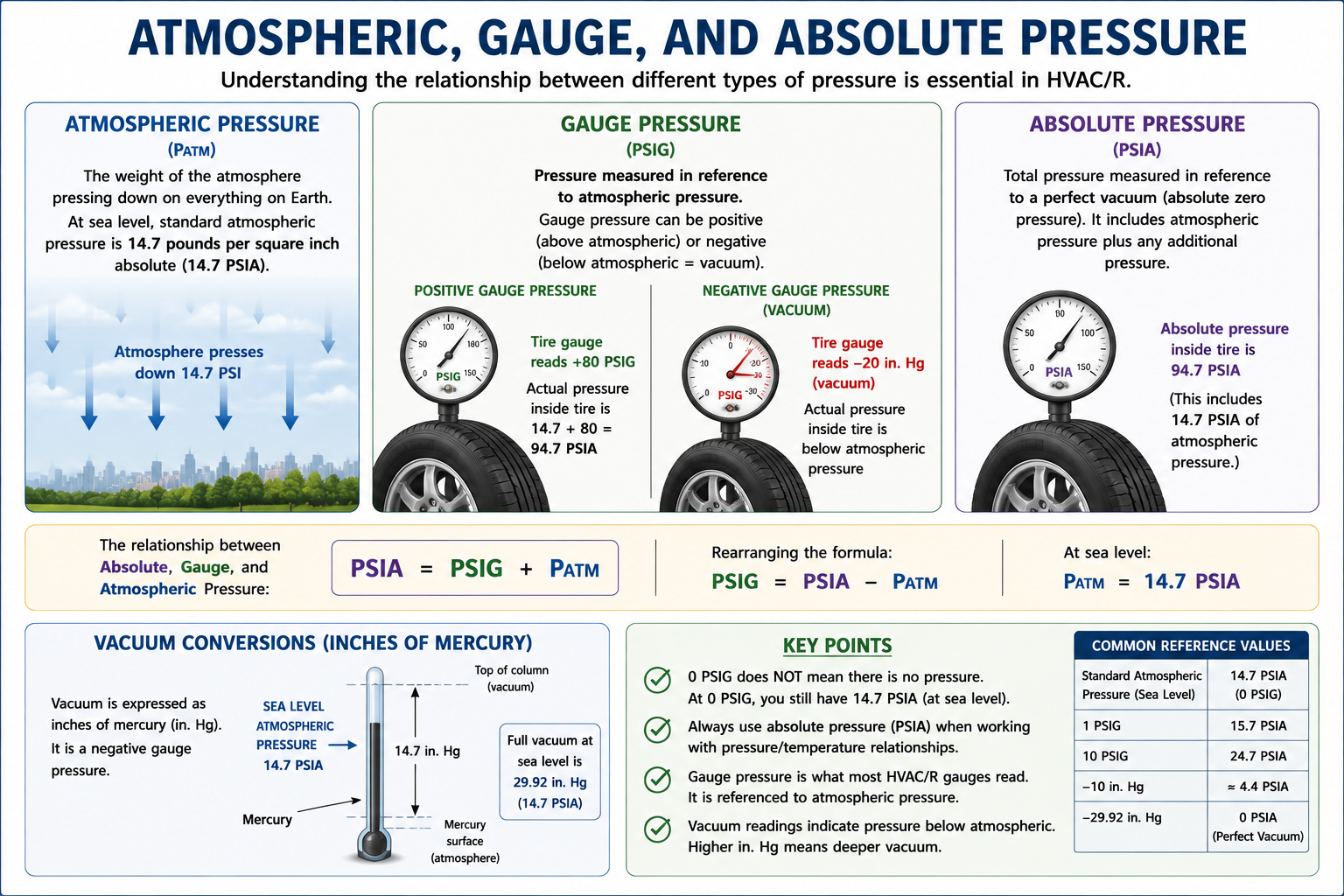
The earth’s atmosphere has mass, and gravity causes that atmosphere to exert pressure on everything below it.
Standard atmospheric pressure at sea level is approximately 14.7 pounds per square inch absolute.
Atmospheric pressure changes with altitude and weather. The 14.7 PSIA value is a standard reference, not a constant pressure at every location and condition.
PSIG Uses Atmospheric Pressure as Zero
Most HVAC/R pressure gauges are designed so that they read zero when open to the surrounding atmosphere.
A gauge reading of 0 PSIG means the pressure is equal to the surrounding atmospheric pressure. At standard sea-level conditions, that is still approximately 14.7 PSIA.
PSIA Uses a True Zero-Pressure Reference
Absolute pressure is measured from a theoretical condition of no pressure at all. This reference is different from ordinary gauge pressure.
At standard sea-level pressure, atmospheric pressure is approximately 14.7 PSI.
A refrigeration gauge reads 70 PSIG. What is the approximate absolute pressure at standard sea-level atmospheric pressure?
PSIA = 70 + 14.7
Many physical relationships involving pressure, volume, and temperature must use absolute pressure rather than gauge pressure.
Gauge Pressure Can Be Positive or Negative
Common during normal refrigeration-system operation and pressure testing.
The reference point used by conventional gauge pressure.
Pressure is lower than the surrounding atmospheric pressure.
Vacuum Is Pressure Below Atmospheric Pressure
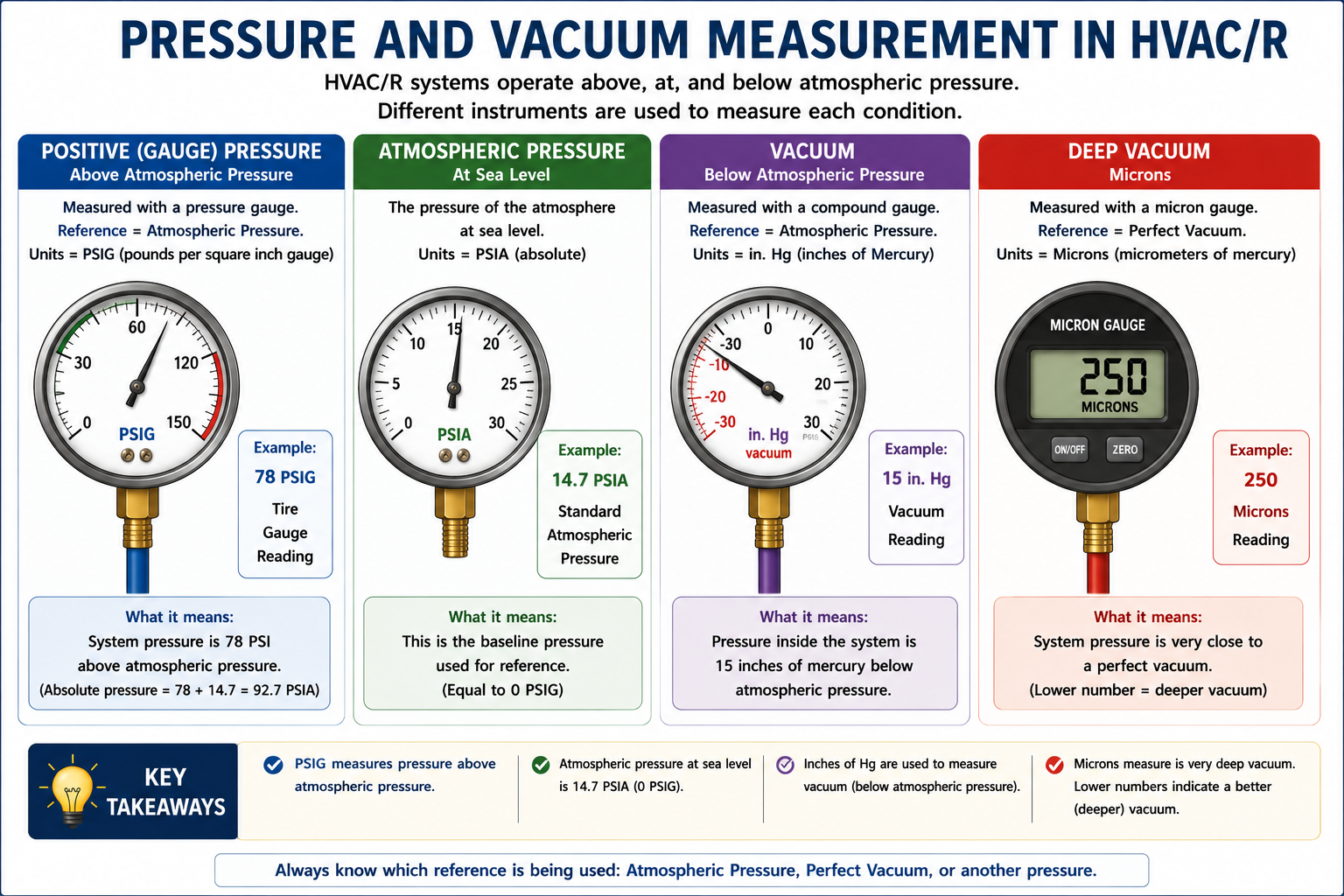
A vacuum exists whenever the pressure inside a space is lower than the atmospheric pressure surrounding it.
A refrigeration system can be under vacuum while still containing significant absolute pressure. Only a perfect vacuum would represent zero absolute pressure.
Traditional Vacuum Measurement
Vacuum is often expressed in inches of mercury, written as in. Hg or “Hg.
At standard atmospheric conditions, a perfect vacuum would correspond to approximately 29.92 inches of mercury below atmospheric pressure.
A compound gauge can show that a system is below atmospheric pressure, but it does not provide enough resolution to determine whether moisture and noncondensables have been adequately removed during evacuation.
Deep Vacuum Requires a More Precise Measurement
HVAC/R evacuation is measured much more precisely using microns of mercury.
A micron gauge measures absolute pressure and is capable of showing pressure changes far below what a standard compound gauge can resolve.
Useful for General Vacuum Indication
Shows whether system pressure has dropped below atmospheric pressure.
Required for Deep-Vacuum Evaluation
Measures very low absolute pressure during evacuation and standing-vacuum testing.
A technician should use a micron gauge to evaluate a refrigeration-system evacuation rather than relying only on the low-side compound gauge.
Always Ask: Pressure Compared With What?
Pressure compared with the surrounding atmosphere.
Pressure compared with a true zero-pressure reference.
Traditional indication of pressure below atmospheric pressure.
Very low absolute pressure used for refrigeration-system evacuation.
Atmospheric Pressure Changes With Elevation
Atmospheric pressure decreases as elevation increases because there is less atmosphere above the location.
Higher Atmospheric Pressure
More atmosphere exists above the location.
Lower Atmospheric Pressure
Less atmosphere exists above the location.
Atmospheric pressure affects boiling temperatures and the relationship between gauge and absolute pressure. Precise calculations may need to account for the actual local atmospheric pressure.
Where Technicians Use Pressure Measurements
System Operation
Suction and discharge pressures help technicians determine the operating conditions on the low and high sides of the system.
Saturation Temperature
Refrigerant pressure is used with pressure-temperature data to determine saturation temperature.
Pressure Testing
Dry nitrogen is used to place refrigeration piping under positive pressure for leak testing.
Evacuation
A vacuum pump lowers system absolute pressure so air, moisture, and other unwanted gases can be removed.
Know Which Pressure Your Refrigerant Data Uses
Most HVAC/R service pressure-temperature charts used in the United States present refrigerant pressure in PSIG.
When you later use a P-T chart, the gauge pressure measured at the system can normally be compared directly with a chart that is also labeled in PSIG.
Always verify whether a chart, table, instrument, or engineering calculation uses PSIG, PSIA, bar, kPa, MPa, or another pressure unit before using the value.
Avoid These Pressure Errors
“0 PSIG means there is no pressure.”
At 0 PSIG, the pressure is equal to the surrounding atmosphere and is still approximately 14.7 PSIA at standard sea-level conditions.
“Vacuum means zero absolute pressure.”
Vacuum only means pressure below atmospheric pressure. A perfect vacuum would be required to reach zero PSIA.
“29 inches of vacuum proves the system is evacuated.”
A compound gauge does not have enough resolution to verify deep evacuation. A micron gauge is required.
“Atmospheric pressure is always 14.7 PSI.”
14.7 PSIA is a standard sea-level reference. Actual atmospheric pressure changes with elevation and weather.
Can You Identify the Pressure Reference?
- What is pressure?
- What unit is commonly used for refrigeration pressure in the United States?
- What creates atmospheric pressure?
- What is standard atmospheric pressure at sea level in PSIA?
- What does PSIG mean?
- What does PSIA mean?
- Why does a conventional gauge read 0 PSIG when open to the atmosphere?
- Approximately what absolute pressure corresponds to 0 PSIG at sea level?
- How do you convert PSIG to PSIA at standard sea-level pressure?
- What is a vacuum?
- What does inches of mercury indicate?
- Why is a micron gauge used during refrigeration-system evacuation?
- Why is a compound gauge inadequate for verifying a deep vacuum?
- How does altitude affect atmospheric pressure?
- Why must you verify the pressure units used by a P-T chart?
What You Should Have Learned
Pressure describes force applied over an area and is commonly measured in PSI in U.S. HVAC/R work.
Atmospheric pressure is produced by the weight of the atmosphere and is approximately 14.7 PSIA at standard sea-level conditions.
PSIG measures pressure relative to atmospheric pressure, while PSIA measures pressure relative to a true zero-pressure reference.
0 PSIG is approximately 14.7 PSIA at standard sea-level conditions, not zero absolute pressure.
A vacuum exists whenever system pressure is below the surrounding atmospheric pressure.
Inches of mercury can indicate ordinary vacuum, while microns provide the precision needed for deep refrigeration-system evacuation.
A micron gauge measures absolute pressure and should be used to verify evacuation.
Understanding the pressure reference is essential before using refrigeration gauges, calculations, or pressure-temperature charts.