Heat, Temperature, and BTUs
Heat and temperature are related, but they are not the same thing. A thermometer tells us the thermal condition of a substance, while heat describes energy that is transferred because of a temperature difference.
HVAC/R technicians constantly work with both ideas. We measure temperatures at coils, refrigerant lines, ducts, and air streams, while equipment capacity and heat transfer are commonly expressed in British Thermal Units.
What You Will Learn
By the end of this lesson you should be able to:
Distinguish heat from temperature.
Explain why temperature indicates thermal condition while heat describes energy transfer.
Explain molecular motion and temperature.
Relate increasing temperature to increasing molecular motion.
Identify common temperature scales.
Recognize Fahrenheit, Celsius, Rankine, and Kelvin and understand the purpose of absolute temperature scales.
Define the British Thermal Unit.
Explain what one BTU represents and why BTUs are commonly used in HVAC/R.
Separate temperature from heat quantity.
Explain why two objects at the same temperature can contain very different amounts of thermal energy.
Relate heat flow to refrigeration.
Understand why heat naturally moves from a warmer substance toward a cooler substance.
Related Concepts, Different Meanings
Energy in Transfer
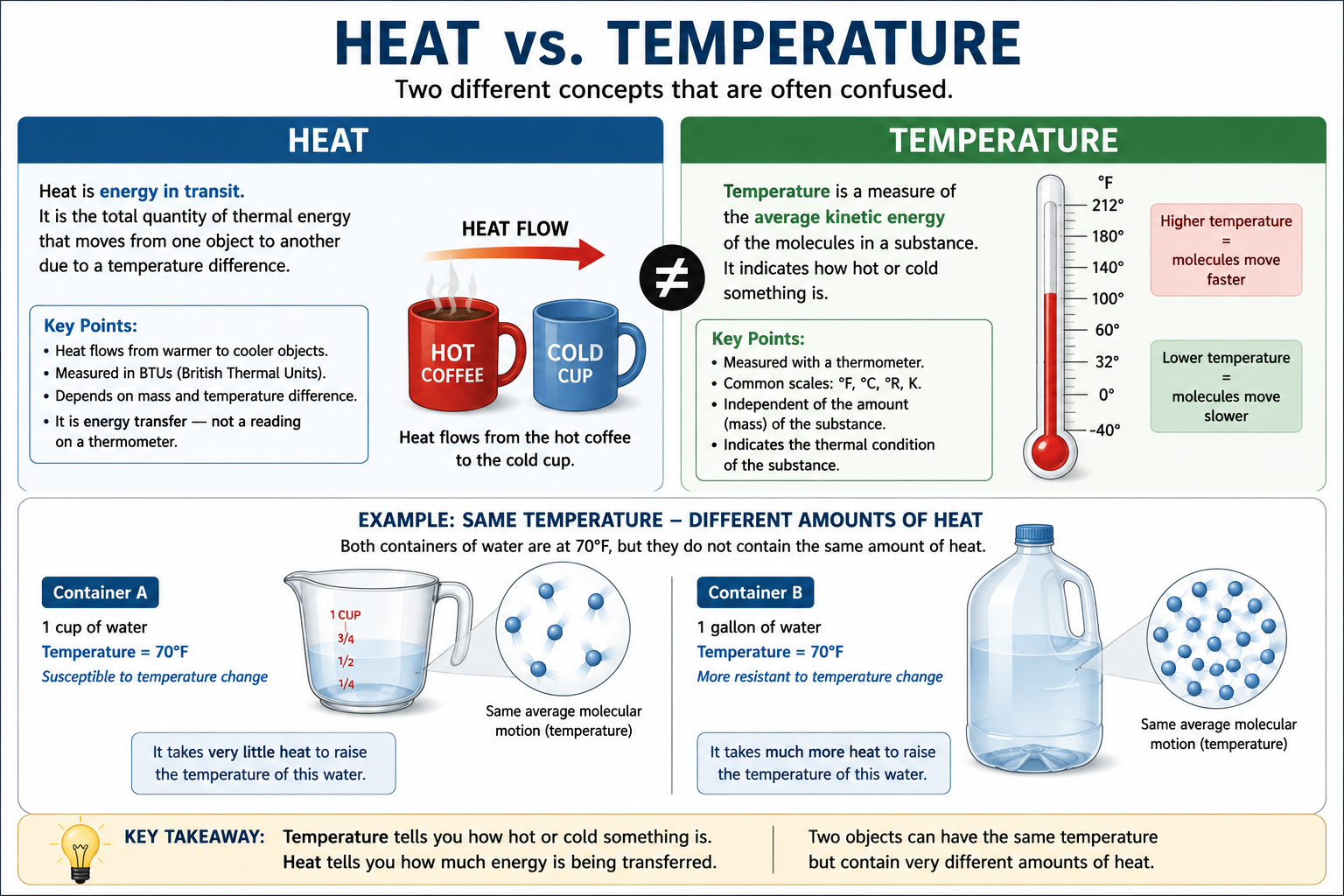
Heat is thermal energy transferred from one substance or location to another because a temperature difference exists.
Thermal Condition
Temperature indicates how hot or cold a substance is and is related to the average kinetic energy of its molecules.
A thermometer can tell us that two containers of water are both 70°F, but it does not tell us whether one contains a cup of water or hundreds of gallons. The larger quantity can contain much more thermal energy even though the measured temperature is the same.
Temperature Reflects Molecular Activity
Molecules in matter are constantly moving or vibrating. As energy is added and molecular motion increases, temperature generally rises. As energy is removed and molecular motion decreases, temperature generally falls.
Less Molecular Motion
Molecules have less average kinetic energy and move or vibrate less rapidly.
Greater Molecular Motion
Molecules have greater average kinetic energy and move or vibrate more rapidly.
Temperature indicates the thermal condition of a substance. It does not by itself tell us the total amount of thermal energy associated with all of the matter present.
Different Scales Describe the Same Physical Condition
HVAC/R technicians in the United States most commonly use the Fahrenheit scale, while Celsius is widely used internationally. Rankine and Kelvin are absolute temperature scales used primarily in scientific and engineering calculations.
Fahrenheit
Commonly used in U.S. HVAC/R work for air, refrigerant, equipment, and ambient temperatures.
Celsius
Commonly used in metric systems and HVAC/R work throughout much of the world.
Rankine
An absolute temperature scale that uses Fahrenheit-sized degree increments and begins at absolute zero.
Kelvin
An absolute temperature scale that uses Celsius-sized increments and begins at absolute zero.
For this course: Fahrenheit will be the primary temperature scale used in examples. Celsius values may be included where useful. Rankine and Kelvin are introduced so you understand the idea of absolute temperature, but detailed conversion work is not a major focus here.
The Lower Limit of Temperature
Absolute temperature scales begin at absolute zero, the theoretical lower limit of thermal energy associated with molecular motion.
Approximately -460°F
Approximately -273°C
Some physical relationships involving gases, pressure, and volume require temperature to be measured from an absolute zero reference rather than from an arbitrary scale such as Fahrenheit or Celsius.
Heat Naturally Moves From Warmer to Cooler
When two substances at different temperatures can exchange heat, thermal energy naturally transfers from the warmer substance toward the cooler substance.
→
Heat transfer continues as long as a temperature difference exists. If the two substances eventually reach the same temperature, there is no longer a net heat transfer between them.
An evaporator is maintained colder than the material or air being cooled, so heat naturally transfers into the evaporator. A condenser is maintained hotter than the surrounding cooling medium, so heat naturally transfers away from the condenser.
The British Thermal Unit
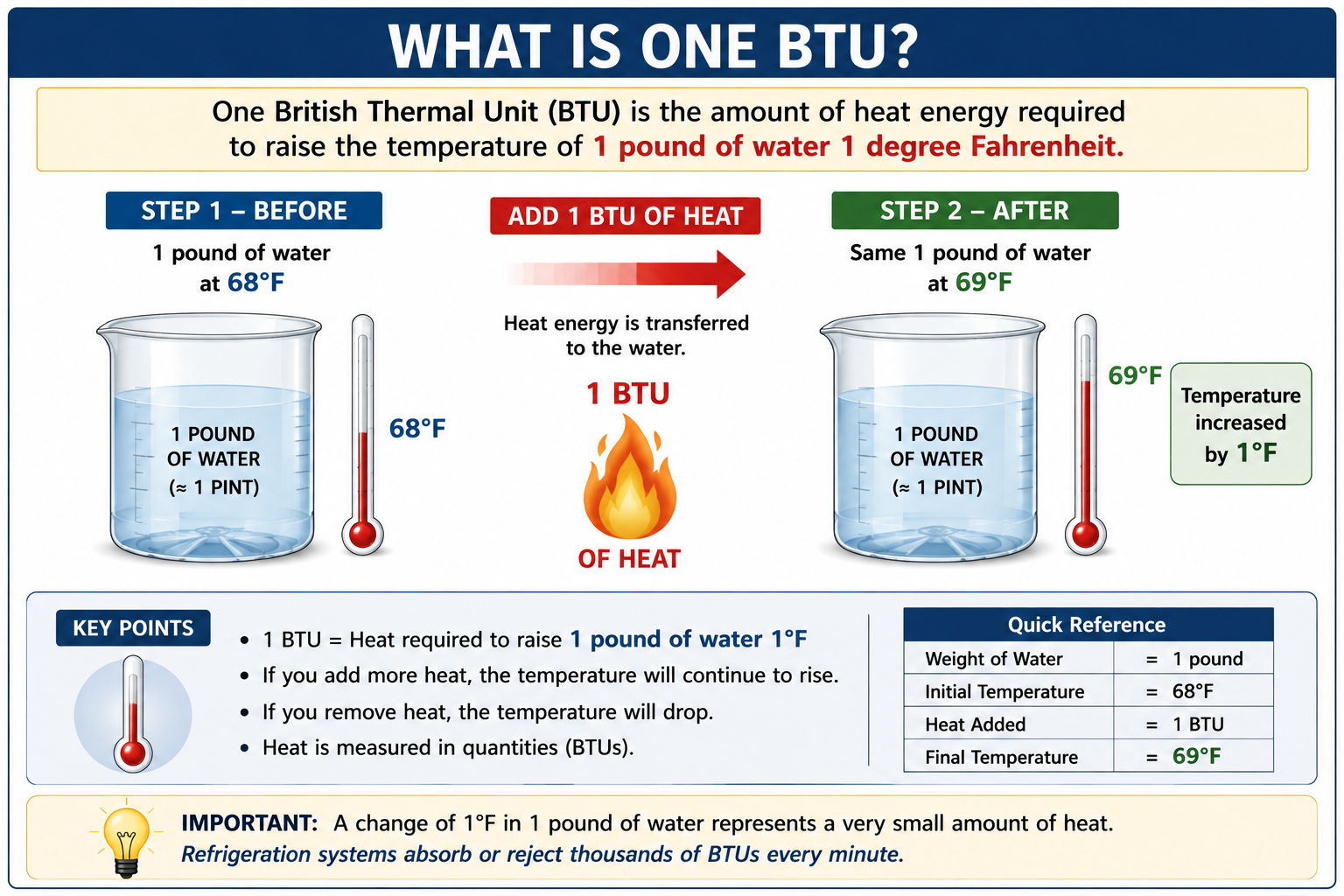
The British Thermal Unit, abbreviated BTU, is a unit used to describe a quantity of thermal energy.
raised approximately
1°F
A BTU does not mean one degree Fahrenheit. It represents a quantity of energy. The temperature change produced by that energy depends on the amount and type of material receiving it.
More Matter Requires More Energy
If two quantities of the same substance undergo the same temperature increase, the larger quantity requires more heat energy.
This simple relationship uses liquid water as the example. Other materials require different amounts of heat for the same weight and temperature change, which leads us to the idea of specific heat in the next lesson.
Energy Quantity and Rate Are Different
Quantity of Heat
Describes an amount of thermal energy.
Rate of Heat Transfer
Describes how quickly thermal energy is being transferred over time.
An air conditioner rated at 24,000 BTU/hr is rated for a rate of heat transfer, not a total lifetime quantity of 24,000 BTU.
Where Technicians Use Heat and Temperature
Air Temperatures
Return-air, supply-air, outdoor-air, and indoor-air temperatures help evaluate heat transfer and system operation.
Refrigerant Temperatures
Suction-line, liquid-line, discharge-line, evaporator, and condenser temperatures help determine refrigerant condition.
Equipment Capacity
Heating and cooling equipment is commonly rated in BTU/hr.
Heat Load
Buildings and refrigerated spaces gain or lose heat at measurable rates that equipment must be sized to handle.
Avoid Confusing These Ideas
“Temperature tells me how much heat is present.”
Temperature indicates thermal condition, not total heat quantity. The amount and type of matter also matter.
“One BTU equals one degree.”
A BTU is an energy quantity. One BTU raises approximately one pound of liquid water by one degree Fahrenheit under the standard definition.
“Heat only moves when equipment makes it move.”
Heat naturally transfers from warmer to cooler substances whenever a heat-transfer path exists.
“BTU and BTU/hr mean the same thing.”
BTU is a quantity of energy. BTU/hr is a rate of energy transfer.
Can You Separate Heat From Temperature?
- What does temperature tell us about a substance?
- What is heat?
- Why can two objects at the same temperature contain different amounts of thermal energy?
- What generally happens to molecular motion as temperature increases?
- Which temperature scale is most commonly used in U.S. HVAC/R work?
- What are Rankine and Kelvin used to represent?
- What is absolute zero?
- In what direction does heat naturally flow?
- What is a British Thermal Unit?
- Why does ten pounds of water require more heat than one pound of water for the same temperature increase?
- What is the difference between BTU and BTU/hr?
- Why must an evaporator be colder than the material being cooled?
What You Should Have Learned
Heat and temperature are related but describe different physical concepts.
Temperature indicates thermal condition and is related to average molecular motion.
Heat is thermal energy transferred because a temperature difference exists.
Heat naturally moves from a warmer substance toward a cooler substance.
Fahrenheit and Celsius are common temperature scales, while Rankine and Kelvin are absolute scales.
One BTU represents approximately the heat required to raise one pound of water by one degree Fahrenheit.
The amount of heat required for a temperature change depends partly on how much matter is being heated or cooled.
BTU describes an energy quantity, while BTU/hr describes a rate of heat transfer.