Matter, Energy, and Refrigeration
Before we can understand refrigerants, pressure-temperature relationships, boiling, condensation, superheat, or subcooling, we need to understand the material that refrigerants are made of and how energy affects that material.
Refrigeration depends on controlling the relationship between matter, heat energy, pressure, and changes of state. These basic physical ideas explain why a refrigerant can exist as a liquid in one part of the system and a vapor in another.
What You Will Learn
By the end of this lesson you should be able to:
Define matter.
Explain what matter is and identify the three states most important to refrigeration: solid, liquid, and vapor.
Describe molecular behavior.
Compare how molecules are arranged and how they move in solids, liquids, and vapors.
Explain how energy changes matter.
Describe how adding or removing energy changes molecular motion and can cause matter to change state.
Distinguish mass, weight, and density.
Recognize several basic physical properties used to describe matter.
Relate pressure to state.
Understand that both energy and pressure help determine whether a substance exists as a liquid or vapor.
Connect theory to refrigeration.
Explain why controlling refrigerant state is fundamental to the refrigeration cycle.
Everything in the Refrigeration System Is Matter
Matter is any substance that occupies space and has mass. Copper tubing, compressor oil, refrigerant, air, water, and the metal components inside an air-conditioning system are all forms of matter.
For refrigeration theory, the three most important states of matter are solid, liquid, and vapor. A refrigerant normally operates as either a liquid, a vapor, or a mixture of both while moving through the system.
The refrigeration cycle depends on deliberately changing refrigerant between liquid and vapor. The system moves large amounts of heat by controlling when and where those changes of state occur.
Solid, Liquid, and Vapor
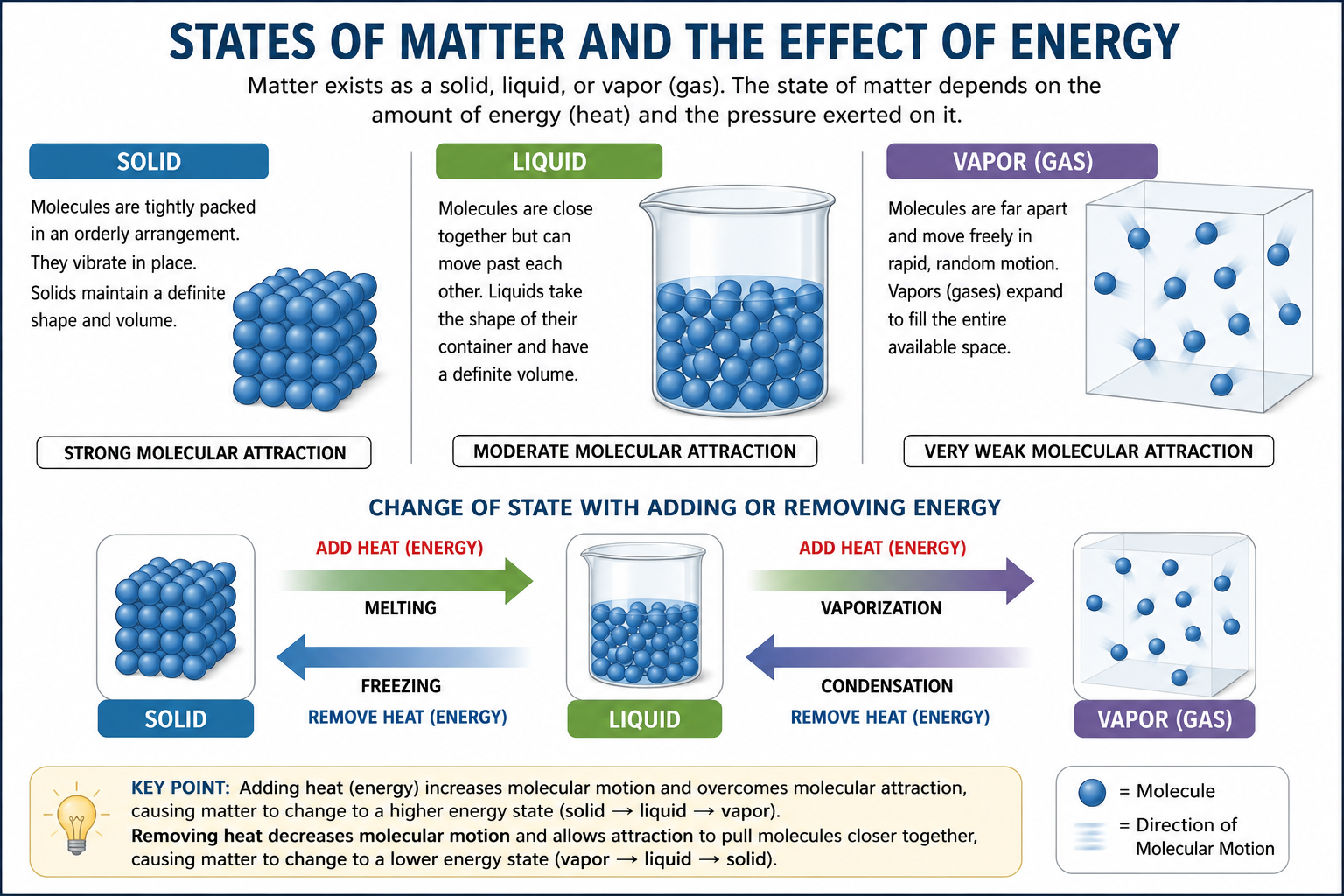
Molecules Are Closely Packed
In a solid, molecules are strongly attracted to one another and remain in relatively fixed positions. They still vibrate, but the material maintains a definite shape and volume.
Molecules Can Move Past One Another
In a liquid, molecular attraction is weaker than in a solid. The molecules remain relatively close together but can move past one another, allowing the liquid to take the shape of its container.
Molecules Move Freely
In a vapor or gas, molecules are much farther apart and move rapidly in many directions. A vapor expands to fill the available space in its container.
Adding Energy Increases Molecular Motion
When energy is added to matter, molecular motion increases. When energy is removed, molecular motion decreases.
Molecular motion increases.
Attraction becomes easier to overcome.
Matter can move toward a higher-energy state.
Molecular motion decreases.
Molecular attraction becomes more dominant.
Matter can move toward a lower-energy state.
Molecular motion is related to temperature, but the total amount of thermal energy associated with a substance also depends on how much matter is present and on the physical properties of that substance. We will examine this distinction in the next lesson.
Energy Can Change the State Without Immediately Changing the Temperature
Melting
Energy is added until molecular attraction can no longer maintain the rigid structure of the solid.
Vaporization
Additional energy allows molecules to escape the liquid and enter the vapor state.
Condensation
Energy is removed from the vapor, allowing molecular attraction to bring the molecules closer together into the liquid state.
Freezing
Additional energy removal reduces molecular motion enough for the material to form a rigid solid structure.
Most vapor-compression refrigeration systems repeatedly vaporize refrigerant in the evaporator and condense it in the condenser. These changes of state allow very large amounts of heat to be absorbed and rejected.
Mass, Weight, Density, and Specific Volume
Several basic properties are useful when describing matter. These terms appear throughout HVAC/R calculations and equipment specifications.
Mass
Mass describes the amount of matter contained in an object or substance.
Weight
Weight is the force produced when gravity acts on mass. An object’s mass does not change simply because gravity changes, but its weight can.
Density
Density describes how much mass is contained in a given volume. A dense substance contains more mass in the same amount of space than a less-dense substance.
Specific Volume
Specific volume describes how much volume is occupied by a given mass. In refrigeration work it is especially useful when discussing refrigerant vapor.
For this course: You do not need to memorize detailed density or specific-volume tables at this stage. The important idea is that liquids and vapors occupy space very differently, and refrigerant vapor density changes substantially with pressure and temperature.
Pressure Also Influences the State of a Substance
Energy alone does not determine whether a substance exists as a liquid or vapor. Pressure also plays a major role.
A liquid can boil at different temperatures when the pressure acting on it changes. Lowering pressure makes vaporization possible at a lower temperature, while increasing pressure allows the liquid to remain liquid at a higher temperature.
Lower Pressure
Encourages liquid to vaporize at a lower temperature.
Higher Pressure
Allows liquid to remain liquid until a higher temperature is reached.
The refrigeration system deliberately creates a low-pressure region where refrigerant can boil at a low temperature and a high-pressure region where refrigerant can condense at a higher temperature.
Energy Can Change Form
Energy cannot simply disappear. It can be transferred from one place to another or converted from one form to another.
In an air-conditioning system, electrical energy powers the compressor and fan motors. The compressor adds mechanical work to the refrigerant, and the refrigeration system transfers heat energy from the conditioned space to the outdoors.
Electrical Energy
Supplied to motors, controls, compressors, and fans.
Mechanical Work
The compressor increases refrigerant pressure and moves refrigerant through the system.
Heat Transfer
Heat is absorbed at the evaporator and rejected at the condenser.
Follow One Refrigerant Through the Cycle
A refrigerant repeatedly changes condition as it moves through a vapor-compression system.
Evaporator
Low-pressure refrigerant absorbs energy and changes primarily from liquid to vapor.
Compressor
Vapor enters the compressor. Mechanical work increases its pressure and temperature.
Condenser
High-pressure vapor rejects energy and changes from vapor to liquid.
Metering Device
Pressure is reduced before the refrigerant enters the evaporator again.
The refrigerant’s ability to change state at useful temperatures makes it possible to absorb heat indoors and reject that heat somewhere else.
Avoid These Early Mistakes
“Vapor means hot.”
Not necessarily. A refrigerant vapor can be very cold or very hot depending on its pressure and temperature.
“Liquid means cold.”
Not necessarily. High-pressure liquid refrigerant leaving a condenser can be much warmer than low-pressure vapor leaving an evaporator.
“Boiling always means 212°F.”
That temperature applies to water at approximately standard atmospheric pressure. Changing pressure changes boiling temperature.
“A refrigerant has one fixed boiling point.”
Its boiling or saturation temperature depends on pressure. Some refrigerant blends also change phase over a temperature range rather than at one temperature.
Can You Explain the Physical Foundation?
- What is matter?
- What three states of matter are most important in refrigeration theory?
- How are molecules arranged differently in a solid, liquid, and vapor?
- What happens to molecular motion when energy is added?
- What happens to molecular motion when energy is removed?
- What is vaporization?
- What is condensation?
- What is the difference between mass and weight?
- What does density describe?
- Why does pressure affect whether a refrigerant is liquid or vapor?
- Why does lowering pressure allow a liquid to boil at a lower temperature?
- Why are vaporization and condensation so important to refrigeration?
What You Should Have Learned
Matter occupies space and has mass, and refrigerants normally operate as liquid, vapor, or a mixture of both.
Solids have closely packed molecules, liquids allow molecules to move past one another, and vapors have widely separated molecules moving freely.
Adding energy increases molecular motion, while removing energy decreases molecular motion.
Adding or removing energy can cause matter to change between solid, liquid, and vapor.
Mass, weight, density, and specific volume describe different physical properties of matter.
Pressure and energy work together to determine the physical state of a substance.
Lower pressure allows a liquid to boil at a lower temperature, while higher pressure raises the boiling temperature.
Mechanical refrigeration works by controlling refrigerant pressure and changes of state so heat can be absorbed and rejected where desired.