Suction-Line Insulation and Condensation Prevention
The suction line in a conventional split air-conditioning system is normally cold during cooling operation. Because its surface temperature can fall below the dew point of the surrounding air, moisture can condense on the tubing if the line is not properly insulated.
Proper suction-line insulation reduces unwanted heat gain and prevents condensation that can damage ceilings, walls, insulation, flooring, equipment, and other building materials. The smaller conventional liquid line, by contrast, is normally left uninsulated unless the equipment manufacturer specifies otherwise.
What You Will Learn
By the end of this lesson you should be able to:
Explain why the suction line is insulated.
Describe how insulation limits heat gain and prevents condensation on the cold suction line.
Connect condensation to dew point.
Explain why moisture forms when the suction-line surface temperature falls below the dew point of the surrounding air.
Recognize condensation damage.
Identify the types of building and equipment damage that can result from missing or damaged suction-line insulation.
Explain why the conventional liquid line is usually not insulated.
Recognize that the high-pressure liquid line normally does not have a condensation problem and can reject additional heat before the metering device.
Recognize proper insulation workmanship.
Identify the importance of continuous insulation, sealed joints, protected fittings, and avoiding crushed or damaged insulation.
Recognize system exceptions.
Understand why ductless, low-temperature refrigeration, heat-pump, and other systems may have different insulation requirements.
Low-Pressure Vapor Leaves the Evaporator at a Low Temperature
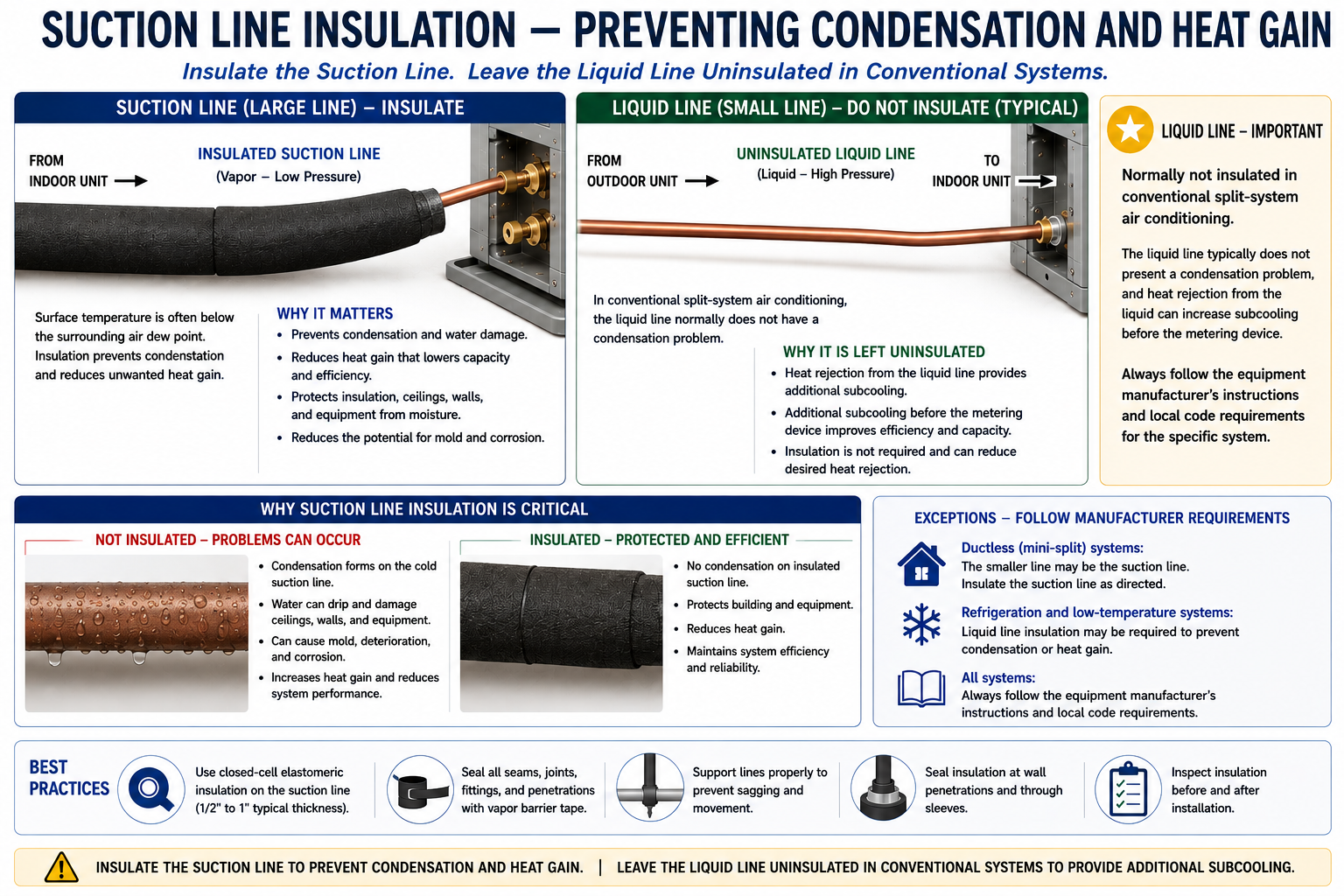
During conventional cooling operation, refrigerant leaves the evaporator as low-pressure vapor and travels through the suction line toward the compressor.
The suction vapor is typically much colder than the surrounding outdoor, attic, crawlspace, mechanical-room, or indoor air. The copper tubing therefore becomes cold as well.
Reducing heat gain is important, but preventing water condensation is often the more immediate building-protection reason for continuous suction-line insulation.
When a Surface Is Cold Enough, Moisture Leaves the Air
Air contains water vapor. The amount of water vapor that can remain in the air depends partly on temperature.
The dew point is the temperature at which the air becomes saturated and moisture begins condensing on surfaces that are at or below that temperature.
The temperature at which air becomes saturated with water vapor and condensation begins to form on a surface at or below that temperature.
Water on the outside of an uninsulated suction line is normally moisture condensed from the surrounding air, not refrigerant leaking through the copper tubing.
Condensation Can Become a Building Problem
A small amount of condensation may seem harmless, but a suction line can operate for many hours during warm and humid weather. Water can drip continuously from exposed or poorly insulated tubing.
Ceiling Damage
Water dripping above finished ceilings can stain drywall, damage ceiling tiles, and weaken building materials.
Wall Damage
Condensation inside wall cavities can wet drywall, framing, and insulation.
Flooring Damage
Water dripping onto flooring can damage wood, laminate, carpet, and other finishes.
Mold and Microbial Growth
Persistent moisture can create conditions favorable for mold or other microbial growth.
Corrosion
Repeated moisture exposure can promote corrosion of nearby metal components, fasteners, and building materials.
Equipment Damage
Dripping water can reach electrical components, controls, insulation, ductwork, or other equipment not intended to remain wet.
Water damage near an air-conditioning line set may initially be blamed on a roof, drain, or plumbing leak. Always inspect suction-line insulation when condensation is possible.
Insulation Also Protects Refrigeration Performance
The suction vapor has already absorbed heat in the evaporator. Additional heat entering the suction line after the evaporator does not provide useful cooling to the conditioned space.
Insulated Suction Line
Limits heat transfer from the surrounding air into the cold suction vapor.
Uninsulated Suction Line
Allows additional sensible heat to enter the refrigerant before it reaches the compressor.
The refrigerant can still absorb heat in the suction line, but that heat is picked up outside the intended evaporator heat-transfer process and increases compressor inlet vapor temperature.
The Smaller Liquid Line Is Usually Not Insulated
In a conventional split air-conditioning system, the smaller liquid line carries high-pressure subcooled liquid from the condenser toward the indoor metering device during cooling operation.
The liquid line is normally warmer than the dew point of the surrounding air, so it typically does not create a condensation problem.
Normally Insulated
Cold low-pressure vapor can cause surface condensation and unwanted heat gain.
Normally Uninsulated
High-pressure subcooled liquid generally does not create condensation and may reject additional heat before reaching the metering device.
When the conventional liquid line rejects heat to cooler surrounding air, the liquid refrigerant can become more subcooled before reaching the metering device. This increases the margin that helps keep refrigerant in the liquid state.
The rule above applies to conventional split-system cooling arrangements. Some ductless systems, low-temperature refrigeration systems, heat pumps, or manufacturer-specific designs may require both refrigerant lines to be insulated. Always follow the equipment manufacturer’s instructions.
Gaps Defeat the Vapor Barrier
Good suction-line insulation should form a continuous thermal and moisture barrier around the cold tubing.
Continuous Coverage
The copper should remain covered through straight runs, bends, fittings, and other areas where the surface could become cold.
Sealed Joints
Insulation joints should be closed and sealed so humid air cannot reach the cold copper beneath the insulation.
Sealed Longitudinal Seams
Split insulation seams must be properly bonded or sealed according to the insulation manufacturer’s instructions.
Protected Ends
Transitions at equipment cabinets, wall penetrations, and fittings should not leave exposed cold copper.
A small opening can allow warm humid air to reach the cold tubing underneath the insulation. Condensation can then form inside the insulation where it may remain hidden for an extended period.
Insulation Must Retain Its Thickness
Insulation works by slowing heat transfer through its material. Crushing the insulation reduces its effective thickness and can create a cold surface on the outside of the insulation.
Correct Support
The support carries the piping without cutting into or severely compressing the insulation.
Compressed Insulation
A tight hanger or clamp can reduce insulation thickness and create a localized condensation point.
Torn or Missing Insulation
Exposed copper can immediately begin sweating when its temperature is below the surrounding-air dew point.
Proper refrigerant-line supports should not damage the suction-line insulation. A line can be mechanically well supported and still have an insulation problem if the hanger crushes the insulation.
Insulation Must Survive Sunlight and Weather
Suction-line insulation located outdoors is exposed to ultraviolet radiation, heat, rain, snow, wind, animals, landscaping work, and physical contact.
UV Damage
Sunlight can degrade insulation that is not designed or protected for outdoor exposure.
Physical Damage
String trimmers, tools, animals, and other contact can tear or remove insulation.
Weather Exposure
Outdoor insulation and coverings must resist moisture and environmental deterioration.
Inspection
Outdoor insulation should be checked during routine service for cracking, shrinkage, gaps, and exposed copper.
Do Not Leave Hidden Bare Copper
Refrigerant lines often pass through walls, floors, roofs, or other building assemblies. These locations require careful attention because defects may become hidden after construction is complete.
Maintain Insulation
Keep the suction line insulated through the penetration unless the equipment or approved installation method requires otherwise.
Protect Against Abrasion
Copper tubing and insulation should not rub directly against sharp masonry, metal, framing, or other surfaces.
Seal the Building Opening
Seal penetrations appropriately to limit air, water, pest, and weather intrusion while maintaining any required fire or code-rated assembly.
Preserve Serviceability
Do not bury unnecessary fittings or service joints where they become inaccessible unless the approved equipment design specifically permits that arrangement.
Do Not Assume the Smaller Line Is Always a Conventional Liquid Line
Many ductless and variable-capacity systems use piping arrangements that differ from a conventional split system with the metering device at the indoor evaporator.
If an electronic expansion valve is located in the outdoor unit, refrigerant traveling through the smaller tube toward the indoor unit may already have passed through the metering device.
Metering Device Location Matters
The thermodynamic state of refrigerant in the line depends on where the metering device is located.
Operating Mode Matters
Heat-pump and multi-zone equipment can change refrigerant direction and line conditions during operation.
Both Lines May Require Insulation
Many ductless manufacturers require insulation on both refrigerant pipes because either line can operate at temperatures where heat gain or condensation becomes important.
Use Manufacturer Terminology
Terms such as gas pipe, liquid pipe, refrigerant pipe, or connection pipe may be more appropriate than assuming conventional suction- and liquid-line conditions.
Follow the manufacturer’s installation instructions for which pipes must be insulated, required insulation thickness, acceptable materials, and treatment of flare connections and branch piping.
Refrigeration Applications May Require More Insulation
Freezers and other low-temperature refrigeration systems can operate with refrigerant piping at temperatures much lower than typical comfort-cooling systems.
These systems may require greater insulation thickness, vapor-retarder protection, special materials, or insulation on additional refrigerant lines.
Comfort-cooling practices should not automatically be transferred to medium- or low-temperature refrigeration. Use the system designer’s and equipment manufacturer’s insulation requirements.
What to Look for During Inspection
Exposed Copper
Look for missing insulation at joints, fittings, service valves, wall penetrations, and repairs.
Wet Insulation
Wet insulation can indicate a failed vapor barrier, damaged covering, or hidden condensation.
Crushed Areas
Inspect hangers, clamps, cable ties, and building penetrations for compressed insulation.
Open Seams
Split seams and joints can allow humid air to reach the cold tubing.
Water Stains
Staining on ceilings, walls, or equipment can provide clues to intermittent line-set condensation.
Outdoor Deterioration
Check for UV damage, cracking, missing insulation, and physical damage around the outdoor unit.
Do Not Assume Thicker Insulation Is the Only Answer
If condensation is occurring on the outside of properly installed insulation, determine why the exterior insulation surface is becoming cold enough to reach the dew point.
Insulation Too Thin
The installed thickness may not be sufficient for the pipe temperature, ambient temperature, and humidity.
Insulation Compressed
Supports or tight spaces may reduce effective insulation thickness.
Vapor Barrier Failure
Open seams or damaged insulation can allow humid air to reach the cold tubing.
Abnormal Suction Temperature
System operating problems can cause the suction line to operate colder than expected.
Wrapping a wet area with additional tape without correcting damaged insulation, open seams, or abnormal refrigeration conditions may hide the problem rather than solve it.
Why Proper Insulation Matters
The conventional suction line carries cold low-pressure refrigerant vapor from the evaporator back to the compressor.
If the suction-line surface temperature is below the surrounding-air dew point, moisture condenses on the tubing.
Suction-line insulation prevents condensation and limits unwanted heat gain into the suction vapor.
Condensation can damage ceilings, walls, insulation, flooring, equipment, and other building materials.
Insulation must remain continuous, sealed, and thick enough to maintain a warm enough exterior surface.
In conventional split-system cooling, the high-pressure liquid line is normally not insulated and can reject additional heat before the metering device.
Ductless, heat-pump, variable-capacity, and low-temperature refrigeration systems may require different insulation practices.
The equipment manufacturer’s insulation requirements must be followed for the actual refrigeration system.
Can You Explain Suction-Line Insulation?
You should be able to answer these questions before continuing.
- Why is the suction line normally cold during cooling operation?
- What is dew point?
- Why does condensation form on an uninsulated suction line?
- Is the water on a sweating suction line normally refrigerant?
- What types of property damage can result from suction-line condensation?
- Why does suction-line insulation also improve refrigeration performance?
- Why is the conventional liquid line normally not insulated?
- How can additional heat rejection from the liquid line affect subcooling?
- Why must insulation joints and seams be sealed?
- Why can crushed insulation create a condensation problem?
- Why should outdoor suction-line insulation be inspected for UV and physical damage?
- Why can ductless systems require both refrigerant lines to be insulated?
- Why should conventional residential air-conditioning insulation rules not automatically be applied to low-temperature refrigeration?
- What should a technician inspect when investigating water damage near a refrigerant line set?
What You Should Have Learned
The conventional suction line carries cold low-pressure vapor from the evaporator to the compressor and normally requires insulation.
Condensation forms when the tubing or insulation surface falls below the dew point of the surrounding air.
Suction-line insulation protects the building from condensation damage and limits unwanted heat gain into the refrigerant vapor.
Missing, open, crushed, or damaged insulation can lead to hidden or visible condensation and water damage.
Insulation should form a continuous thermal and vapor barrier through straight runs, bends, fittings, and penetrations.
The conventional high-pressure liquid line normally does not require insulation and can reject additional heat, increasing liquid subcooling before the metering device.
Ductless, variable-capacity, heat-pump, and low-temperature refrigeration systems can have different refrigerant states and insulation requirements.
The equipment manufacturer’s installation instructions determine required insulation materials, thickness, coverage, and treatment of the refrigerant piping.