Automatic Expansion Valves (AEVs)
The automatic expansion valve, commonly called an AEV, is a modulating refrigerant metering device designed to maintain a relatively constant evaporator pressure.
Although an AEV may look similar to a thermostatic expansion valve, the two devices respond very differently to changing evaporator load. Understanding that difference is the key to understanding AEV operation.
What You Will Learn
By the end of this lesson you should be able to:
Explain the purpose of an AEV.
Describe how an automatic expansion valve regulates refrigerant flow in an attempt to maintain a relatively constant evaporator pressure.
Identify the forces that operate an AEV.
Explain how evaporator pressure and spring pressure act on the valve diaphragm and determine valve position.
Explain how an AEV responds to increasing load.
Describe why rising evaporator pressure tends to move the AEV toward closed as refrigeration load increases.
Explain how an AEV responds to decreasing load.
Describe why falling evaporator pressure allows the valve to open farther as refrigeration load decreases.
Compare an AEV with a TXV.
Recognize that the AEV controls evaporator pressure while the TXV regulates refrigerant feed in response to evaporator outlet conditions and superheat.
Recognize AEV service considerations.
Understand pressure adjustment, system charge, receiver use, and why AEV systems must be evaluated differently from TXV systems.
What Is an Automatic Expansion Valve?
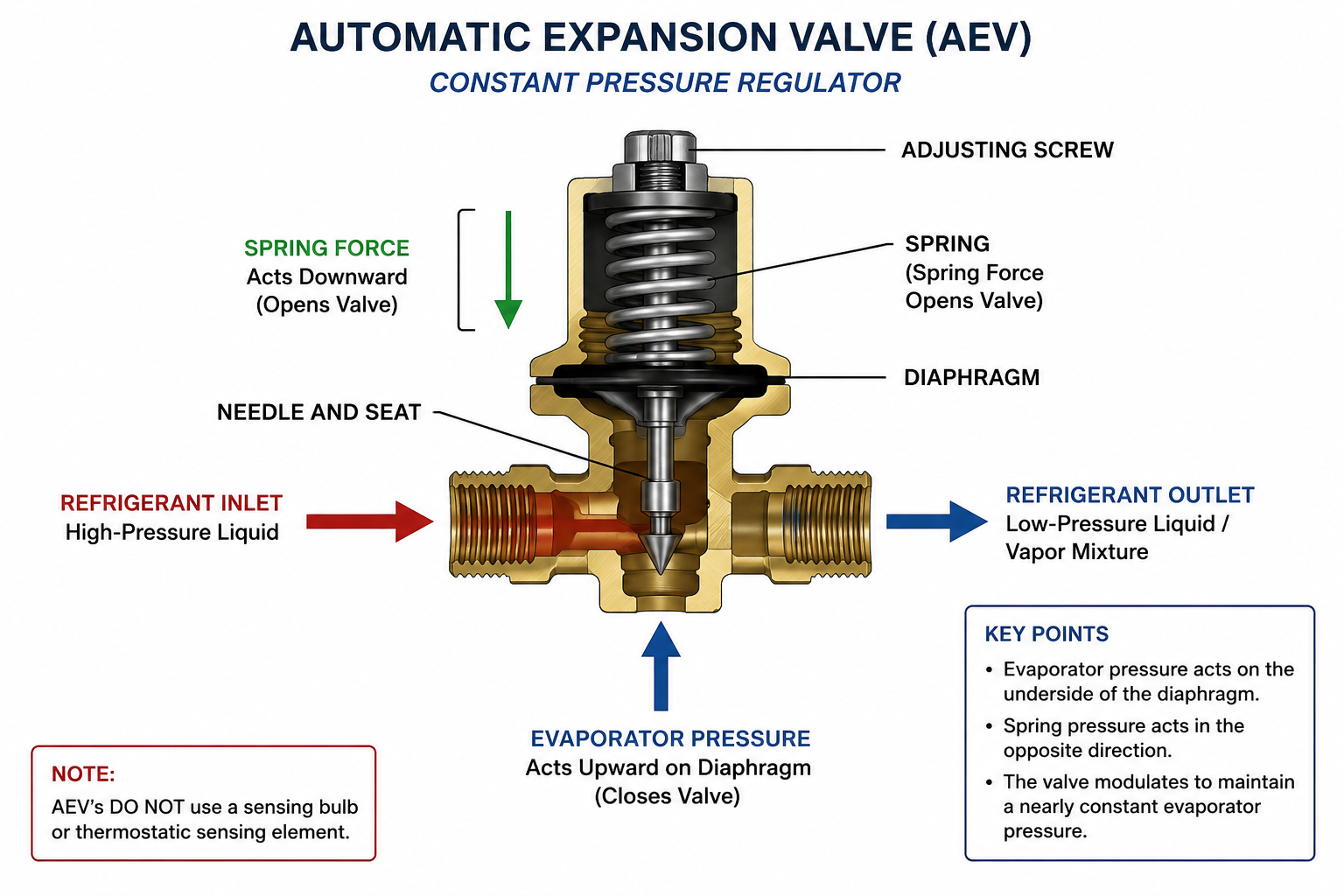
An automatic expansion valve is also called a constant-pressure expansion valve because its control action is intended to maintain evaporator pressure near a selected value.
Like other metering devices, the AEV separates the high-pressure liquid side of the refrigeration system from the low-pressure evaporator side and controls the amount of refrigerant entering the evaporator.
A modulating metering device that changes refrigerant flow in response to evaporator pressure in order to maintain a relatively constant evaporator pressure.
Both valves can modulate refrigerant flow, but they do not respond to system load in the same way. A TXV responds to evaporator outlet conditions and superheat. An AEV primarily responds to evaporator pressure.
How the Valve Is Constructed
An AEV contains a movable valve mechanism operated by pressure acting on a diaphragm and by an opposing spring force.
Diaphragm
The diaphragm moves in response to the forces acting above and below it and transfers that movement to the valve mechanism.
Needle and Seat
The needle and seat form the variable restriction that controls the amount of refrigerant flowing into the evaporator.
Evaporator Pressure
Evaporator pressure acts on the diaphragm and provides the primary force that tends to move the valve toward closed.
Spring
The adjustable spring provides the opposing force that tends to open the valve and establishes the evaporator-pressure setting.
Refrigerant Inlet
High-pressure liquid refrigerant enters the valve from the liquid line.
Refrigerant Outlet
After the pressure drop through the valve, a low-pressure liquid/vapor mixture enters the evaporator.
What Opens and Closes an AEV?
The basic AEV operates by balancing evaporator pressure against spring pressure.
Evaporator Pressure
Evaporator pressure acts on the bottom of the diaphragm. As evaporator pressure rises, the closing force becomes stronger.
Spring Pressure
Spring pressure acts in the opposite direction and tends to open the valve. The spring setting establishes the evaporator pressure the valve attempts to maintain.
When these forces are balanced, the valve settles at a position that supplies enough refrigerant to maintain the selected evaporator pressure under the present operating conditions.
The AEV does not use a sensing bulb to measure evaporator outlet temperature. Its operating response is based primarily on evaporator pressure.
Increasing Load Tends to Close the AEV
This is the concept that most clearly separates AEV operation from TXV operation.
When more heat enters the evaporator, refrigerant boils more rapidly and evaporator pressure tends to increase. Because evaporator pressure is the AEV closing force, the higher pressure pushes the valve toward closed.
Refrigeration load increases.
More heat enters the evaporator from the air, product, water, or other material being cooled.
Evaporator pressure tends to rise.
The increased heat load causes refrigerant to boil more rapidly and raises evaporator pressure.
The closing force increases.
Higher evaporator pressure exerts more force on the diaphragm.
The valve moves toward closed.
The needle moves closer to the seat and refrigerant flow decreases.
Evaporator pressure is held near the setting.
Reducing refrigerant feed helps prevent evaporator pressure from continuing to rise.
When evaporator load rises, the AEV tends to reduce refrigerant feed. This is opposite the response of a TXV, which generally opens farther when evaporator load increases.
The original course describes this as the AEV beginning to starve the evaporator as load increases in order to maintain evaporator pressure and boiling point. :contentReference[oaicite:2]{index=2}
Decreasing Load Allows the AEV to Open
When refrigeration load decreases, less heat is available to boil refrigerant in the evaporator. Evaporator pressure tends to fall.
Refrigeration load decreases.
Less heat enters the evaporator.
Evaporator pressure tends to fall.
With less heat being absorbed, the evaporator pressure begins to decrease.
The evaporator-pressure closing force decreases.
The diaphragm receives less upward force from the evaporator pressure.
Spring pressure becomes relatively stronger.
The spring moves the valve farther open.
More refrigerant enters the evaporator.
The increased refrigerant feed helps prevent evaporator pressure from falling below the selected operating range.
The Two Valves Respond Oppositely to Load
| Operating Condition | Automatic Expansion Valve | Thermostatic Expansion Valve |
|---|---|---|
| Primary Control | Evaporator pressure | Evaporator outlet conditions / superheat |
| Load Increases | Evaporator pressure rises and valve tends to close | Outlet conditions cause valve to open farther |
| Refrigerant Feed With Increasing Load | Decreases | Increases |
| Load Decreases | Evaporator pressure falls and valve tends to open | Valve moves toward closed |
| Main Operating Goal | Maintain relatively constant evaporator pressure | Maintain intended evaporator superheat |
| Sensing Bulb | No | Yes |
TXV: More load generally means more refrigerant. AEV: More evaporator pressure means the valve moves toward closed.
Why Maintain Evaporator Pressure?
Refrigerant saturation temperature depends on refrigerant pressure. If an AEV maintains evaporator pressure near a selected value, it also tends to maintain a corresponding refrigerant boiling temperature.
Controlled near selected value
Corresponds to evaporator pressure
Remains relatively steady
This operating characteristic made constant-pressure expansion valves useful in applications where maintaining a steady evaporating temperature was particularly important.
Another name for an automatic expansion valve because the valve modulates refrigerant flow in response to evaporator pressure and attempts to maintain that pressure near a selected setting.
Changing the Spring Changes the Pressure Setting
The adjustable spring determines how much evaporator pressure is required to balance the opening force and move the valve toward closed.
The original course describes the AEV adjustment direction differently from the TXV: turning the AEV adjustment clockwise opens the valve and allows more refrigerant into the evaporator, while turning it counterclockwise reduces refrigerant feed. :contentReference[oaicite:3]{index=3}
More Refrigerant Feed
The original course specifies that clockwise adjustment opens the AEV farther, increases refrigerant feed, and tends to lower superheat.
Less Refrigerant Feed
The original course specifies that counterclockwise adjustment moves the valve toward a more restricted condition, decreases refrigerant feed, and tends to raise superheat.
Adjustment direction and procedure must be verified for the specific valve being serviced. Do not assume that every expansion valve adjusts in the same direction simply because it has an adjustment stem.
Pressure Is the Main Diagnostic Measurement
Because the AEV is designed to control evaporator pressure, pressure measurement is central to evaluating its operation.
Identify the Refrigerant
The refrigerant must be known before evaporator pressure can be related to saturation temperature.
Determine Evaporator Pressure
Measure pressure as close as practical to the evaporator conditions the valve is intended to control.
Convert Pressure to Saturation Temperature
Use the appropriate refrigerant pressure-temperature relationship to determine the corresponding boiling temperature.
Compare With the Required Setting
Determine whether evaporator pressure and temperature are appropriate for the equipment and application.
The original course notes that the technician may not have a pressure port directly at the evaporator and therefore must consider pressure loss between the evaporator and the pressure-measurement location. :contentReference[oaicite:4]{index=4}
The AEV Needs a Reliable Supply of Liquid Refrigerant
Like a TXV, the AEV is intended to receive high-pressure liquid refrigerant at its inlet. A dependable supply of liquid refrigerant allows the valve to meter refrigerant consistently.
Liquid refrigerant should reach the valve from the high-pressure side of the system.
The pressure drop creates flash gas while the remaining liquid enters the evaporator and absorbs heat.
The AEV may control refrigerant differently from a TXV, but high-pressure liquid still enters the metering device and a low-pressure liquid/vapor mixture still enters the evaporator.
Why Is a Receiver Often Used?
The original course associates AEV systems with liquid receivers. A receiver stores liquid refrigerant on the high-pressure side and helps maintain a supply of liquid refrigerant to the metering device. :contentReference[oaicite:5]{index=5}
Condenses vapor to liquid
Stores high-pressure liquid refrigerant
Meters liquid into evaporator
The receiver provides space for refrigerant inventory as operating conditions change while helping ensure that liquid rather than vapor is supplied to the expansion valve.
The receiver stores liquid refrigerant. The AEV still performs the actual pressure reduction and refrigerant-flow control between the high-pressure and low-pressure sides of the system.
Where Does an AEV Make Sense?
The AEV’s constant-pressure characteristic is most useful where the refrigeration load remains relatively steady and maintaining a consistent evaporating pressure is important.
Relatively Constant Loads
The AEV is better suited to applications where refrigeration load does not change dramatically because the valve does not increase refrigerant feed when load rises.
Constant Evaporating Temperature
Maintaining evaporator pressure also tends to maintain a relatively constant refrigerant saturation temperature.
Older Refrigeration Applications
AEVs can be encountered in refrigeration equipment even though TXVs and electronic expansion valves are more common in many modern applications.
Application Must Match the Valve
The unusual load response of the AEV means it should not be substituted for another metering-device type simply because the connections fit.
The AEV Cannot Feed More Refrigerant as Load Rises
Consider an evaporator subjected to a sudden large increase in heat load. A TXV would normally respond by increasing refrigerant feed. The AEV responds differently.
Heat Load Rises
More heat enters the evaporator.
Evaporator Pressure Rises
The increased boiling rate raises pressure.
AEV Moves Toward Closed
Higher evaporator pressure increases the valve’s closing force.
Refrigerant Feed Decreases
The evaporator may become increasingly starved as the heat load rises.
An AEV is not designed to follow large changes in refrigeration load the way a TXV does. Its priority is maintaining evaporator pressure, not increasing refrigerant feed to match increasing evaporator load.
Where the AEV Fits
| Device | How Refrigerant Flow Is Controlled | Primary Response |
|---|---|---|
| Capillary Tube | Fixed tubing diameter and length | System pressure difference |
| Fixed Orifice | Fixed calibrated opening | System pressure difference |
| TXV | Variable needle and seat | Evaporator outlet conditions / superheat |
| AEV | Variable needle and seat | Evaporator pressure |
| EEV | Electronically positioned valve | Electronic sensors and control algorithm |
Follow AEV Operation Step by Step
High-pressure liquid refrigerant reaches the automatic expansion valve from the liquid line.
The AEV meters refrigerant through a variable needle-and-seat opening.
Evaporator pressure provides the primary force that tends to close the valve.
Spring pressure opposes evaporator pressure and tends to open the valve.
When evaporator pressure rises, the AEV moves toward closed and refrigerant feed decreases.
When evaporator pressure falls, spring pressure opens the valve farther and refrigerant feed increases.
The valve continually seeks a position that maintains evaporator pressure near its selected setting.
The AEV response to load is fundamentally different from the response of a TXV.
Can You Explain an Automatic Expansion Valve?
You should be able to answer these questions before continuing.
- What is another name for an automatic expansion valve?
- What system condition is an AEV designed to maintain?
- What force tends to close an AEV?
- What force tends to open an AEV?
- What happens to evaporator pressure when refrigeration load increases?
- How does the AEV respond when evaporator pressure rises?
- How does the valve respond when evaporator pressure falls?
- Why is the AEV response to increasing load considered opposite the response of a TXV?
- Why does maintaining evaporator pressure also tend to maintain evaporator saturation temperature?
- What refrigerant state should enter an AEV?
- What refrigerant state leaves the AEV and enters the evaporator?
- Why is a receiver often associated with AEV systems?
What You Should Have Learned
An automatic expansion valve is also called a constant-pressure expansion valve because it attempts to maintain a relatively constant evaporator pressure.
Evaporator pressure acts as the primary AEV closing force, while spring pressure tends to open the valve.
When evaporator load and pressure increase, the AEV moves toward closed and decreases refrigerant flow.
When evaporator pressure decreases, the spring opens the valve farther and increases refrigerant feed.
The AEV responds to changing refrigeration load in the opposite direction from a TXV.
Maintaining evaporator pressure also tends to maintain the corresponding refrigerant saturation temperature.
AEV systems require a reliable supply of high-pressure liquid refrigerant, and liquid receivers are commonly associated with these systems in the original course material.
High-pressure liquid enters the AEV, and a low-pressure liquid/vapor mixture containing flash gas enters the evaporator.