Capillary Tubes and Fixed-Orifice Devices
Capillary tubes and fixed-orifice devices are fixed metering devices. Unlike TXVs and electronic expansion valves, they do not actively change the size of the refrigerant opening as system conditions change.
Both devices create the pressure drop needed between the high-pressure liquid line and the low-pressure evaporator, but they accomplish this with a permanently sized restriction.
What You Will Learn
By the end of this lesson you should be able to:
Explain how a capillary tube meters refrigerant.
Describe how the small inside diameter and length of the tubing restrict refrigerant flow and produce a pressure drop.
Identify the factors that affect capillary-tube operation.
Explain why tube diameter, tube length, pressure difference, refrigerant, and system operating conditions affect refrigerant flow.
Recognize a capillary-tube suction-line heat exchanger.
Identify systems in which part of the capillary tube is attached to or wrapped around the suction line.
Explain how a fixed-orifice device operates.
Describe how a precisely sized opening meters refrigerant entering the evaporator.
Compare fixed metering devices with modulating devices.
Understand why capillary tubes and fixed orifices respond differently to changing loads than TXVs and EEVs.
Recognize important service considerations.
Understand why correct sizing, system charge, cleanliness, and proper replacement practices are especially important with fixed metering devices.
A Restriction Controls Refrigerant Flow
In Lesson 1 you learned that a metering device controls refrigerant entering the evaporator and creates the pressure drop between the high-pressure liquid line and the low-pressure evaporator.
A capillary tube or fixed orifice accomplishes this with a restriction whose physical size does not automatically change as the refrigeration load changes.
High-Pressure Liquid
Pressure Drops
Low-Pressure Liquid / Vapor Mixture
Because the opening is fixed, these devices cannot directly open farther when the evaporator load increases or close farther when the load decreases. Refrigerant flow instead changes as the pressures and operating conditions on each side of the restriction change.
A fixed metering device has no sensing bulb, diaphragm, controller, or stepper motor telling it how much refrigerant the evaporator needs. The system and the restriction must be properly matched to one another.
The Simplest Refrigerant Metering Device
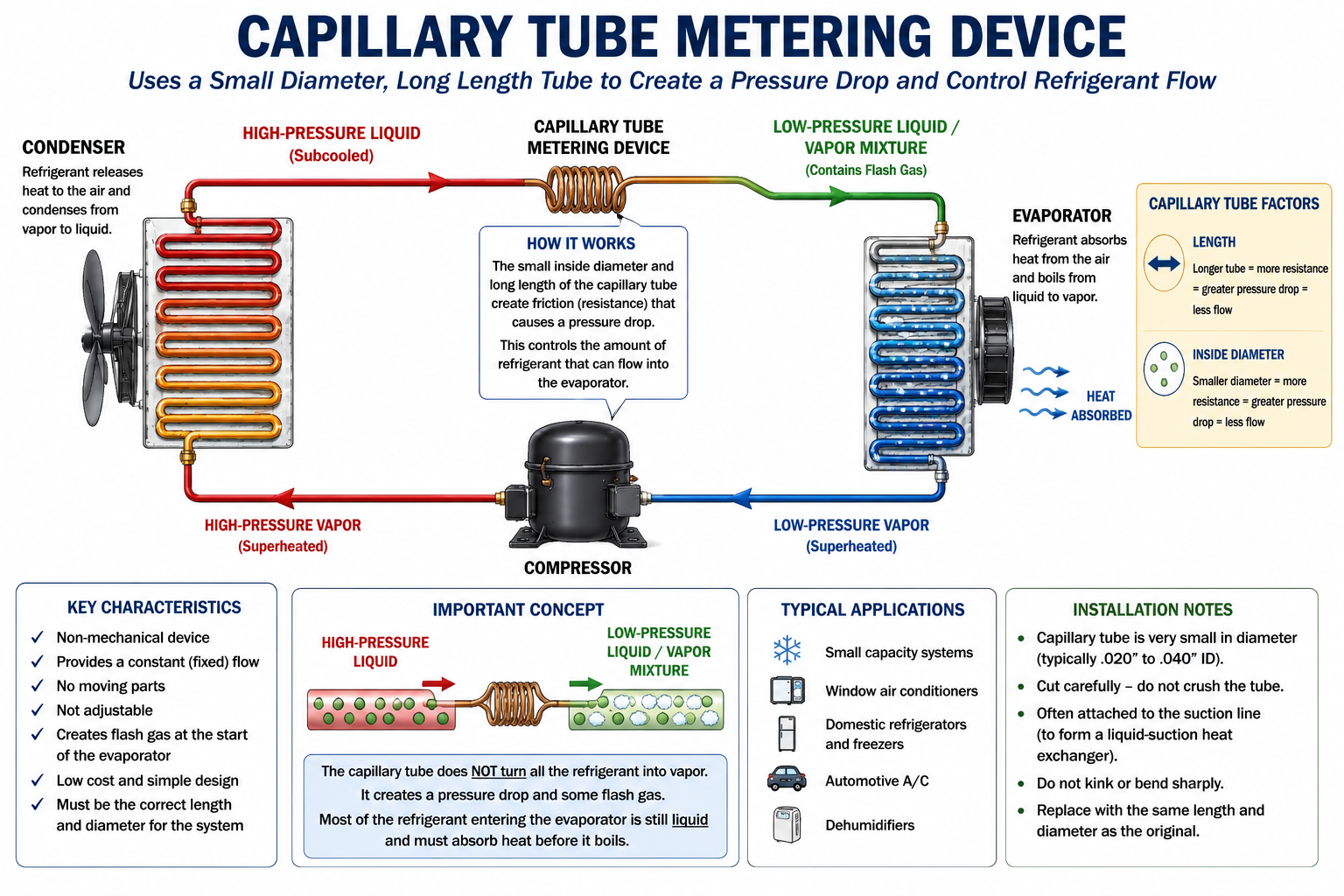
A capillary tube is a long piece of tubing with a very small inside diameter. It contains no moving mechanical parts and has no adjustment mechanism.
Instead of forcing refrigerant through one short opening, the capillary tube creates resistance to refrigerant flow throughout its length. The combination of the tube’s inside diameter and length determines how restrictive the tube is.
No Moving Parts
A capillary tube is simply carefully selected small-diameter tubing. There is no needle, seat, diaphragm, sensing bulb, or motor.
Not Adjustable
Once installed, the restriction cannot be adjusted. Changing the metering characteristics requires changing the tubing dimensions or replacing the tube with the specified part.
Small Inside Diameter
The narrow passage creates resistance to refrigerant flow. Even a small change in inside diameter can substantially change the metering characteristics.
Selected Length
The length of the tube is part of the design. Refrigerant experiences friction and pressure loss as it travels through the tubing.
Length and Diameter Work Together
The capillary tube must be sized for the refrigerant and the system in which it is installed. Two of the most important physical characteristics are the tube’s inside diameter and its length.
Inside Diameter
A smaller inside diameter creates more resistance to refrigerant flow. A larger inside diameter creates less resistance.
Tube Length
A longer capillary tube generally creates more resistance and a greater pressure loss. A shorter tube generally creates less resistance.
You cannot determine capillary-tube capacity by looking at length alone or diameter alone. The combination of inside diameter and length determines the restriction, and the correct combination depends on the system design.
When replacing a capillary tube, do not assume that another piece of small tubing will work. Use the manufacturer’s specified replacement or match the required inside diameter and effective length exactly unless an approved replacement procedure specifies otherwise.
A Fixed Restriction Does Not Mean Constant Refrigerant Flow
The physical restriction of a capillary tube remains fixed, but the amount of refrigerant moving through it can change as system conditions change.
Pressure Difference
The pressure difference between the high side and low side helps drive refrigerant through the capillary tube. Changing condensing or evaporating pressures can therefore change refrigerant flow.
Liquid Condition
The condition of the refrigerant arriving at the capillary tube affects its operation. The device is intended to receive liquid refrigerant from the liquid side of the system.
System Load
The capillary tube cannot sense evaporator load and reposition itself. The entire refrigeration system is designed so the fixed restriction provides acceptable operation over the equipment’s intended range.
Refrigerant Charge
Because the capillary tube cannot adjust itself to compensate for incorrect system conditions, proper refrigerant charge is particularly important.
A fixed restriction means the physical metering opening does not automatically change size. It does not mean that refrigerant mass flow remains exactly the same under every operating condition.
Why Is the Capillary Tube Sometimes Attached to the Suction Line?
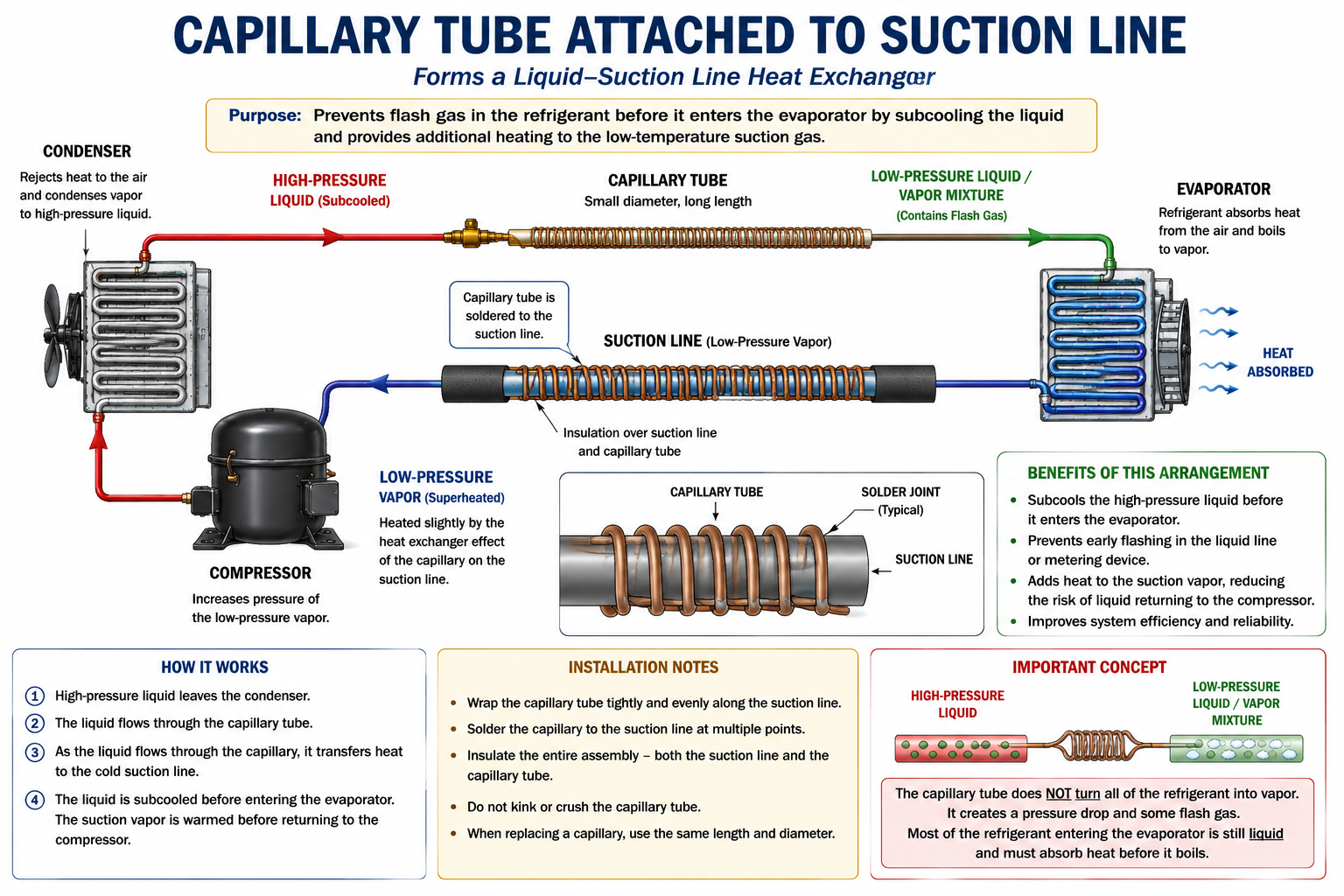
On some refrigeration systems, part of the capillary tube is placed in close thermal contact with the suction line. The two lines then form a simple liquid-to-suction heat exchanger.
The relatively warm liquid traveling through the capillary tube can transfer heat to the colder suction vapor returning from the evaporator. This interaction can increase liquid subcooling before or during the metering process while increasing the superheat of the suction vapor.
Capillary Tube
Heat is removed from the warmer high-pressure liquid refrigerant as it travels toward the evaporator.
Suction Line
The colder low-pressure vapor receives that heat as it returns from the evaporator toward the compressor.
This arrangement is common in some small refrigeration appliances and other equipment designed around capillary-tube metering.
If the original capillary tube was bonded to, soldered to, or wrapped around the suction line, that arrangement is part of the system design. Replacing the tube without restoring the intended thermal contact can change system operation.
Small Tubing Requires Careful Handling
The very small internal passage that allows a capillary tube to meter refrigerant also makes it vulnerable to damage and restriction.
Do Not Crush the Tube
Flattening or deforming the tubing changes its internal dimensions and therefore changes the refrigerant restriction.
Keep the System Clean
Contamination that could pass through a larger refrigerant line can obstruct the very small passage inside a capillary tube.
Match the Replacement
The correct replacement must provide the restriction intended by the equipment manufacturer. Diameter and length are both important.
Protect the Opening
Improper cutting can partially close or distort the end of the tube. A clean, unrestricted opening is essential to proper operation.
Because the opening is extremely small, moisture, debris, oil breakdown products, or other contamination can restrict refrigerant flow. System cleanliness and proper filtration and dehydration practices are especially important.
A Short, Precisely Sized Restriction
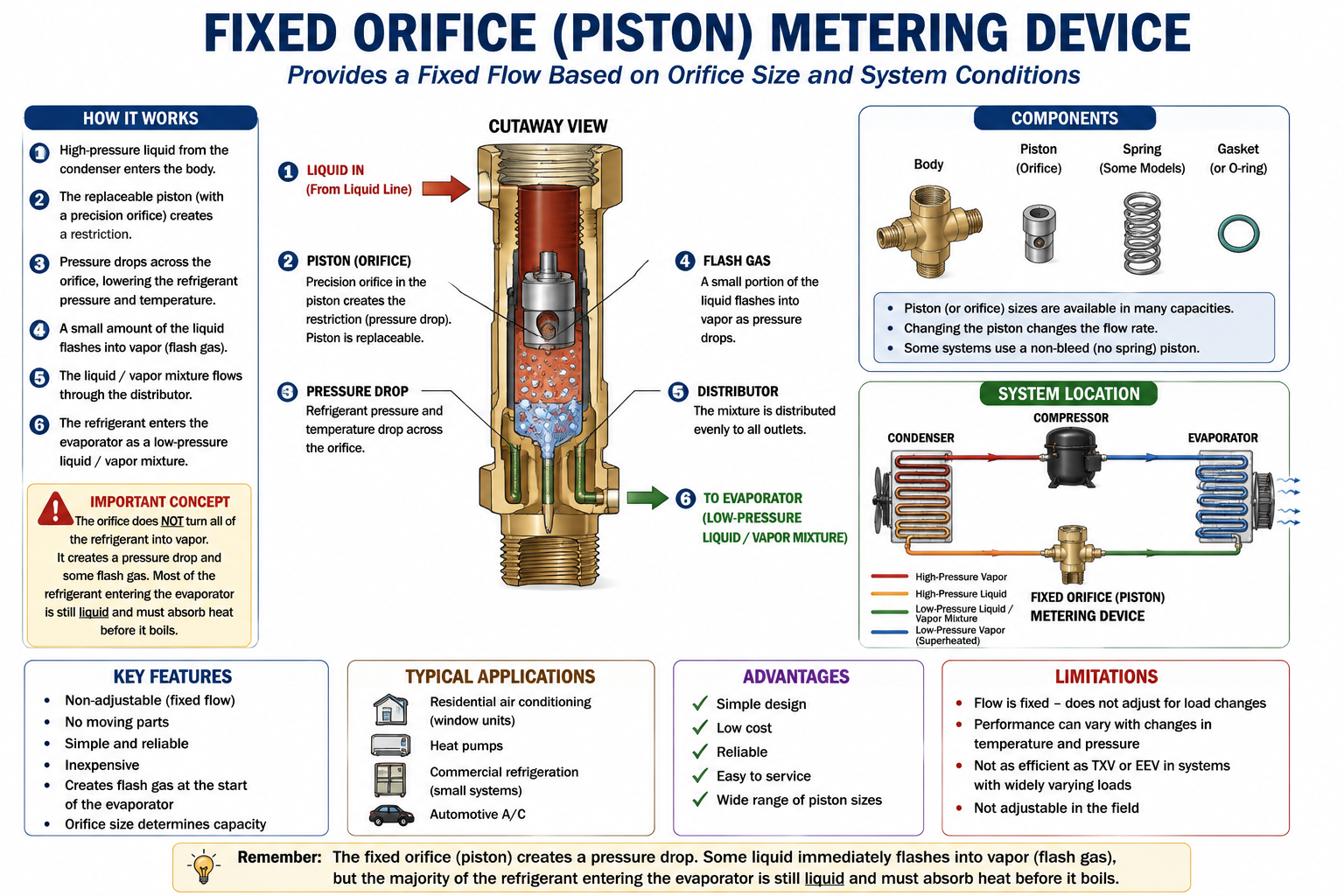
A fixed-orifice device performs the same basic refrigeration function as a capillary tube: it creates a restriction between the high-pressure liquid side and the low-pressure evaporator side.
Instead of using a long length of small-diameter tubing, a fixed orifice uses a short opening of a carefully selected size. One common form is the removable metering piston used in some air-conditioning and heat-pump equipment.
Creates the required restriction through a combination of very small inside diameter and tubing length.
Creates the required restriction primarily through a precisely sized opening in the metering device.
The orifice size is part of the equipment design. Installing an orifice that is larger or smaller than specified changes refrigerant feed to the evaporator and can produce incorrect system operation.
How the Piston Controls Refrigerant Flow
A metering piston contains a calibrated opening through which refrigerant must pass while the system is operating in the direction for which the piston is metering.
Liquid refrigerant reaches the piston.
High-pressure liquid refrigerant from the liquid line reaches the inlet side of the fixed-orifice assembly.
Refrigerant is forced through the opening.
The calibrated hole restricts refrigerant flow and separates the high-pressure side from the lower evaporator pressure.
The pressure drops.
As the refrigerant passes through the restriction, its pressure falls to the lower evaporator pressure.
Flash gas forms.
Part of the liquid refrigerant immediately boils because of the pressure reduction, producing the liquid/vapor mixture entering the evaporator.
Notice that the pressure-drop and flash-gas process is the same basic process introduced in Lesson 1. What changes from one metering-device design to another is how refrigerant flow is controlled.
Fixed Devices Cannot Follow the Load Directly
An important difference between a fixed metering device and a TXV or EEV is the ability to actively respond to changing evaporator conditions.
Opening Does Not Change
The restriction remains physically fixed. Refrigerant flow changes because the pressures and other system conditions change.
Opening Can Change
The valve can increase or decrease refrigerant flow in response to sensed system conditions and evaporator requirements.
This does not mean fixed metering devices are poor designs. When correctly matched to the equipment, they can be simple, reliable, and effective. It does mean that the equipment designer must account for the operating range without relying on the metering device to actively reposition itself.
Why Charge Is Important With Fixed Metering Devices
A fixed metering device cannot compensate for an incorrect refrigerant charge by opening or closing itself. The amount of refrigerant in the system therefore has a strong effect on how the evaporator and condenser operate.
Too Little Refrigerant
The evaporator may be underfed because insufficient liquid refrigerant is available to the metering device.
Correct Charge
The system can provide the pressure and liquid conditions for which the fixed metering device and heat exchangers were designed.
Too Much Refrigerant
Excess refrigerant can alter condenser operation, liquid-line conditions, and the pressure difference across the fixed restriction.
The presence of a fixed metering device is important when interpreting system pressures, temperatures, superheat, and subcooling, but refrigerant charge should be evaluated using the equipment manufacturer’s specified procedure and the complete set of operating conditions.
Where Are These Devices Used?
Household Refrigeration
Capillary tubes are commonly associated with refrigerators, freezers, and other relatively small factory-designed refrigeration systems.
Small Refrigeration Equipment
Some coolers, dehumidifiers, room air conditioners, and specialized refrigeration equipment use capillary-tube metering.
Comfort Air Conditioning
Fixed-orifice pistons have been widely used in residential and light-commercial air-conditioning equipment.
Heat Pumps
Some heat-pump designs use piston-type metering arrangements that provide the required refrigerant restriction according to the direction of refrigerant flow and the equipment design.
The technician should never identify the correct metering device based only on the general type of equipment. Always determine what device and size the manufacturer specified for the particular system.
Capillary Tube vs. Fixed Orifice
| Characteristic | Capillary Tube | Fixed Orifice / Piston |
|---|---|---|
| Type | Fixed metering device | Fixed metering device |
| Moving Parts | None | None required for basic metering action |
| Adjustment | Not adjustable | Not adjustable during operation |
| How Restriction Is Established | Inside diameter and tubing length | Calibrated orifice size |
| Active Load Response | No | No |
| Pressure Drop | Develops through the length of the small tubing | Develops across the calibrated opening |
| Common Applications | Small refrigeration and appliance-type systems | Many air-conditioning and heat-pump systems |
| Critical Service Concern | Correct diameter, length, cleanliness, and charge | Correct orifice size, cleanliness, and charge |
The Refrigerant State Is Still the Same
Whether the restriction is a capillary tube or a fixed orifice, the basic refrigerant-state change across the metering device remains the same.
Liquid refrigerant arrives from the condenser and liquid line.
Some liquid has become flash gas, while the remaining liquid enters the evaporator and must absorb heat before boiling.
The vapor formed because of the pressure drop through the metering device is flash gas. The refrigerant leaving the device is not all vapor. A liquid/vapor mixture enters the evaporator.
What Should You Remember About Fixed Metering Devices?
Capillary tubes and fixed orifices are fixed metering devices because their physical restriction does not actively change while the system operates.
A capillary tube meters refrigerant through a combination of very small inside diameter and tubing length.
Smaller capillary-tube diameter or greater tube length generally increases restriction to refrigerant flow.
A capillary tube may be placed in thermal contact with the suction line to form a liquid-to-suction heat exchanger.
A fixed-orifice device meters refrigerant through a calibrated opening rather than through a long length of tubing.
Neither device directly senses evaporator load and changes its opening the way a TXV or EEV can.
Correct sizing, cleanliness, refrigerant charge, and manufacturer-specified replacement practices are especially important with fixed metering devices.
High-pressure liquid enters the restriction and a low-pressure liquid/vapor mixture containing flash gas leaves it and enters the evaporator.
Can You Explain Fixed Metering Devices?
You should be able to answer these questions before continuing.
- Why is a capillary tube considered a fixed metering device?
- What two physical dimensions are especially important when selecting a capillary tube?
- What generally happens to restriction when capillary-tube length is increased?
- What generally happens to restriction when the inside diameter is decreased?
- Why should a replacement capillary tube match the original system specification?
- Why might a capillary tube be attached to the suction line?
- Why is contamination especially troublesome in a capillary-tube system?
- How does a fixed-orifice piston differ physically from a capillary tube?
- Can a fixed-orifice device open farther when evaporator load increases?
- What is the refrigerant state before a fixed metering device?
- What is the refrigerant state immediately after the metering device?
- What do we call the portion of liquid that boils because of the pressure drop?
What You Should Have Learned
Capillary tubes and fixed orifices are fixed metering devices with restrictions that do not actively change size as refrigeration load changes.
A capillary tube creates its restriction through the combination of a very small inside diameter and a selected tubing length.
Smaller inside diameter and greater tubing length generally increase resistance to refrigerant flow.
Some systems place the capillary tube in thermal contact with the suction line to create a liquid-to-suction heat exchanger.
A fixed-orifice piston controls refrigerant flow through a calibrated opening rather than through a long section of small tubing.
Fixed metering devices cannot directly sense evaporator load and reposition themselves the way TXVs and EEVs can.
Correct metering-device size, system cleanliness, refrigerant charge, and replacement practices are important to proper system operation.
High-pressure liquid enters the fixed metering device and a low-pressure liquid/vapor mixture containing flash gas enters the evaporator.