Direct-Expansion Evaporator Coils
A direct-expansion evaporator places refrigerant directly inside the coil that absorbs heat from the air being conditioned.
Warm air moves across the evaporator surface while low-pressure refrigerant flows through internal passages. Heat transfers from the air, through the coil material, and into the refrigerant.
Modern direct-expansion coils use several different heat-exchanger constructions. Two important designs are the traditional fin-and-tube coil and the microchannel coil.
What You Will Learn
By the end of this lesson you should be able to:
Describe how refrigerant inside the evaporator directly absorbs heat from air passing across the coil.
Describe how the refrigerant passages and fins work together to provide an effective heat-transfer surface.
Identify round refrigerant tubing, fins, headers, and multiple refrigerant circuits.
Identify flat tubes containing multiple small refrigerant passages and the fins located between those tubes.
Understand that the two designs accomplish the same basic heat-transfer job using different physical construction.
Recognize that either coil design depends on proper air movement and clean heat-transfer surfaces.
What Does Direct Expansion Mean?
In a direct-expansion, or DX, system, the refrigerant evaporates inside the heat exchanger that directly serves the conditioned air.
Air passes across the evaporator coil while low-pressure refrigerant flows through the coil passages.
Warm Air Reaches the Coil
Return air contains sensible and latent heat that must be removed.
Heat Transfers Through the Coil
Heat moves from the air through the metal fins and refrigerant passages.
Refrigerant Absorbs Heat
Low-pressure refrigerant boils as it absorbs heat from the air.
Cooler Air Leaves the Coil
The air leaves with less sensible heat and, when the coil is below the air dew point, less moisture.
The Heat-Transfer Path
A DX evaporator depends on several heat-transfer surfaces working together.
Contains heat that must be removed.
Increase the air-side heat-transfer surface.
Transfers heat through the metal wall.
Absorbs the heat and boils.
The coil is only one part of the heat-transfer process. Proper airflow, clean surfaces, correct refrigerant flow, and adequate temperature difference all matter.
Standard Fin-and-Tube Evaporator Coils
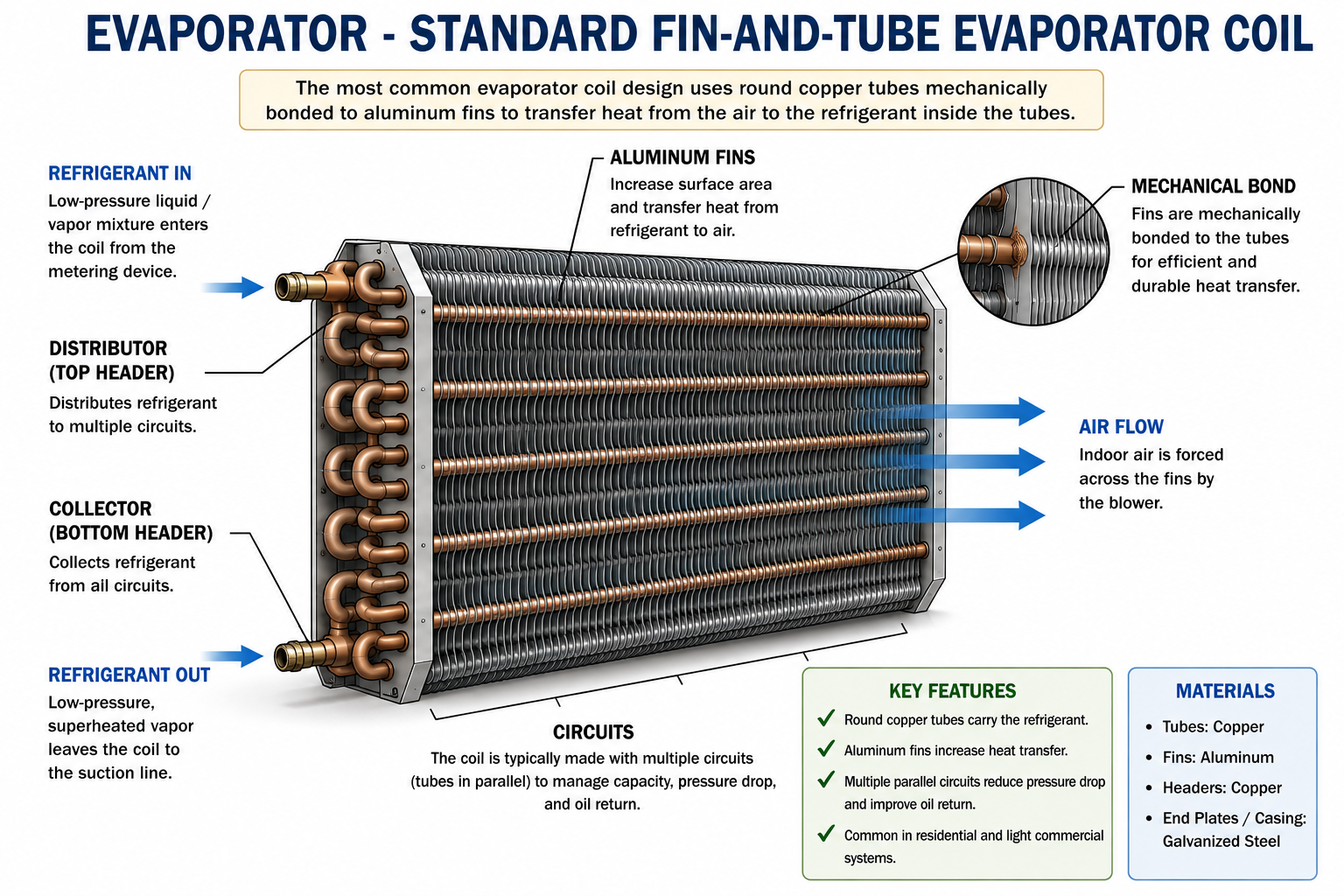
Traditional evaporator coils commonly use round refrigerant tubing passing through a large number of closely spaced metal fins.
The tubing carries the refrigerant. The fins increase the amount of metal surface exposed to the moving air.
Refrigerant Tubing
Round tubing carries refrigerant through the evaporator.
Fins
Closely spaced fins greatly increase the air-side surface area available for heat transfer.
Headers and Distributors
Refrigerant is divided among multiple coil circuits and later collected again before leaving the evaporator.
Multiple Circuits
Several refrigerant paths allow a large coil to maintain useful refrigerant velocity while limiting excessive pressure drop.
Why Are Fins Necessary?
The tubing alone would provide relatively little surface area for contact with the air.
Attaching fins to the tubing greatly increases the effective air-side heat-transfer surface.
Without Fins
Only the outside surface of the refrigerant tubing would transfer heat directly from the passing air.
With Fins
Heat can move from the air into a much larger metal surface and then conduct through the fins to the refrigerant tubing.
The fins do not create cooling. They increase the surface area available for heat transfer.
Why Does an Evaporator Have Multiple Refrigerant Circuits?
A large evaporator cannot always be treated as one extremely long refrigerant tube.
Excessive circuit length can produce excessive refrigerant pressure drop. Dividing the coil into several parallel circuits shortens the individual refrigerant paths.
Refrigerant Enters the Coil
The incoming refrigerant is distributed to several parallel paths.
Refrigerant Travels Through Multiple Circuits
Each circuit carries a portion of the total refrigerant flow through the heat-transfer surface.
The Circuits Rejoin
Refrigerant leaving the individual circuits is collected before entering the suction line.
Evaporator circuiting, pressure drop, refrigerant velocity, and oil return are examined in greater detail later in this subsection.
Microchannel Evaporator Coils
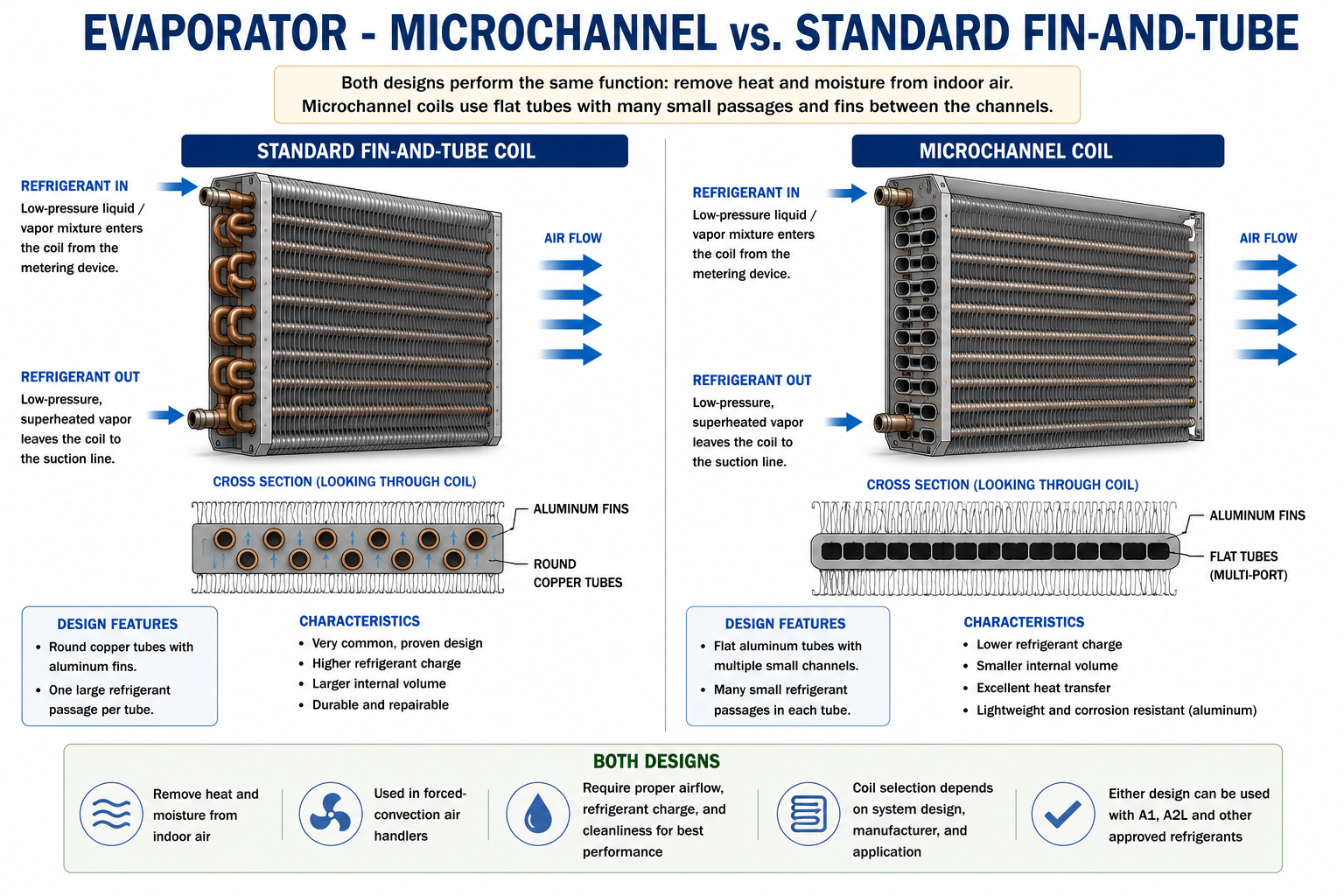
A microchannel coil uses flat refrigerant tubes containing many small internal passages instead of traditional round tubing.
These flat multiport tubes are connected to fins that provide the air-side heat-transfer surface.
Flat Multiport Tubes
Each flat tube contains several small refrigerant passages rather than one large round passage.
Closely Coupled Fins
Fins located between the flat tubes provide the surface area needed to transfer heat from the air.
Standard Fin-and-Tube vs. Microchannel
Both designs perform the same basic job: transfer heat from the air into the refrigerant.
Fin-and-Tube
Microchannel
Round tubing
Flat multiport tubes with many small passages
Fins attached to round tubing
Fins installed between flat tubes
Generally larger internal volume
Generally smaller internal volume
Individual tubes expanded or bonded into fins
Compact brazed multiport heat-exchanger assembly
Traditional coil service practices apply
Repair and cleaning procedures must account for smaller passages and different construction
Different Construction, Same Operating Requirements
Microchannel construction changes the physical design of the evaporator, but it does not change the fundamental requirements for heat transfer.
Proper Airflow
Air must move through the coil at the required rate.
Clean Heat-Transfer Surface
Dirt and debris reduce airflow and interfere with heat transfer.
Proper Refrigerant Flow
Refrigerant must be distributed correctly through the available coil circuits or passages.
Temperature Difference
The evaporator must remain colder than the air being conditioned for heat to move into the refrigerant.
Airflow Across a DX Coil
Forced-convection evaporators depend on the blower to move the proper quantity of air through the coil.
Airflow that is too low reduces heat transfer and can cause the evaporator temperature to fall excessively.
Airflow that is too high can reduce the amount of temperature and moisture change that occurs as the air passes through the coil.
Check Airflow Before Blaming the Refrigerant
Dirty filters, dirty coils, incorrect blower settings, duct restrictions, and closed registers can all alter evaporator performance.
Refrigerant measurements should be interpreted only after airflow problems have been considered.
Coil Cleanliness Matters
Both fin-and-tube and microchannel evaporators depend on clean air passages and clean heat-transfer surfaces.
Dirty Air Side
Dust, lint, biological material, and other debris can restrict airflow and insulate the heat-transfer surface.
Clean Air Side
Proper airflow can reach the full coil surface and transfer heat efficiently into the refrigerant.
Different coil materials and constructions may require different cleaning procedures. Always follow the equipment manufacturer’s approved cleaning method.
Coil Materials Have Changed
Older evaporator coils commonly used copper refrigerant tubing with aluminum fins.
Modern equipment may also use all-aluminum fin-and-tube construction or aluminum microchannel construction.
The technician should identify the actual coil material before cleaning, repairing, or applying chemicals to the evaporator.
Coil construction varies by manufacturer and equipment design. Service procedures must match the actual materials and construction of the coil being serviced.
Refrigerant Must Be Distributed Through the Coil
Large direct-expansion coils contain multiple refrigerant paths so the available heat-transfer surface can be used effectively.
Poor refrigerant distribution can leave some portions of the evaporator underfed while other portions receive more refrigerant.
Good Distribution
Refrigerant is divided appropriately among the available coil circuits and uses the heat-transfer surface effectively.
Poor Distribution
Uneven refrigerant flow can produce uneven coil temperatures and reduced evaporator performance.
The equipment that meters and distributes refrigerant into the evaporator will be covered separately in the metering-device lessons.
Put the Concepts Together
A direct-expansion evaporator contains refrigerant inside the coil that directly absorbs heat from the conditioned air.
Fins increase the air-side heat-transfer surface of the evaporator.
Traditional fin-and-tube coils commonly use round refrigerant tubing passing through closely spaced fins.
Large fin-and-tube evaporators are commonly divided into several parallel refrigerant circuits.
Microchannel evaporators use flat multiport tubes containing several small refrigerant passages.
Fin-and-tube and microchannel designs perform the same basic heat-transfer job using different physical construction.
Both designs depend on correct airflow, clean surfaces, proper refrigerant distribution, and adequate temperature difference.
Modern evaporators may use copper/aluminum, all-aluminum, or microchannel construction.
Can You Explain Direct-Expansion Evaporator Coils?
You should be able to answer these questions before continuing.
1. What does direct expansion mean?
2. What material flows inside a DX evaporator coil?
3. Why are fins attached to or incorporated into evaporator coils?
4. What carries refrigerant through a traditional fin-and-tube evaporator?
5. Why are large evaporators divided into multiple refrigerant circuits?
6. How is a microchannel refrigerant passage different from traditional round tubing?
7. Do microchannel and fin-and-tube coils perform different refrigeration functions?
8. Why is airflow important to both coil designs?
9. How can dirt on the evaporator affect system performance?
10. Why should a technician identify coil construction and material before cleaning or repair?
What You Should Have Learned
DX evaporator coils place refrigerant directly inside the heat exchanger serving the conditioned air.
Heat moves from the air through the coil material and into the refrigerant.
Fin-and-tube construction uses refrigerant tubing and fins to create a large heat-transfer surface.
Microchannel construction uses flat tubes containing multiple small refrigerant passages.
Both designs require proper airflow and clean heat-transfer surfaces.
Multiple refrigerant circuits help manage pressure drop and refrigerant velocity in larger coils.
Modern evaporator coils can use several different material combinations and service procedures.
Coil construction changes how the evaporator is built, but not its basic job of transferring heat into the refrigerant.
Next: Split-System Evaporator Coil Configurations
Direct-expansion evaporator coils can be arranged in several different physical configurations to fit the airflow path and equipment cabinet.
The next lesson examines A-coils, H-coils, V-coils, slab coils, and common upflow, downflow, and horizontal applications.
Same Heat-Transfer Job · Different Physical Configuration