Evaporator Fundamentals
The evaporator is the heat-absorbing component of the refrigeration system. Low-pressure refrigerant enters the evaporator, absorbs heat from the space or substance being cooled, and leaves as low-pressure refrigerant vapor.
Understanding the evaporator begins with one central idea: the evaporator does not create cold—it absorbs heat.
What You Will Learn
By the end of this lesson you should be able to:
Describe how the evaporator absorbs heat from the conditioned space or product.
Recognize the evaporator as the low-pressure side of the refrigeration system.
Describe how refrigerant absorbs latent heat while changing from liquid to vapor.
Relate sensible heat to temperature change and latent heat to a change of state.
Describe how an air-conditioning evaporator can remove both sensible and latent heat from the air.
Compare natural and forced convection and direct- and indirect-expansion systems.
The Evaporator in the Refrigeration Cycle
The evaporator is located on the low-pressure side of the refrigeration system. It receives refrigerant after the refrigerant has passed through the system’s metering device.
The metering device creates the conditions necessary for the refrigerant to enter the evaporator at a low pressure and low saturation temperature. The detailed operation of metering devices will be covered in a separate lesson.
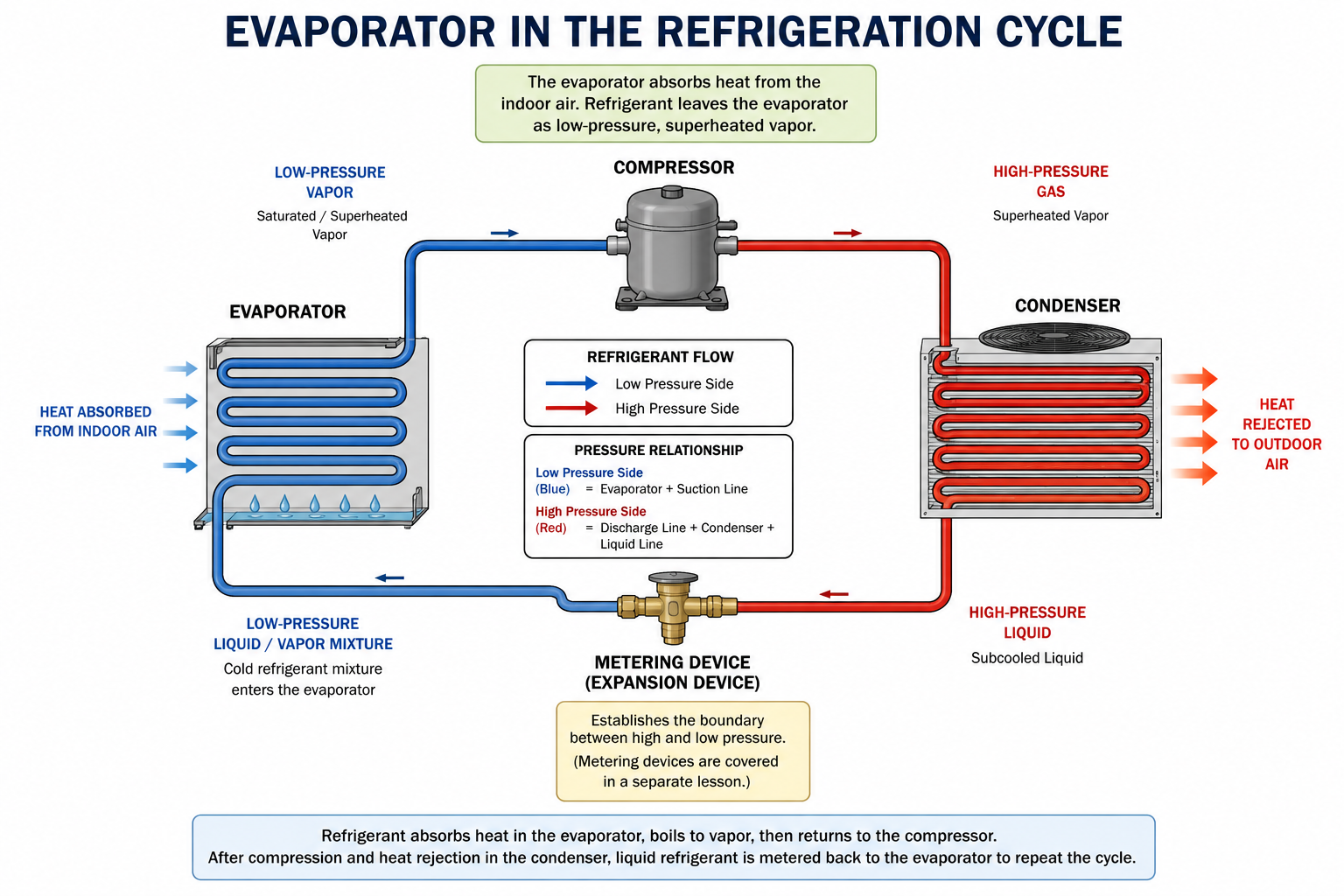
The compressor and metering device establish the pressure conditions that allow the refrigeration cycle to operate, but the evaporator is where the useful cooling effect occurs.
Heat from the conditioned space enters the refrigerant in the evaporator.
The Evaporator Does Not Make Cold
It is common to describe an evaporator as producing cold air. Technically, the evaporator is removing heat from the air.
Heat naturally moves from a higher-temperature substance toward a lower-temperature substance when a path for heat transfer exists.
The refrigerant inside the evaporator is maintained at a temperature below the temperature of the air, water, product, or other material being cooled.
Contains heat that must be removed.
Provides the heat-transfer path.
Absorbs the heat.
Think in Terms of Heat
When diagnosing refrigeration equipment, it is usually more useful to think about where heat is moving than to think about where “cold” is being produced.
What Happens Inside the Evaporator?
Refrigerant entering a direct-expansion evaporator normally contains both liquid and vapor. As the refrigerant travels through the evaporator, it absorbs heat from the material being cooled.
Low-Pressure Refrigerant Enters
The refrigerant enters the evaporator at a low pressure and a correspondingly low saturation temperature.
Heat Enters the Refrigerant
Heat moves from the warmer air, water, or product through the evaporator surface and into the refrigerant.
Liquid Refrigerant Boils
The refrigerant absorbs latent heat as the remaining liquid changes state into vapor.
Refrigerant Vapor Leaves
By the time refrigerant leaves a properly operating direct-expansion evaporator, the liquid refrigerant has boiled into vapor.
Additional heat absorbed after the final liquid refrigerant has boiled raises the vapor temperature above its saturation temperature. This condition is called superheat and will be covered in detail in the Evaporator Superheat lesson.
Boiling Refrigerant and Latent Heat
One of the most important characteristics of an evaporator is that much of the heat absorbed by the refrigerant is used to change the refrigerant from liquid to vapor.
Heat involved in a change of state is called latent heat. During the boiling process, the refrigerant absorbs heat while remaining at approximately its saturation temperature, assuming pressure remains essentially constant.
Sensible Heat
Sensible heat causes a measurable change in the temperature of a substance without changing its state.
Temperature changes.
Latent Heat
Latent heat causes a substance to change state without producing the same kind of temperature change during the phase-change process.
State changes.
The boiling refrigerant can absorb a large quantity of heat while changing from liquid to vapor.
This latent-heat absorption is fundamental to refrigeration.
Cooling and Dehumidification
An air-conditioning evaporator normally performs two related jobs: cooling the air and removing moisture from the air.
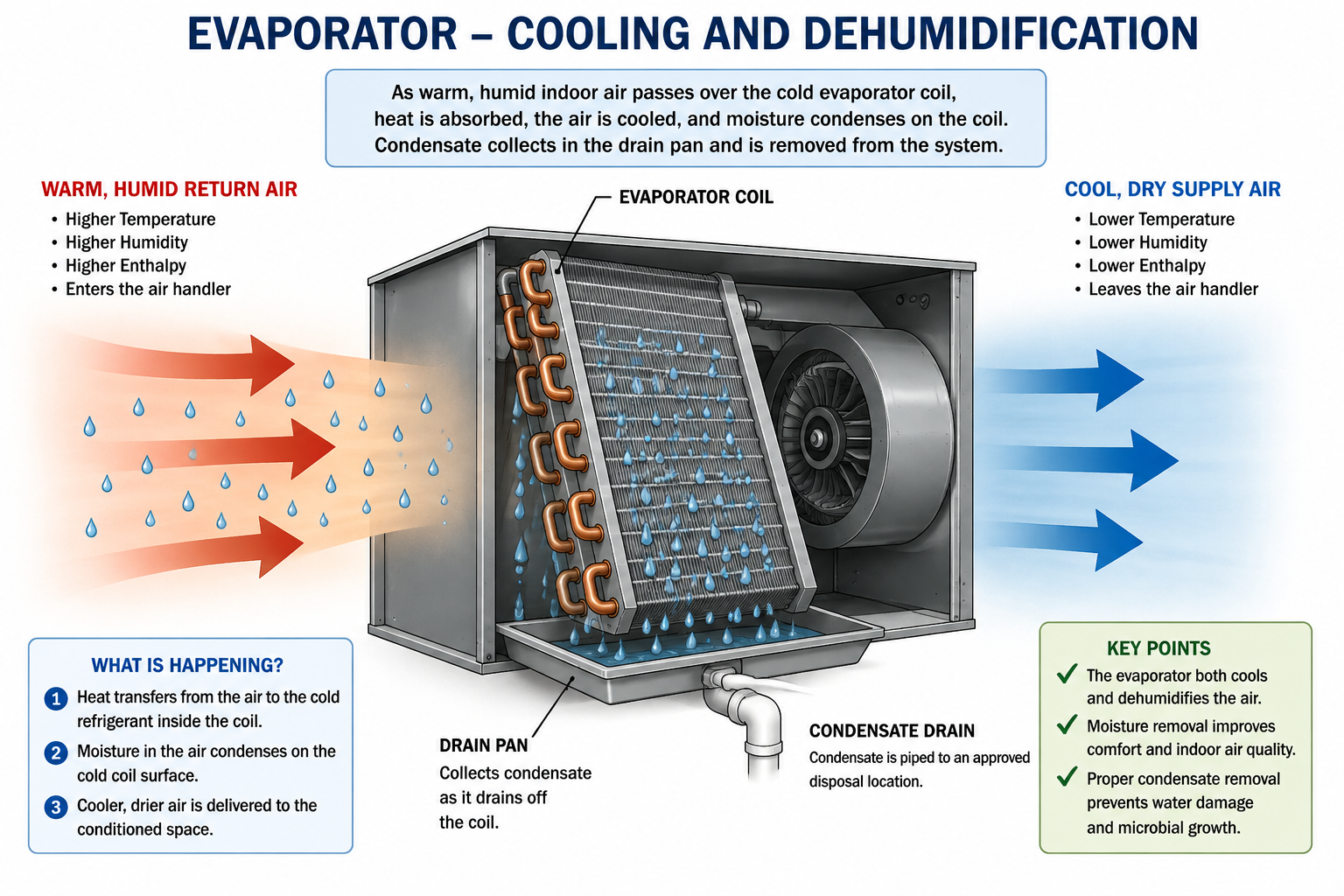
Sensible Cooling
Air temperature decreases as sensible heat transfers from the air to the evaporator.
Dehumidification
When the evaporator surface is below the dew-point temperature of the air, water vapor condenses on the coil and is removed from the airstream.
The moisture that forms on the coil must be collected and safely removed from the equipment. Drain pans, condensate piping, traps, vents, and air breaks are covered in the separate Condensate Management lesson.
Natural-Convection Evaporators
An evaporator does not always require a fan to move air across its surface. A natural-convection evaporator relies on differences in air density to circulate air.
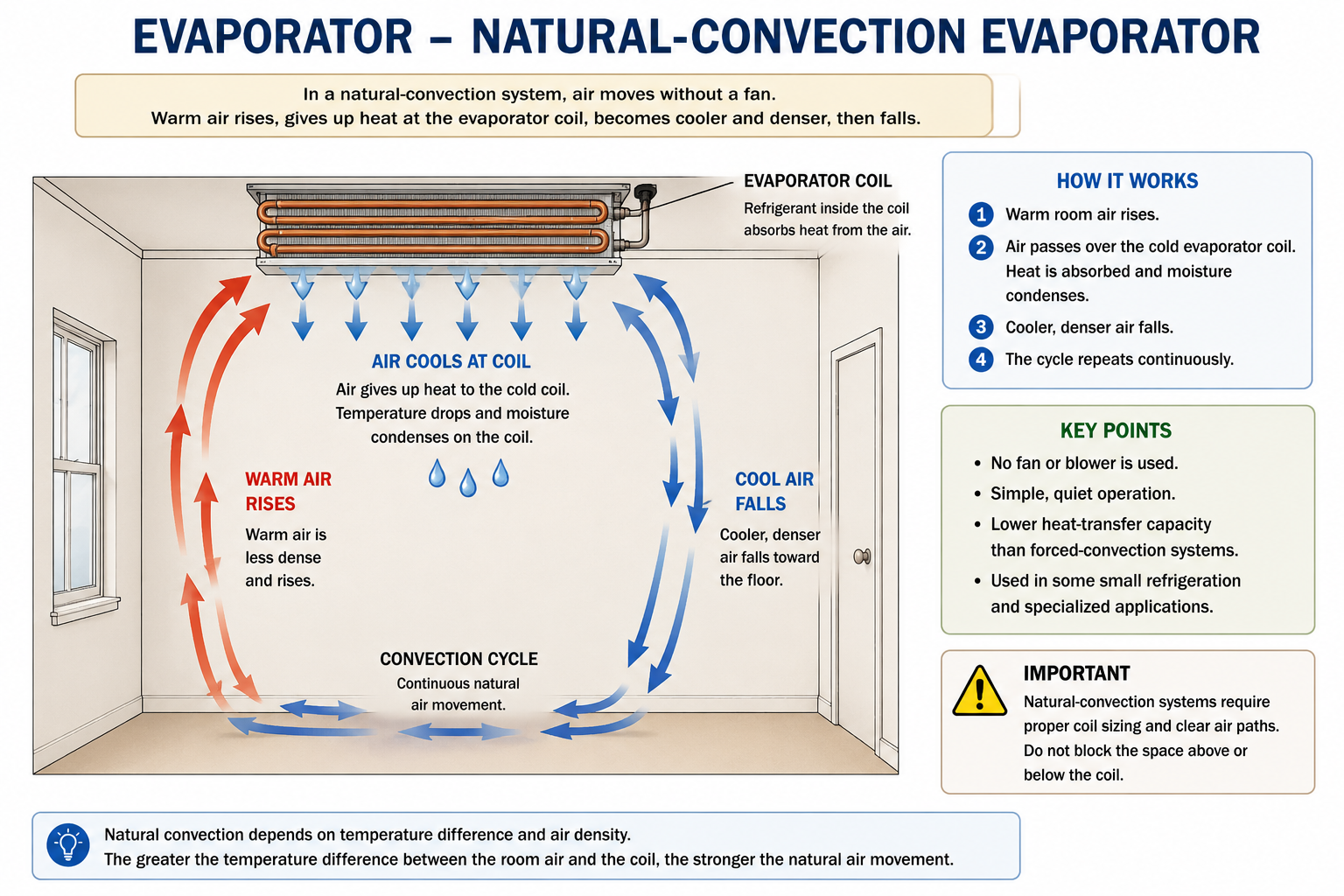
Warmer Air Rises
Warmer, less-dense air moves upward toward the evaporator.
Air Transfers Heat to the Evaporator
The air loses heat as it passes near the colder evaporator surface.
The Cooler Air Becomes Denser
The cooled air naturally moves downward.
Natural Circulation Continues
The temperature difference maintains air movement without a blower or fan.
Forced-Convection Evaporators
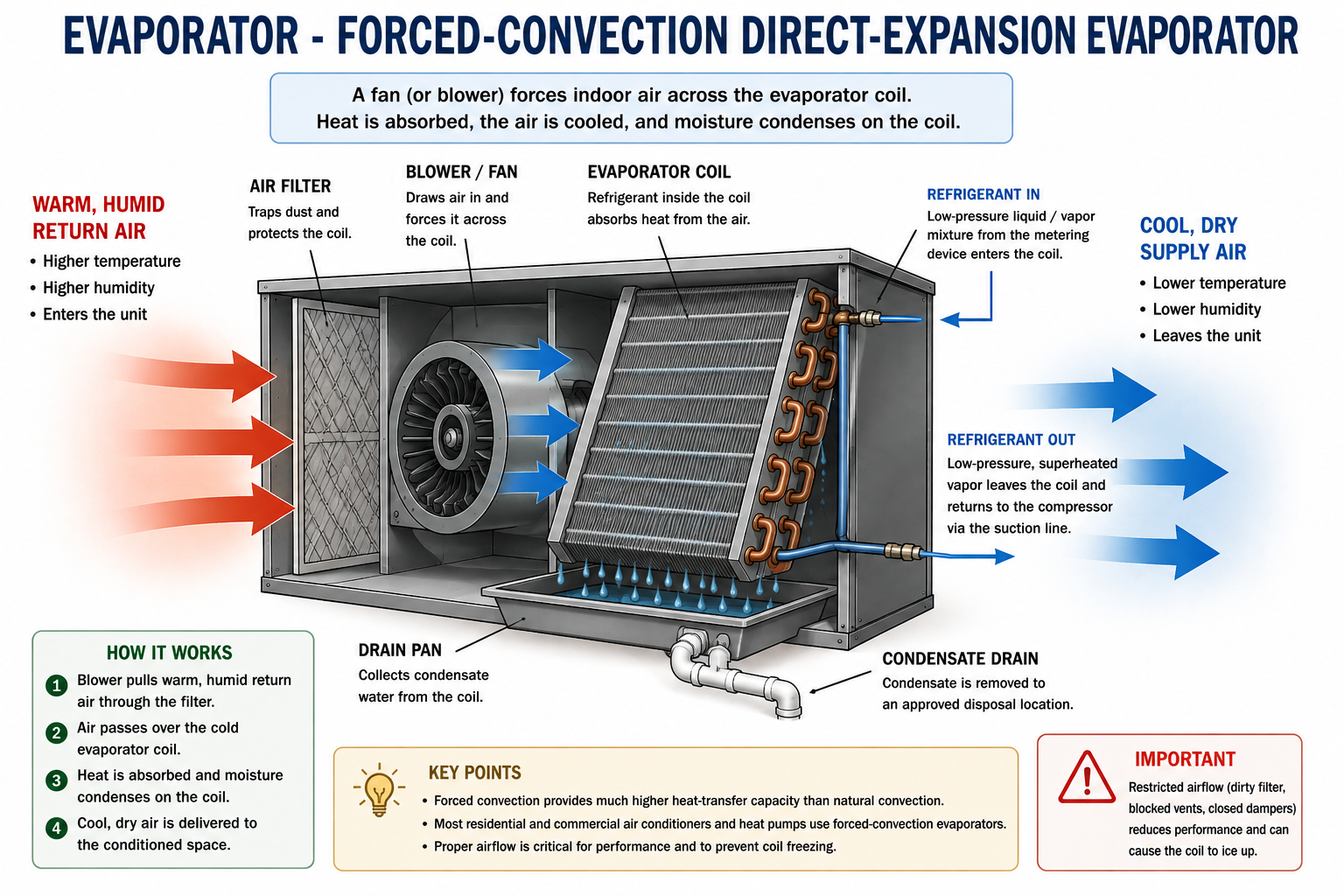
Forced-convection evaporators use a fan or blower to move air across the evaporator surface.
This allows much larger quantities of air to contact the evaporator and greatly increases the rate of heat transfer compared with relying only on natural air movement.
Natural Convection
Air movement results from differences in air temperature and density.
No fan is required for circulation.
Forced Convection
A fan or blower actively moves air across the evaporator.
Airflow becomes a major factor in evaporator performance.
Airflow Matters
A forced-convection evaporator depends on proper airflow as well as proper refrigerant conditions.
A refrigeration system can have the correct refrigerant charge and still perform poorly if airflow across the evaporator is inadequate.
Direct-Expansion Evaporators
In a direct-expansion (DX) system, refrigerant evaporates inside the evaporator while the material being cooled is in direct thermal contact with the evaporator surface.
In a typical comfort air-conditioning system, air passes directly across the refrigerant-filled evaporator coil.
Heat is removed from the air.
Heat passes through the coil surface.
Refrigerant boils while absorbing heat.
Most residential split-system evaporator coils are examples of direct-expansion evaporators.
Modern DX coil construction—including standard fin-and-tube coils, microchannel coils, refrigerant circuiting, and common coil configurations—is covered in the next lessons.
Indirect-Expansion Systems
Not every evaporator directly cools the air or product being conditioned. An indirect-expansion system uses an intermediate fluid to carry heat between the conditioned space and the refrigerant.
Heat originates here.
Heat enters the secondary fluid.
The secondary fluid transports the heat.
Heat ultimately enters the refrigerant.
Chilled-water air-conditioning systems are a common example. Refrigerant cools water in the chiller, and the chilled water is then circulated to coils located throughout the building.
Indirect-expansion evaporators and secondary-fluid systems will be examined in more detail later in this subsection.
Direct Expansion vs. Indirect Expansion
Direct Expansion
The refrigerant evaporates in the coil that directly absorbs heat from the air, product, or space being cooled.
Air → Evaporator Surface → Refrigerant
Indirect Expansion
The refrigerant cools a secondary fluid such as water or glycol, which then carries the cooling effect to another location.
Air → Secondary Fluid → Refrigerant
The Evaporator Is a Heat Exchanger
Regardless of its physical shape or application, an evaporator is fundamentally a heat exchanger.
Its effectiveness depends on how readily heat can move from the material being cooled into the refrigerant.
Temperature Difference
A temperature difference must exist between the refrigerant and the material being cooled for heat transfer to occur.
Surface Area
Increasing effective heat-transfer surface area can increase the amount of heat that can move into the refrigerant.
Air or Fluid Movement
Airflow or secondary-fluid flow continually brings additional heat to the evaporator surface.
Refrigerant Flow
The refrigerant must move through the evaporator in a manner that supports proper heat transfer and reliable system operation.
These factors become increasingly important when studying evaporator coil construction, circuiting, capacity, pressure drop, and system diagnostics.
Follow the Heat Through the Evaporator
The conditioned air, water, or product contains heat that must be removed.
A temperature difference causes heat to move toward the colder evaporator.
Heat passes through the evaporator’s heat-transfer surface.
Low-pressure refrigerant absorbs the heat.
Liquid refrigerant absorbs latent heat and boils into vapor.
In air-conditioning applications, moisture may also condense from the air.
Refrigerant vapor leaves the evaporator and travels toward the compressor.
The absorbed heat is carried through the refrigeration system to the condenser, where it can be rejected.
Think Like a Technician
When evaluating an evaporator, do not look at the refrigerant circuit alone. The evaporator is where two sides of the system interact.
Refrigerant Side
Pressure, saturation temperature, refrigerant flow, boiling, superheat, pressure drop, and refrigerant distribution all affect evaporator operation.
Load Side
Airflow or fluid flow, entering temperature, humidity, heat load, cleanliness, and heat-transfer surface condition also affect evaporator performance.
A symptom that appears to be a refrigerant problem may actually be caused by poor airflow or another heat-transfer problem.
Likewise, an evaporator that appears clean and has good airflow can still perform poorly if refrigerant conditions are incorrect.
Can You Explain Evaporator Operation?
You should be able to answer these questions before continuing.
1. What is the primary purpose of the evaporator?
2. Does an evaporator create cold or remove heat?
3. Why must the refrigerant be colder than the material being cooled?
4. What happens to liquid refrigerant as it absorbs heat in the evaporator?
5. What is latent heat?
6. What is the difference between sensible and latent heat?
7. How can an air-conditioning evaporator provide both cooling and dehumidification?
8. What causes air movement through a natural-convection evaporator?
9. What produces airflow through a forced-convection evaporator?
10. What is a direct-expansion evaporator?
11. What is an indirect-expansion system?
12. Why must a technician consider both airflow and refrigerant conditions when diagnosing an evaporator?
What You Should Have Learned
The evaporator is the heat-absorbing component of the refrigeration system.
The useful cooling effect results from removing heat rather than producing cold.
Low-pressure refrigerant boils as it absorbs heat in the evaporator.
Latent heat is absorbed as refrigerant changes from liquid to vapor.
Air-conditioning evaporators can remove both sensible heat and moisture from the air.
Natural-convection evaporators rely on density differences to move air.
Forced-convection evaporators use fans or blowers to move air across the heat-transfer surface.
Direct-expansion systems place refrigerant directly in the evaporator serving the load.
Indirect systems use a secondary fluid such as water or glycol to transport heat.
Evaporator performance depends on both refrigerant conditions and conditions on the air or fluid side.
Next: Direct-Expansion Evaporator Coils
Now that we understand what the evaporator does, the next lesson examines how modern direct-expansion evaporator coils are actually constructed.
We will compare traditional fin-and-tube construction with microchannel coil construction and examine how the coil provides the surface area needed to transfer heat from the air into the refrigerant.
Heat In · Refrigerant Boils · Vapor Out