Cooling Towers
A cooling tower removes heat from condenser water so the water can be returned to the water-cooled condenser and used again.
In a recirculating condenser-water system, water absorbs heat from the refrigerant in the condenser. Instead of discharging that heated water, the system pumps it to a cooling tower.
The cooling tower transfers heat from the water to outdoor air. The cooled water collects in the tower basin and returns to the condenser, where the process begins again.
What You Will Learn
By the end of this lesson you should be able to:
Describe how a cooling tower removes heat from condenser water so the water can be reused.
Trace water from the cooling tower to the condenser and back to the tower.
Describe how evaporation of a small portion of the water removes heat from the remaining water.
Recognize the water distribution system, fill, fan, basin, pump, makeup water, and blowdown connection.
Recognize that water lost through evaporation, drift, and blowdown must be replaced.
Recognize how evaporation concentrates dissolved minerals and why water quality affects system operation.
Why Use a Cooling Tower?
A water-cooled condenser transfers refrigerant heat into condenser water.
That heat does not disappear. Before the water can efficiently return to the condenser, the absorbed heat must be rejected somewhere else.
A cooling tower provides that second heat-transfer process.
Refrigerant Rejects Heat
The condenser transfers heat from the high-pressure refrigerant to the condenser water.
Warm Water Goes to the Tower
The condenser-water pump moves the heated water from the condenser to the cooling tower.
The Tower Rejects Heat
The cooling tower transfers heat from the water to outdoor air.
Cooler Water Returns
The cooled water returns to the condenser and can absorb heat again.
Follow the Heat
Refrigerant → Condenser Water → Outdoor Air
The cooling tower is the final heat-rejection step in a conventional water-cooled condenser system.
The Cooling-Tower Condenser-Water Loop
Water to the Cooling Tower
The water has absorbed heat from the refrigerant in the condenser.
Water Returning to the Condenser
The cooling tower has rejected heat from the water so it can return to the condenser and absorb more heat.
How Does a Cooling Tower Cool the Water?
A cooling tower exposes warm condenser water to a large quantity of outdoor air.
The water is distributed through the tower so that a large water surface is exposed to the moving air. A small portion of the water evaporates.
Evaporation requires energy. The heat needed to evaporate that water comes primarily from the water remaining in the tower.
As heat leaves the remaining water, its temperature decreases.
Warm Water Enters the Tower
Water returning from the condenser contains heat absorbed from the refrigeration system.
Water Is Distributed
Sprays or other distribution devices spread the water over the tower fill.
Air Contacts the Water
Outdoor air moves through the tower and contacts the water over a large surface area.
Some Water Evaporates
A small portion of the circulating water changes from liquid to vapor and enters the airstream.
The Remaining Water Cools
The evaporation removes heat, lowering the temperature of the water that remains in the tower.
Evaporation Is the Key
A cooling tower is not simply a large radiator.
Although sensible heat transfer also occurs, evaporation of water is the primary cooling process.
Major Cooling-Tower Components
Water Distribution System
Distributes warm condenser water across the tower so that it can contact the air.
Fill
Increases the surface area and contact time between the water and air.
Fan
Moves outdoor air through a mechanical-draft cooling tower.
Cold-Water Basin
Collects the cooled water at the bottom of the tower.
Condenser-Water Pump
Circulates water between the cooling tower and condenser.
Makeup Water
Replaces water lost from the system.
Why Is Fill Used?
The cooling process improves when more water surface is exposed to the moving air.
Cooling-tower fill spreads the water into thin films or droplets and increases the amount of time the water remains exposed to the airstream.
Without Effective Fill
Water can fall through the tower quickly with relatively little surface area exposed to the air.
With Effective Fill
The water spreads over a much larger area, increasing air-to-water contact and improving evaporative heat transfer.
Think Surface Area
The purpose of fill is similar to the purpose of fins on an air-cooled condenser: increase the effective area available for heat transfer.
Airflow Through the Tower
Cooling towers require airflow as well as water flow.
Mechanical-draft cooling towers use fans to move outdoor air through the tower. The air absorbs heat and water vapor before leaving the tower.
Air Entering
Outdoor air enters the cooling tower and contacts the warm circulating water.
Air Leaving
The leaving air contains additional heat and moisture acquired during the cooling process.
Where Does Cooling-Tower Water Go?
A cooling-tower system recirculates most of its water, but it cannot recirculate all of it indefinitely.
Water leaves the system in several ways.
Evaporation
Some water changes into vapor as part of the cooling process.
Drift
Very small water droplets can be carried out of the tower with the leaving airstream.
Blowdown
A controlled quantity of circulating water is intentionally removed to limit the concentration of dissolved minerals and other contaminants.
Makeup Water Replaces Water That Is Lost
Because water continually leaves the cooling-tower system, replacement water must be added.
This replacement water is called makeup water.
COOLING-TOWER WATER BALANCE
Technician Point
If the tower loses water without adequate makeup water, the basin water level will fall and the condenser-water circulation system can be affected.
Evaporation Leaves Minerals Behind
When water evaporates, the water vapor leaves the cooling tower but most dissolved minerals remain in the circulating water.
As evaporation continues, these minerals can become increasingly concentrated.
Primarily water leaves as vapor.
The minerals stay behind in the circulating water.
Repeated evaporation can increase the concentration of dissolved solids.
Why Is Blowdown Necessary?
If water were replaced only for evaporation, dissolved minerals would continue accumulating in the circulating water.
Blowdown removes a controlled amount of concentrated tower water from the system. Fresh makeup water then replaces it.
Blowdown Removes
A portion of the circulating water containing elevated dissolved solids is discharged.
Makeup Adds
Replacement water enters the system and helps control the concentration of dissolved material.
Cooling-Tower Water Management
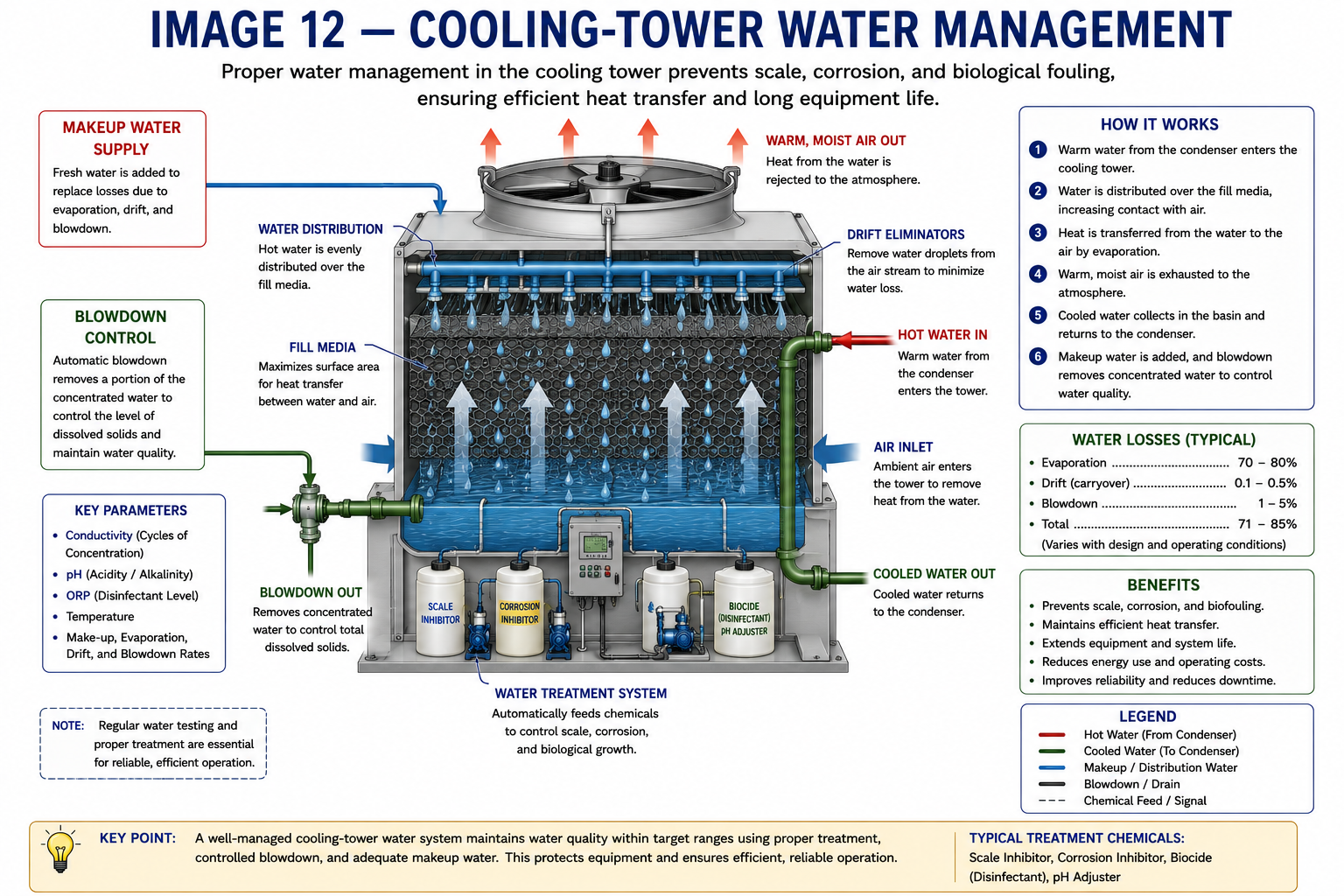
Water management is an important part of cooling-tower operation because the tower continuously interacts with both water and outdoor air.
Minerals in the makeup water, airborne contaminants, corrosion products, and biological growth can all affect the condenser-water system.
Water Treatment Is More Than Blowdown
Blowdown helps control the concentration of dissolved solids, but it does not address every water-quality problem.
Scale, corrosion, biological growth, and other water-quality concerns require a properly designed water-treatment program.
Condenser-water treatment and computerized water-treatment controls are covered in a separate lesson.
Do Not Confuse the Cooling Tower With the Condenser
The cooling tower and water-cooled condenser perform two different heat-transfer jobs.
Water-Cooled Condenser
Transfers heat from the refrigerant to the condenser water.
Cooling Tower
Transfers heat from the condenser water to outdoor air.
Follow the Complete Heat Path
Building Heat → Refrigerant → Condenser Water → Outdoor Air
Put the Concepts Together
The water-cooled condenser transfers refrigerant heat to condenser water.
Warm condenser water travels from the condenser to the cooling tower.
The cooling tower exposes the water to outdoor air over a large surface area.
Evaporation of a small amount of water removes heat from the remaining water.
Cooled water collects in the tower basin and returns to the condenser.
Makeup water replaces water lost through evaporation, drift, and blowdown.
Blowdown removes some concentrated circulating water to help control dissolved solids.
Cooling-tower water requires ongoing water-quality management.
Can You Explain Cooling-Tower Operation?
You should be able to answer these questions before continuing.
1. What is the purpose of a cooling tower?
2. Where does the water entering the cooling tower get its heat?
3. What happens to the cooled water after it collects in the tower basin?
4. What is the primary cooling process used in a cooling tower?
5. Why is fill used inside a cooling tower?
6. What does a cooling-tower fan do?
7. What are the three major ways water leaves the cooling-tower system?
8. What is makeup water?
9. Why do dissolved minerals become more concentrated as water evaporates?
10. What is blowdown?
11. What is the difference between the job of the water-cooled condenser and the job of the cooling tower?
What You Should Have Learned
A cooling tower removes heat from condenser water so the water can be reused.
Condenser water carries heat from the water-cooled condenser to the cooling tower.
Cooling towers primarily cool water through evaporation.
Fill increases the contact area and contact time between water and air.
The cooled water collects in the tower basin and is circulated back to the condenser.
Makeup water replaces water lost through evaporation, drift, and blowdown.
Evaporation leaves dissolved minerals behind and increases their concentration in the circulating water.
Blowdown and water treatment are necessary parts of managing a recirculating condenser-water system.
The Cooling Tower Completes the Heat-Rejection Process
The condenser moves heat from the refrigerant into the water.
The cooling tower then moves that heat from the water into the outdoor air.
Warm Water In · Heat Rejected · Cooler Water Out · Water Reused