Water-Cooled Condensers
Water-cooled condensers reject refrigerant heat to water instead of directly to outdoor air.
Hot, high-pressure refrigerant vapor enters the condenser through the compressor discharge line. Heat transfers from the refrigerant to cooling water flowing through the condenser, causing the refrigerant to condense into high-pressure liquid.
The source material identifies three major water-cooled condenser designs: tube-in-tube, shell-and-tube, and shell-and-coil. :contentReference[oaicite:1]{index=1}
What You Will Learn
By the end of this lesson you should be able to:
Describe how refrigerant transfers heat to water flowing through the condenser.
Recognize tube-in-tube, shell-and-tube, and shell-and-coil designs.
Describe the relationship between the inner water tube and outer refrigerant passage.
Describe how multiple water tubes pass through a shell containing refrigerant.
Describe how cooling water flows through a coil located inside a shell containing refrigerant.
Understand why some water passages can be mechanically cleaned while others are more difficult to access.
How a Water-Cooled Condenser Works
A water-cooled condenser uses water as the medium that receives heat from the refrigerant.
Hot, high-pressure refrigerant vapor enters the condenser and transfers heat through metal tubing or coil surfaces to the cooling water.
As heat leaves the refrigerant, the refrigerant condenses from vapor into liquid.
Hot Vapor Enters
High-pressure refrigerant vapor arrives from the compressor through the discharge line.
Heat Transfers to Water
Heat passes through the condenser metal into the cooler water.
Refrigerant Condenses
The refrigerant changes from high-pressure vapor to high-pressure liquid.
Heated Water Leaves
The cooling water carries the rejected heat away from the condenser.
Technician Point
The compressor may be physically remote from the water-cooled condenser.
The hot refrigerant connection shown entering the condenser represents the compressor discharge line, not a requirement that the compressor be mounted beside the condenser.
Three Types of Water-Cooled Condensers
The source lesson identifies three common water-cooled condenser constructions.
Tube-in-Tube
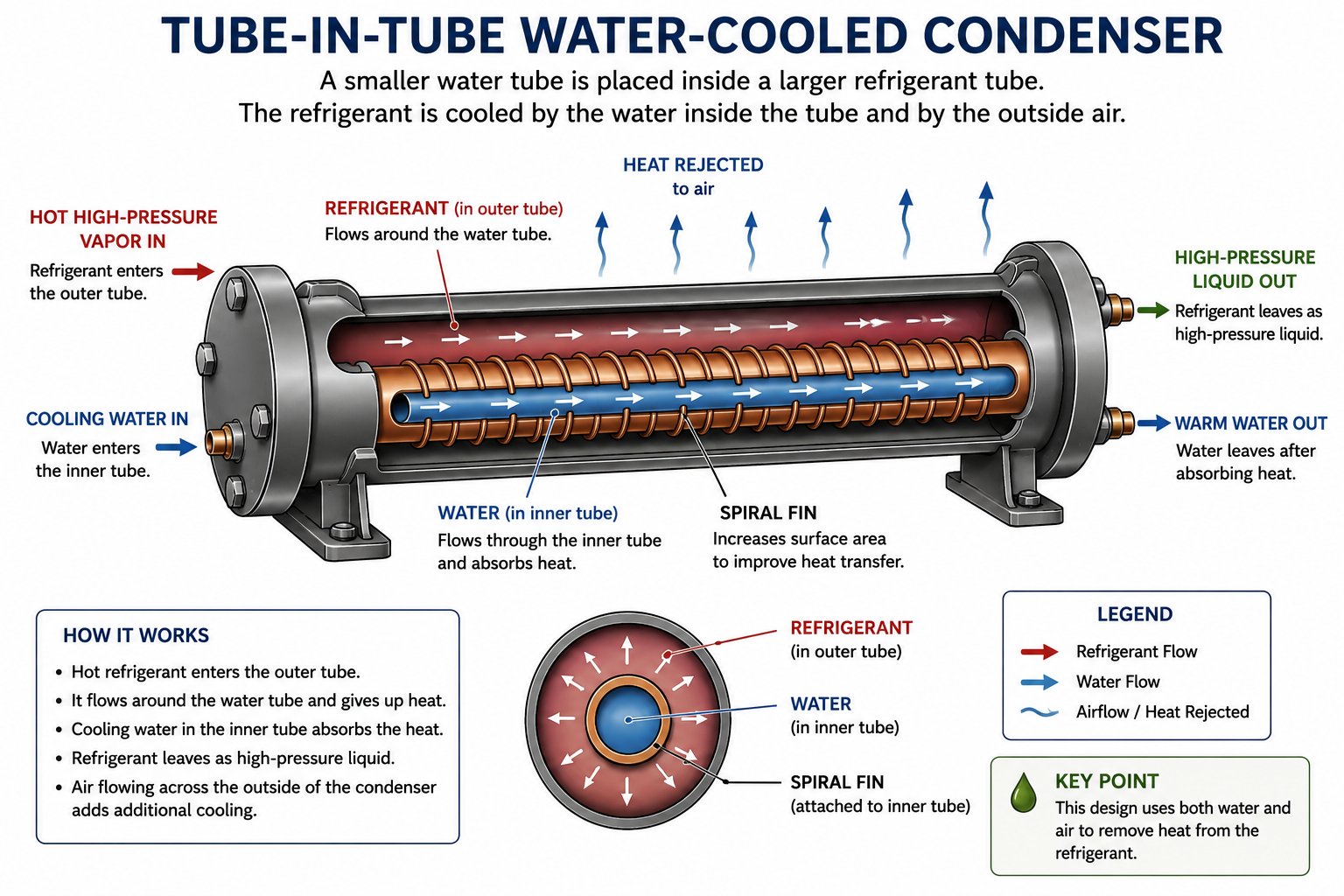
A smaller water tube is installed inside a larger refrigerant tube or passage.
Shell-and-Tube
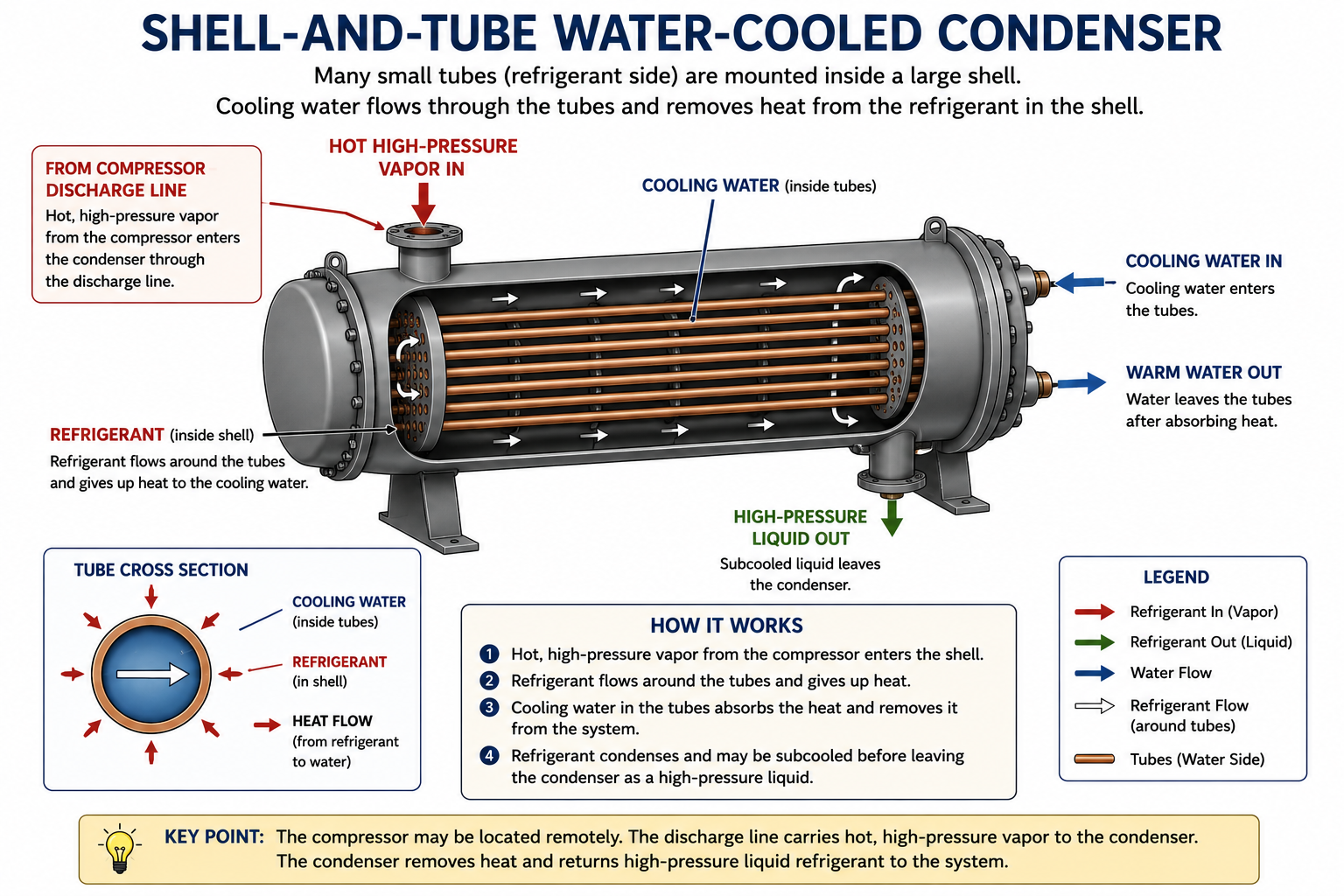
Multiple smaller water tubes pass through a larger shell containing refrigerant.
Shell-and-Coil
A water-carrying coil is located inside a shell or tank containing refrigerant.
Tube-in-Tube Condensers
A tube-in-tube condenser is constructed with one tube inside another.
The source states that the outer tube carries refrigerant and the inner tube carries cooling water. It also notes that the inner tube may have a spiral fin to increase heat-transfer surface area. :contentReference[oaicite:2]{index=2}
About the Refrigerant Inlet
The hot, high-pressure refrigerant vapor shown entering the condenser arrives through the compressor discharge line.
The compressor can be located remotely from the condenser.
Inner Tube
Water flows through the inner tube and absorbs heat from the refrigerant.
Outer Passage
High-pressure refrigerant surrounds the water tube and rejects heat through the tube wall.
Heat-Transfer Relationship
Refrigerant → Tube Wall → Cooling Water
Shell-and-Tube Condensers
A shell-and-tube condenser uses a larger outer shell containing a number of smaller water tubes.
The source describes refrigerant as circulating around the water tubes while the water flows through the tubes. :contentReference[oaicite:3]{index=3}
Inside the Tubes
Cooling water flows through the smaller tubes.
Inside the Shell
High-pressure refrigerant surrounds the tubes and transfers heat to the water through the tube walls.
Cleaning Tube-in-Tube and Shell-and-Tube Condensers
Water passages can accumulate deposits that interfere with heat transfer.
The source specifically states that both tube-in-tube and shell-and-tube condensers may be cleaned by forcing a special brush through the water tubes or by using chemical cleaning methods. :contentReference[oaicite:4]{index=4}
Mechanical Cleaning
A special brush can be pushed or forced through accessible water tubes to remove deposits.
Chemical Cleaning
Chemical treatment may also be used to remove deposits from the water passages.
Why Cleaning Matters
Deposits on the water side create resistance to heat transfer.
Keeping the water passages clean helps maintain condenser heat-transfer performance.
Shell-and-Coil Condensers
A shell-and-coil condenser consists of a large shell or tank containing a coil.
The source states that water is pumped through the coil while the refrigerant is outside the coil in the shell. :contentReference[oaicite:5]{index=5}
Inside the Coil
Water is pumped through the internal coil.
Inside the Shell
High-pressure refrigerant surrounds the coil and transfers heat through the coil wall to the water.
Shell-and-Coil Illustration
A dedicated shell-and-coil illustration will be added here once the correct course image is available.
Compare the Three Designs
Water Location
Refrigerant Location
Inner tube
Outer tube or surrounding passage
Multiple smaller tubes
Around the tubes inside the shell
Internal coil
Outside the coil inside the shell
What Happens to the Heated Water?
The water leaving a water-cooled condenser has absorbed heat from the refrigerant.
That heat must then be rejected somewhere else.
Open Water System
Some systems use water from a municipal or well-water supply and discharge the warmed water after it passes through the condenser.
Recirculating Water System
Other systems reuse the condenser water and reject its heat through equipment such as a cooling tower.
Water-regulating valves and cooling towers are covered in later lessons.
Put the Concepts Together
Water-cooled condensers transfer refrigerant heat to water.
The three source-lesson designs are tube-in-tube, shell-and-tube, and shell-and-coil.
Tube-in-tube condensers carry water through the inner tube and refrigerant through the surrounding passage.
Shell-and-tube condensers carry water through multiple tubes surrounded by refrigerant.
Shell-and-coil condensers carry water through an internal coil surrounded by refrigerant.
Tube-in-tube and shell-and-tube water passages may be mechanically or chemically cleaned.
The compressor supplying hot refrigerant vapor may be located remotely from the condenser.
The heated condenser water must eventually reject the heat it absorbed from the refrigerant.
Can You Explain Water-Cooled Condensers?
You should be able to answer these questions before continuing.
1. What medium receives heat from the refrigerant in a water-cooled condenser?
2. What are the three water-cooled condenser types identified in the source lesson?
3. Where does water flow in a tube-in-tube condenser?
4. Where does refrigerant flow in a tube-in-tube condenser?
5. Where does water flow in a shell-and-tube condenser?
6. Where does refrigerant flow in a shell-and-tube condenser?
7. Where does water flow in a shell-and-coil condenser?
8. Where does refrigerant flow in a shell-and-coil condenser?
9. What two cleaning methods does the source describe for tube-in-tube and shell-and-tube condensers?
10. Why must the heated condenser water eventually reject its absorbed heat?
What You Should Have Learned
A water-cooled condenser rejects refrigerant heat to cooling water.
Hot, high-pressure refrigerant vapor reaches the condenser through the compressor discharge line.
Tube-in-tube condensers use one tube inside another.
Shell-and-tube condensers contain multiple water tubes inside a refrigerant shell.
Shell-and-coil condensers use an internal water coil surrounded by refrigerant.
Water-side deposits can reduce heat transfer and may require mechanical or chemical cleaning.
The water leaving the condenser carries heat that must be rejected elsewhere.
Different Construction, Same Heat-Rejection Job
Tube-in-tube, shell-and-tube, and shell-and-coil condensers arrange the refrigerant and cooling water differently.
They all perform the same basic function:
Hot Refrigerant In · Heat Transfers to Water · High-Pressure Liquid Refrigerant Out