Compressor Types
All refrigeration compressors perform the same basic job: they draw in low-pressure refrigerant vapor and raise its pressure so the refrigeration cycle can continue.
Different compressor designs accomplish that job in different ways. Some trap vapor in chambers that become smaller, some use pistons, and others increase vapor velocity and convert that velocity into pressure.
This lesson introduces the five major compressor types used in refrigeration and air-conditioning systems and explains the basic operating principle of each.
What You Will Learn
By the end of this lesson you should be able to:
Recognize rotary, screw, scroll, centrifugal, and reciprocating compressors.
Describe how an eccentric rotor and vanes or blades trap and move refrigerant vapor.
Describe how intermeshing helical rotors compress refrigerant vapor.
Describe how stationary and orbiting scrolls trap vapor in progressively smaller spaces.
Describe how a high-speed impeller increases refrigerant velocity and pressure.
Describe how pistons moving inside cylinders draw in and compress refrigerant vapor.
Five Ways to Compress Refrigerant Vapor
Although all compressors serve the same basic purpose, their internal mechanisms are very different.
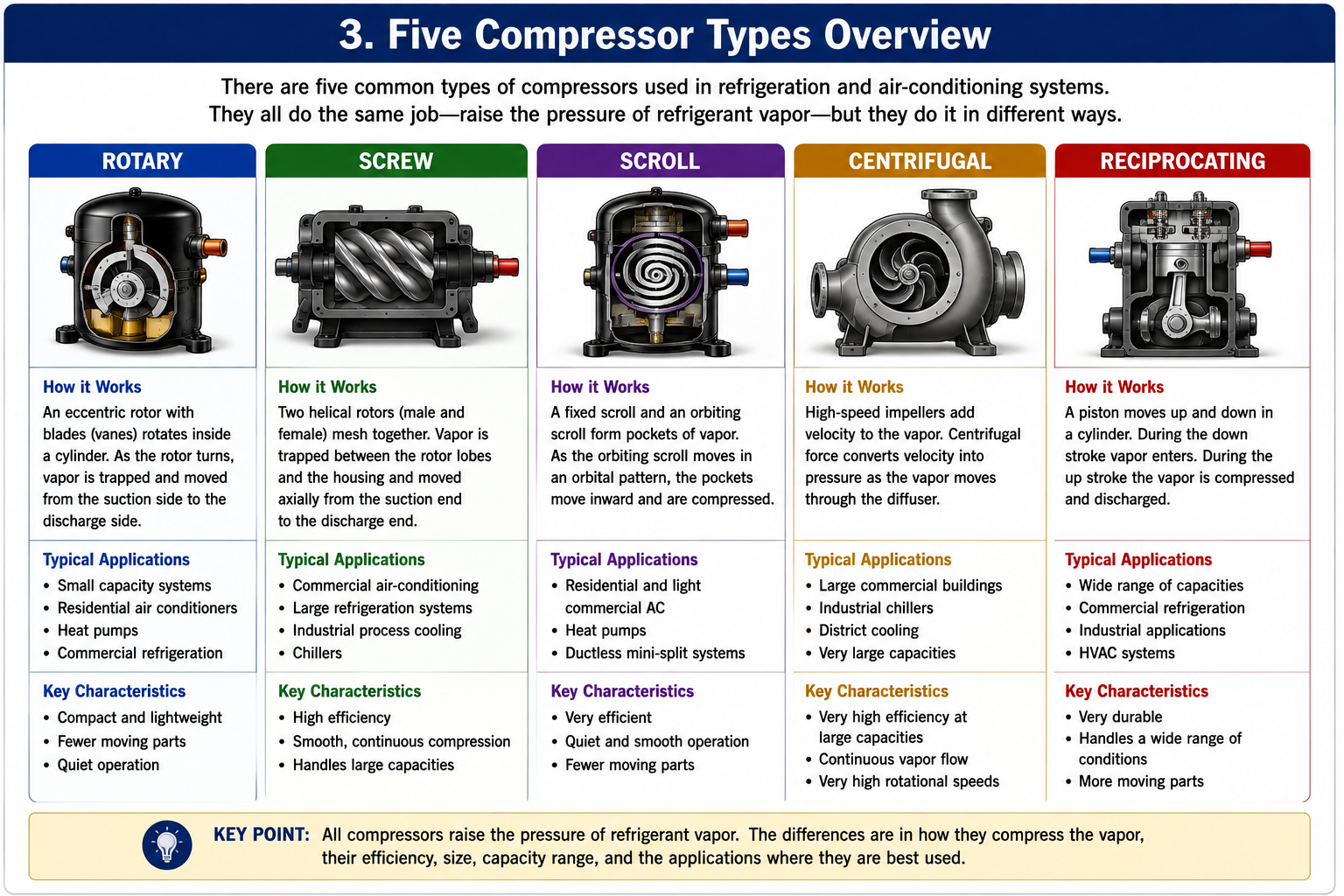
Eccentric rotor and vanes
Intermeshing helical rotors
Stationary and orbiting scrolls
High-speed impeller
Pistons and cylinders
Technician Point
All five compressor types increase refrigerant vapor pressure, but they do it using different mechanical methods.
Rotary Compressors
Rotary compressors are generally small and lightweight. The source describes them as using blades or vanes to move refrigerant vapor. :contentReference[oaicite:1]{index=1}
A rotary compressor contains an eccentric rotor, meaning the rotor is positioned off-center inside the cylinder.
As the rotor turns, the space available to the trapped refrigerant vapor changes. This movement draws vapor into the compressor and then forces it toward the discharge side.
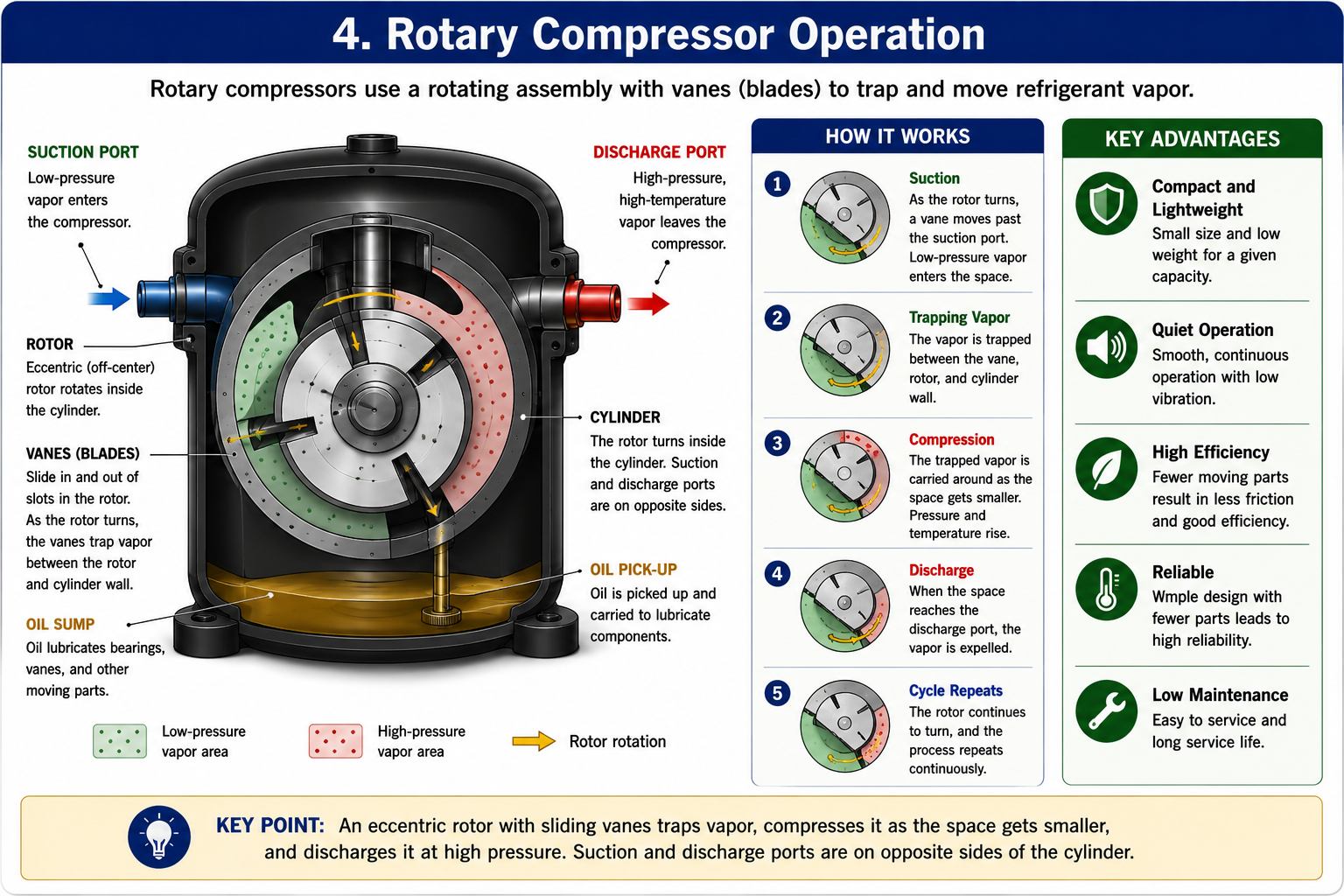
Stationary Vane
The source describes a stationary-vane design as using a fixed blade or vane with an eccentric rotor and discharge valve.
Rotary Vane
A rotary-vane design uses two or more sliding vanes that move with the rotor.
The source identifies these as the two basic rotary compressor arrangements. :contentReference[oaicite:2]{index=2}
Characteristics from the Source Lesson
The presentation describes rotary compressors as having higher efficiency than reciprocating compressors, no unused head space, and less tendency to blow fuses at startup. :contentReference[oaicite:3]{index=3}
Screw Compressors
Screw compressors are commonly associated with larger refrigeration and chilled-water systems.
The source describes them as using a pair of specially shaped helical rotors, or screws. :contentReference[oaicite:4]{index=4}
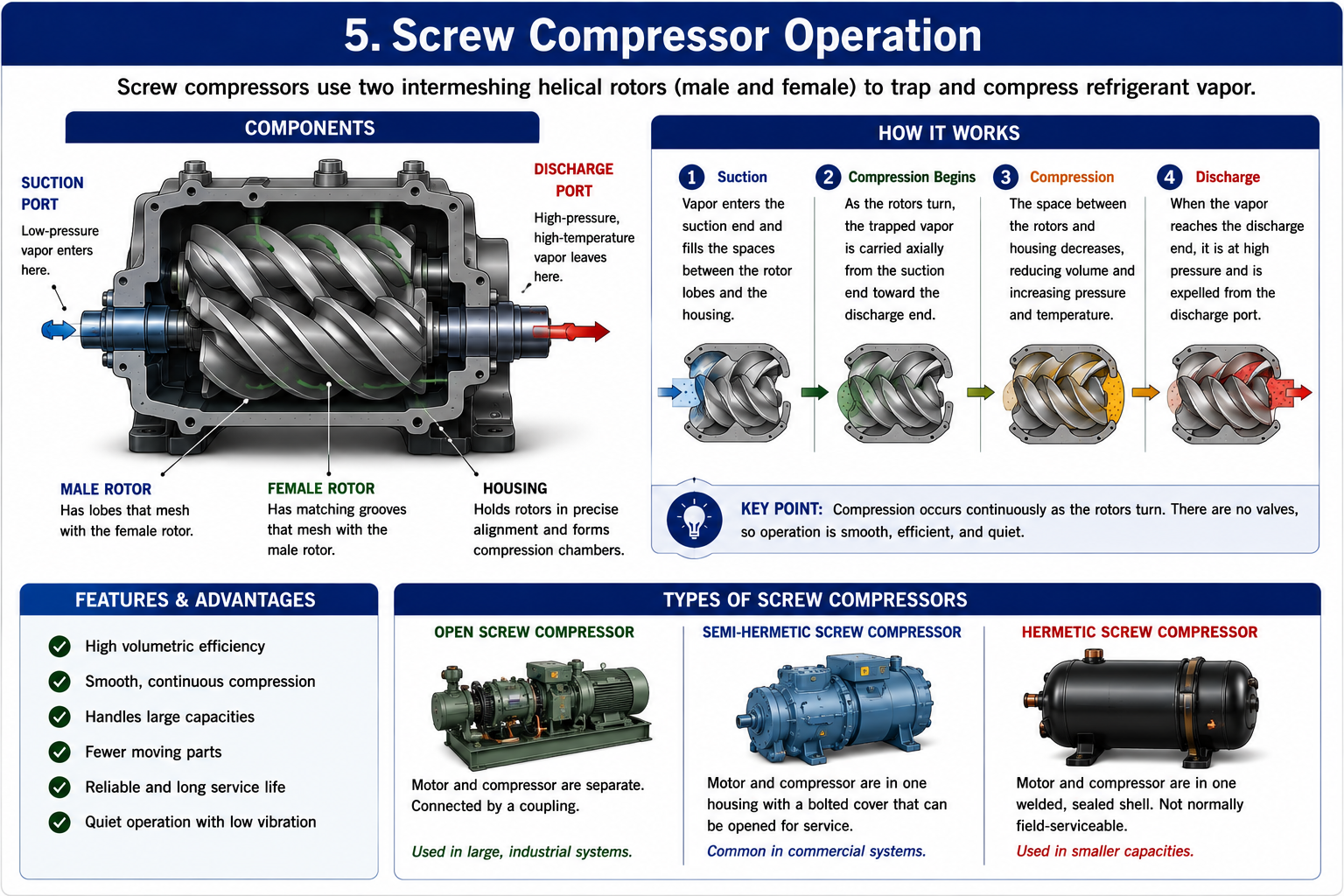
Vapor enters. Refrigerant vapor is drawn into the open spaces between the screw lobes.
The vapor becomes trapped. The rotating screws carry refrigerant along the length of the rotors.
The trapped space becomes smaller. As the available volume decreases, refrigerant pressure increases.
Compressed vapor leaves. High-pressure refrigerant vapor exits toward the condenser.
The source explains that refrigerant is drawn into the spaces between the screw lobes and compressed as those spaces become smaller. :contentReference[oaicite:5]{index=5}
Technician Point
Screw compressors provide a continuous pumping action, which helps explain their smooth operation and relatively low vibration.
The presentation also identifies open-drive, hermetic, and semi-hermetic screw compressor designs. :contentReference[oaicite:6]{index=6}
Scroll Compressors
A scroll compressor uses two spiral-shaped scrolls to compress refrigerant vapor.
The source describes one scroll as stationary and the other as driven in an orbiting motion. :contentReference[oaicite:7]{index=7}
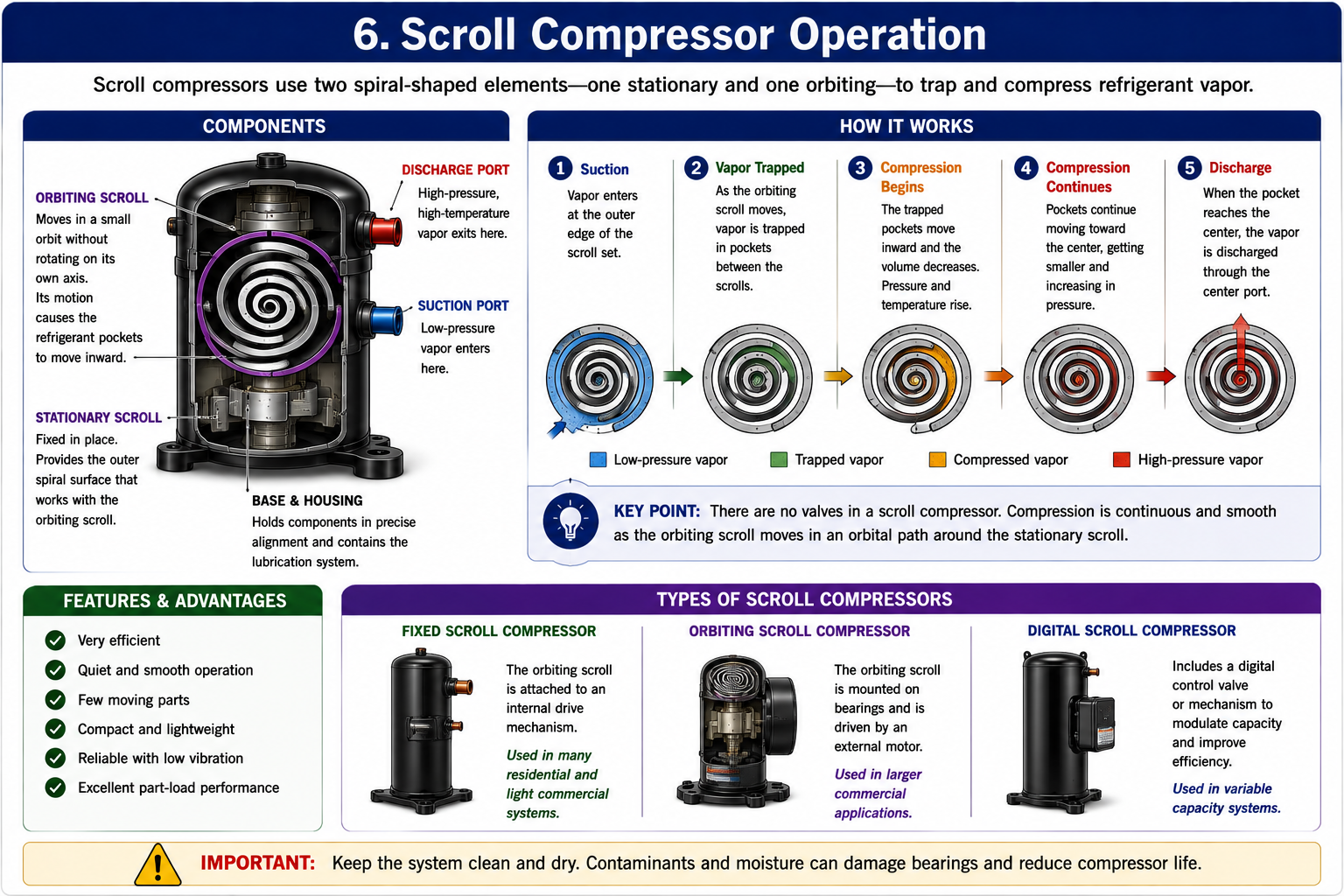
Vapor enters the outer portion of the scroll set.
The orbiting motion traps vapor between the scrolls.
The trapped pockets move inward and become smaller.
The refrigerant pressure increases as the pocket volume decreases.
High-pressure refrigerant vapor leaves through the discharge opening.
The source states that refrigerant vapor is trapped between the scrolls and compressed by the orbiting motion. :contentReference[oaicite:8]{index=8}
No Conventional Suction or Discharge Valves
The source lesson identifies the scroll compressor as operating without conventional compressor valves. :contentReference[oaicite:9]{index=9}
Centrifugal Compressors
Centrifugal compressors operate very differently from rotary, screw, scroll, and reciprocating compressors.
Instead of trapping refrigerant vapor in a chamber and mechanically reducing its volume, a centrifugal compressor uses a high-speed impeller or wheel to accelerate the refrigerant vapor.
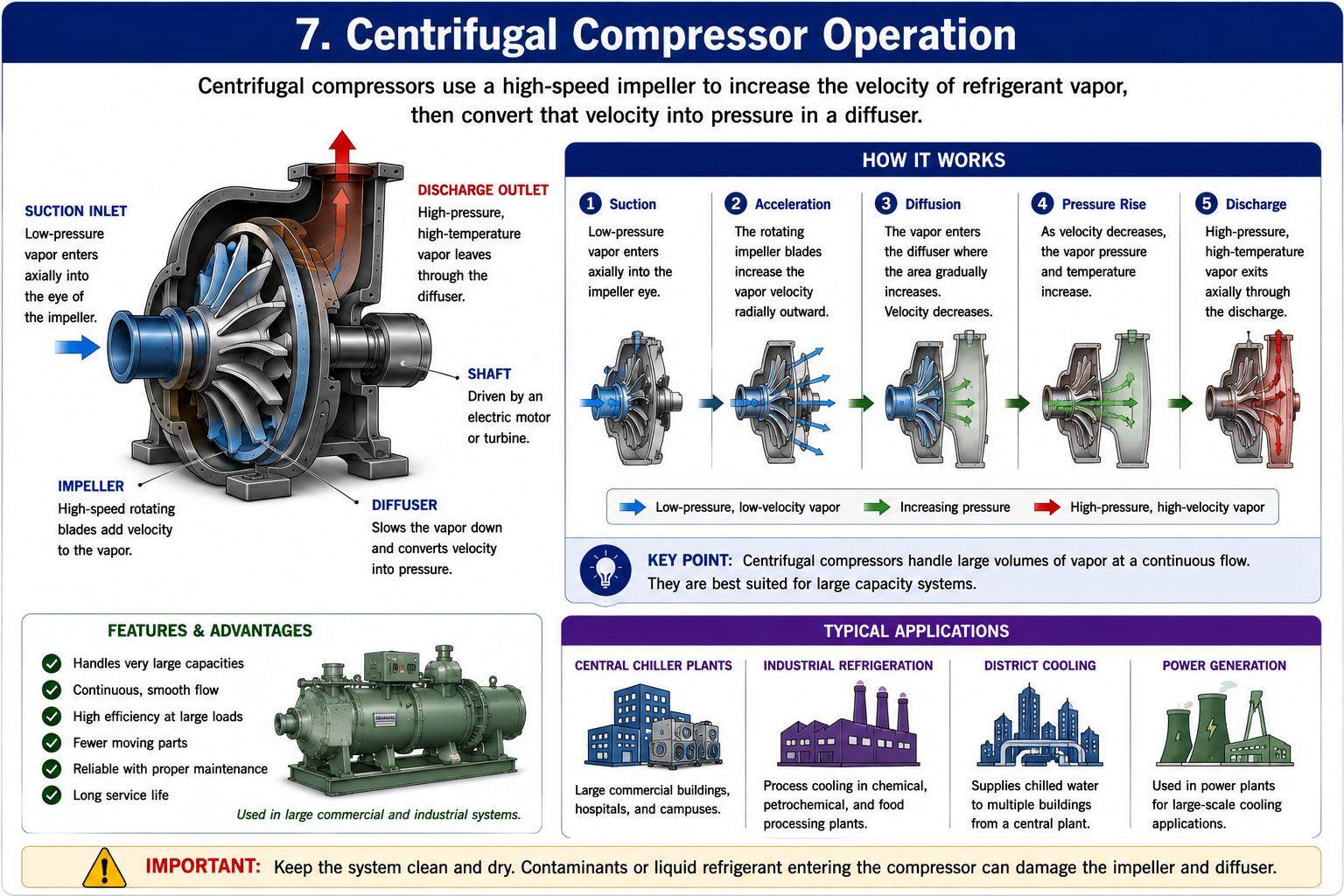
Low-pressure vapor enters near the center of the impeller.
The impeller rotates at high speed.
Refrigerant vapor is accelerated outward.
The high-velocity vapor enters a passage or diffuser.
Velocity is converted into increased pressure before discharge.
The source describes centrifugal compression as producing pressure through centrifugal force by spinning a mass of refrigerant vapor at high speed and throwing it outward. :contentReference[oaicite:10]{index=10}
Technician Point
Centrifugal compressors are most closely associated with large-capacity commercial refrigeration and chilled-water systems.
Reciprocating Compressors
Reciprocating compressors use pistons moving up and down inside cylinders to draw in and compress refrigerant vapor.
The source identifies them as piston-type compressors used in domestic and commercial refrigeration equipment. :contentReference[oaicite:11]{index=11}
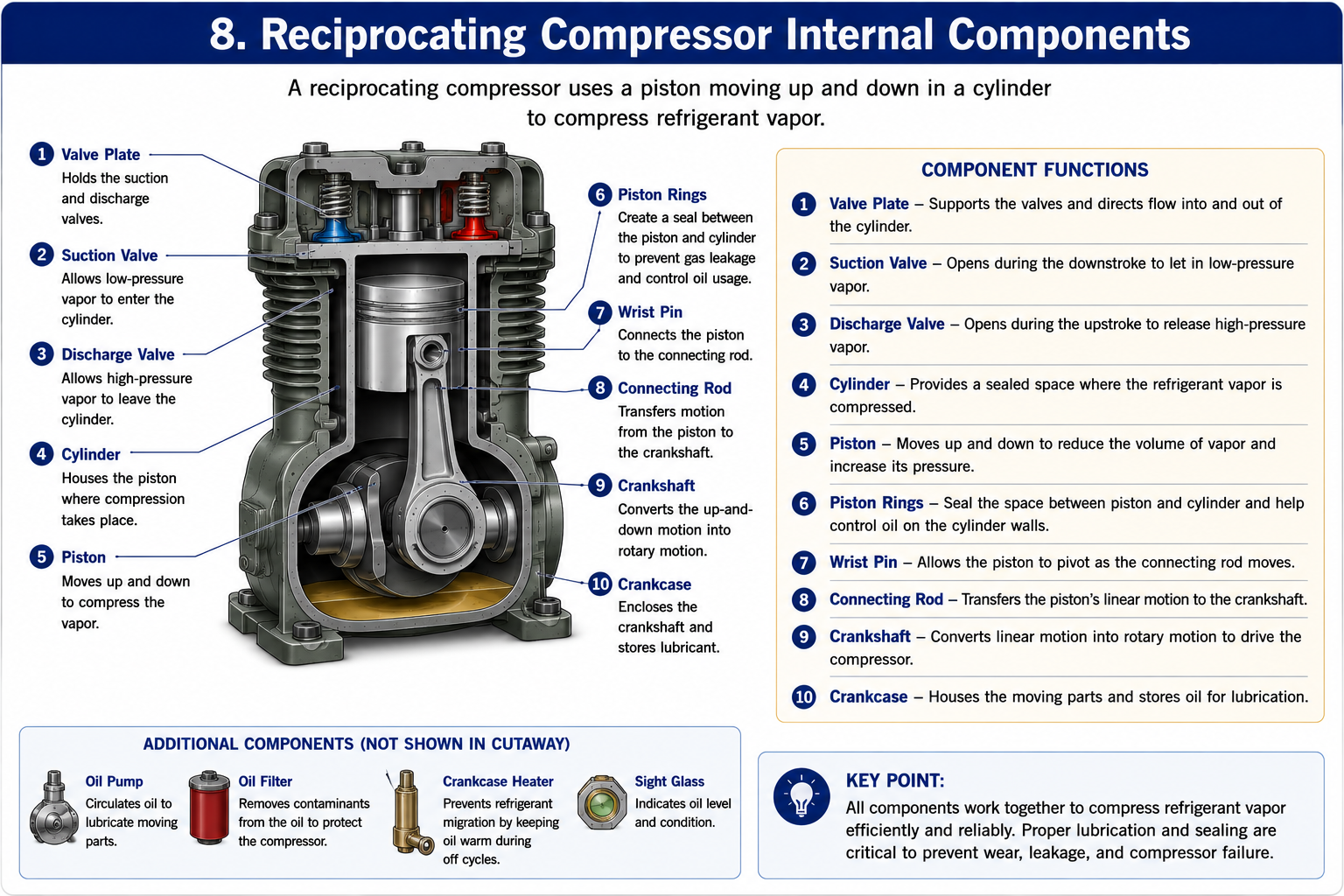
Piston Moves Down
The suction valve opens and low-pressure refrigerant vapor enters the cylinder.
Piston Moves Up
The suction valve closes, the trapped vapor is compressed, and the discharge valve opens when cylinder pressure becomes high enough.
The source identifies the major reciprocating compressor parts as the cylinder, pistons, connecting rods, crankshaft, cylinder head, and valves. :contentReference[oaicite:12]{index=12}
More Detail Comes Next
Reciprocating compressors receive a separate lesson because their internal construction, piston cycle, valves, clearance volume, housing types, shaft seals, and lubrication systems require substantially more detail.
Compare the Five Compressor Types
Compression Method
Typical Characteristic
Eccentric rotor and vanes
Compact, continuous rotary motion
Intermeshing helical rotors
Continuous compression with low vibration
Orbiting and stationary scrolls
Few moving parts and continuous compression
High-speed impeller
Large-capacity dynamic compression
Piston and cylinder
Positive-displacement compression using suction and discharge valves
Put the Concepts Together
All refrigeration compressors raise the pressure of refrigerant vapor.
Rotary compressors use an eccentric rotor and vanes or blades.
Screw compressors use intermeshing helical rotors.
Scroll compressors use stationary and orbiting spiral scrolls.
Centrifugal compressors use high-speed impellers to increase refrigerant velocity and pressure.
Reciprocating compressors use pistons moving inside cylinders.
Each compressor type uses a different mechanical method to accomplish the same basic refrigeration function.
Can You Identify the Compressor Types?
You should be able to answer these questions before continuing.
1. What are the five major compressor types introduced in this lesson?
2. What does a rotary compressor use to trap and move refrigerant vapor?
3. What is meant by an eccentric rotor?
4. What mechanical components compress vapor in a screw compressor?
5. What happens to the trapped refrigerant spaces as a screw compressor operates?
6. What are the two major scroll components in a scroll compressor?
7. How does a centrifugal compressor differ from the other compressor types?
8. What mechanical component creates refrigerant velocity in a centrifugal compressor?
9. What basic mechanism does a reciprocating compressor use to compress vapor?
10. Why will reciprocating compressors be studied in greater detail in a separate lesson?
What You Should Have Learned
The five major compressor types are rotary, screw, scroll, centrifugal, and reciprocating.
Rotary compressors use an off-center rotor and vanes or blades.
Screw compressors compress vapor between rotating helical rotors.
Scroll compressors trap refrigerant between stationary and orbiting scrolls.
Centrifugal compressors use high-speed rotating impellers rather than positive-displacement chambers.
Reciprocating compressors use pistons, cylinders, suction valves, and discharge valves.
Different compressor designs are selected for different capacities, applications, and operating requirements.
Different Designs, Same Basic Purpose
Every compressor in this lesson performs the same fundamental refrigeration function: it raises refrigerant vapor pressure.
What changes is the mechanical method used to accomplish that compression.
Remember the basic mechanisms:
Rotary — Vanes · Screw — Helical Rotors · Scroll — Spiral Scrolls · Centrifugal — Impeller · Reciprocating — Pistons