Compressor Lubrication and Oil Management
Compressor oil does much more than reduce friction. It helps cool moving parts, lubricates bearings and mechanical surfaces, and helps seal rings and valves inside the compressor.
Proper oil condition and oil level are essential to compressor life. A compressor that loses lubrication, operates with contaminated oil, or allows refrigerant to interfere with the oil can suffer rapid mechanical damage.
This lesson introduces the purpose of compressor oil, proper oil level, refrigerant-oil interaction, common refrigeration oils, and the importance of protecting refrigeration oil from moisture and contamination.
What You Will Learn
By the end of this lesson you should be able to:
Identify cooling, lubrication, and sealing as important functions of compressor oil.
Explain how a compressor sight glass may be used to observe oil level during operation.
Describe how liquid refrigerant entering the compressor can cause oil foaming and oil loss.
Distinguish traditional mineral oils from synthetic oils used with many newer refrigerants.
Recognize that some synthetic oils readily attract moisture from the surrounding air.
Recognize the importance of maintaining correct oil level, preventing contamination, and keeping oil containers sealed.
Why Does a Compressor Need Oil?
A compressor contains moving mechanical components that operate under load and at elevated temperatures.
Lubricating oil is required to protect those components and help the compressor operate efficiently.
Cooling
Oil absorbs heat from compressor components and helps carry that heat away from moving surfaces.
Lubrication
Oil forms a protective film between moving parts, reducing friction and mechanical wear.
Sealing
Oil helps seal clearances around rings and valves so the compressor can maintain the pressure difference required for efficient operation.
Technician Point
Compressor oil has three basic jobs that you should remember:
Cooling · Lubrication · Sealing
Compressor Oil Management at a Glance
The following illustration summarizes several of the oil-management concepts introduced in this lesson.
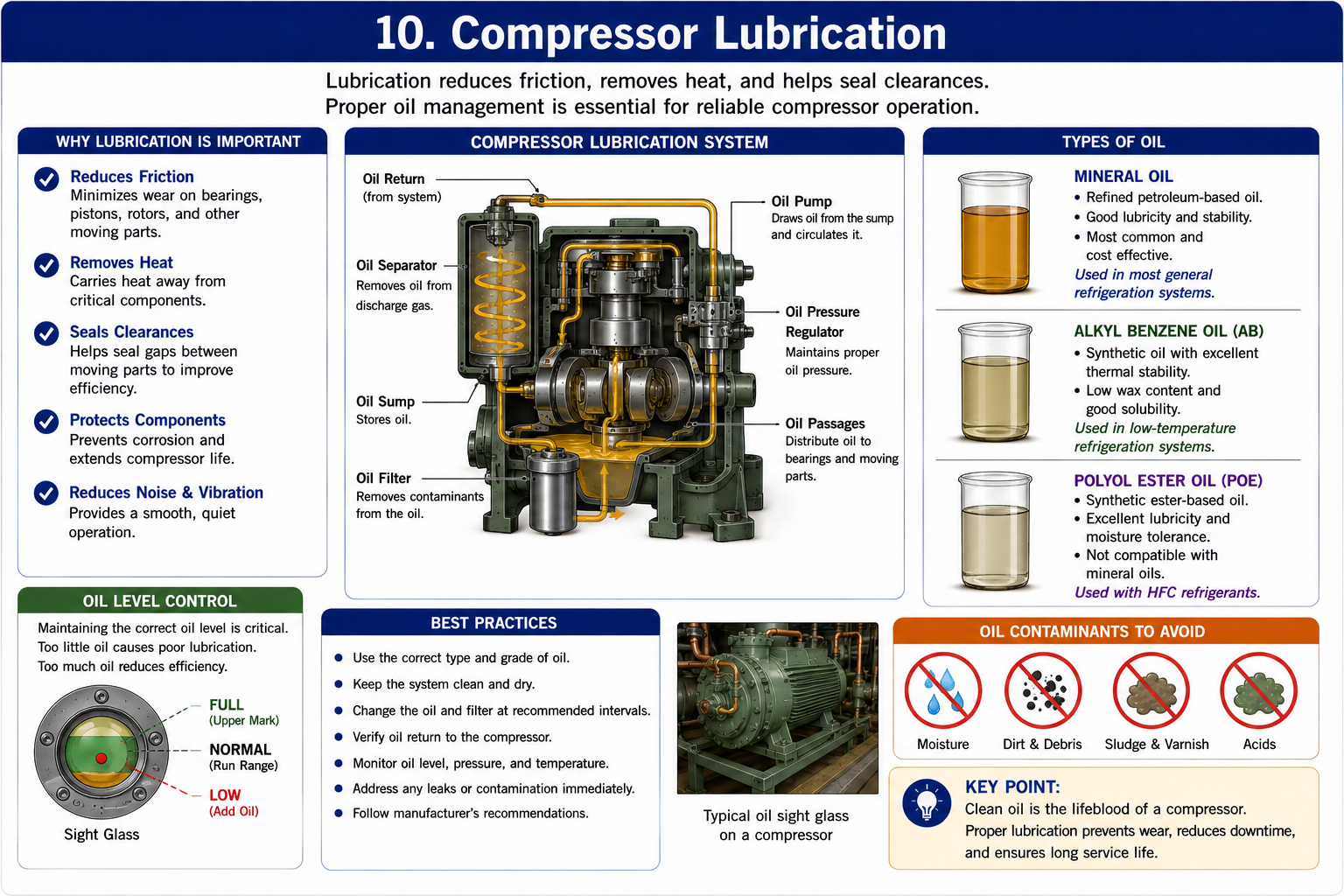
Checking Compressor Oil Level
Some compressors are equipped with an oil sight glass that allows the technician to observe the oil level in the compressor crankcase.
The original lesson states that when a compressor has an oil sight glass, the oil level should be slightly above the center of the sight glass while the compressor is running. :contentReference[oaicite:1]{index=1}
TOO LOW
Insufficient oil may leave bearings and other moving components without adequate lubrication.
NORMAL REFERENCE
For compressors covered by the source lesson, oil should be slightly above the center of the sight glass while running.
ABNORMAL CONDITION
An unusual oil level should be investigated rather than corrected by simply adding or removing oil without determining the cause.
Important
Oil-level requirements can vary by compressor design and manufacturer. The sight-glass level described here reflects the compressor material in this lesson; later service work should always follow the requirements for the specific compressor being serviced.
What Happens When Liquid Refrigerant Reaches the Compressor?
In the previous compressor lesson, we established that a compressor is designed to pump vapor rather than liquid refrigerant.
Liquid refrigerant entering the compressor can also interfere with lubrication.
The source lesson explains that liquid refrigerant entering from the low side can cause oil to boil or foam. Oil can then be carried out of the compressor with the discharge refrigerant. :contentReference[oaicite:2]{index=2}
Liquid refrigerant reaches the compressor. Refrigerant mixes with or enters the compressor oil.
The oil can foam or boil. Refrigerant rapidly leaving the oil can create violent foaming.
Oil can be carried out of the compressor. Oil droplets may leave with the discharge refrigerant.
The compressor may lose lubrication. Reduced oil in the crankcase can leave moving parts inadequately protected.
Technician Point
Liquid refrigerant can damage a compressor in more than one way.
It can cause mechanical slugging and it can also interfere with the compressor’s lubricating oil.
Refrigeration Oils
Refrigeration oils are specially prepared for use inside refrigeration systems.
The source lesson describes traditional refrigeration oils as high-grade mineral oils and notes that many replacement and newer refrigerants require synthetic oils, including ester-based oils. :contentReference[oaicite:3]{index=3}
Mineral Oil
Mineral oil has historically been used with many older refrigerants and compressor systems.
The source material describes refrigeration mineral oils as highly refined, cleaned, dehydrated, and generally wax-free.
Synthetic Oil
Many newer refrigerants and replacement refrigerants require synthetic lubricants.
The source specifically identifies ester-based synthetic oils as being used with many replacement refrigerants.
Do Not Mix Oil Types Based on Appearance
Refrigeration oil must be compatible with the refrigerant, compressor, and system design. Oil selection should be based on the equipment and refrigerant requirements rather than simply replacing one oil with another.
Properties of Refrigeration Oil
The refrigeration oil described in the source material is specially processed for use inside a sealed refrigeration system.
Refrigeration oil is highly refined and cleaned.
Much of the oil used in refrigeration is formulated to be wax-free.
Additives may be used to reduce or prevent foaming.
Refrigeration oil is dehydrated so that moisture is not intentionally introduced into the system.
These characteristics are important because the refrigeration circuit is expected to remain clean, dry, and sealed.
Moisture Is a Serious Oil Contaminant
Some synthetic refrigeration oils readily absorb moisture from the air.
The source lesson strongly emphasizes this characteristic and warns that some refrigeration oils can attract extremely large amounts of water when left exposed to the atmosphere. :contentReference[oaicite:4]{index=4}
Keep Oil Containers Closed
Always reseal refrigeration oil containers immediately when they are not being used.
Leaving an oil container open allows moisture in the surrounding air to contaminate the oil before it is ever added to the refrigeration system.
Clean Oil
Oil that has been properly stored remains protected from unnecessary exposure to moisture and contamination.
Exposed Oil
Oil left open to the atmosphere may absorb moisture and should not automatically be assumed suitable for use in a refrigeration system.
Why Keep the Refrigeration System Dry?
Moisture does not belong inside the refrigerant circuit.
Oil is one possible path by which moisture can accidentally be introduced during service work.
The detailed effects of moisture on refrigerant, oil, acids, metering devices, filter driers, evacuation, and system contamination will be covered later in the course.
For Now, Remember
Clean system + clean refrigerant + clean, dry oil
All three are important to compressor reliability.
Basic Compressor Oil Management
Good oil management begins with protecting the oil already in the compressor and preventing contamination during service.
Maintain the Correct Oil Level
Do not assume that an unusual sight-glass level simply means oil should be added. Determine why the level is abnormal.
Keep Liquid Refrigerant Out of the Compressor
Liquid refrigerant can contribute to slugging, oil foaming, and loss of oil from the compressor.
Use the Correct Oil
Oil must be compatible with the refrigerant and compressor for the system being serviced.
Keep Oil Clean
Use clean containers and service procedures that prevent dirt and other contaminants from entering the refrigeration system.
Keep Oil Dry
Minimize exposure to the atmosphere and reseal oil containers immediately after use.
Oil Circulation and Oil Pressure Come Later
This lesson is concerned with the purpose and condition of compressor oil.
Later compressor lessons will examine how oil is physically distributed through different compressors and how larger compressors develop and monitor oil pressure.
Lubrication Systems
Splash lubrication, forced lubrication, oil pumps, oil passages, and bearings will be covered separately.
Oil Pressure
Crankcase pressure, oil pump discharge pressure, net oil pressure, and oil-pressure controls will also be covered in a later lesson.
Can You Explain Compressor Oil Management?
You should be able to answer these questions before continuing.
1. What are the three major functions of compressor oil?
2. How does oil help reduce compressor wear?
3. How can oil help compressor rings and valves?
4. Where should the oil level generally appear in the sight glass described in this lesson while the compressor is running?
5. How can liquid refrigerant affect compressor oil?
6. How can oil be lost from the compressor after foaming occurs?
7. What type of oil was traditionally used in many refrigeration systems?
8. What general type of oil is required by many newer and replacement refrigerants?
9. Why must some synthetic refrigeration oils be protected from exposure to air?
10. Why should an oil container be resealed immediately after use?
What You Should Have Learned
Compressor oil provides cooling, lubrication, and sealing.
Proper oil level is necessary to keep compressor components adequately lubricated.
Liquid refrigerant entering the compressor can cause oil to foam and can carry oil out of the compressor.
Traditional refrigeration systems commonly used highly refined mineral oils.
Many newer and replacement refrigerants require synthetic refrigeration oils.
Some synthetic refrigeration oils readily absorb moisture from the atmosphere.
Refrigeration oil containers should remain sealed whenever they are not being used.
Correct oil type, correct oil level, and clean, dry oil are all important to compressor reliability.
Protect the Lubricant and You Help Protect the Compressor
The compressor depends on its lubricating oil every time it operates.
A loss of oil, contaminated oil, incorrect oil, or refrigerant interfering with the oil can quickly become a compressor problem.
Remember the basic requirements:
Correct Oil · Correct Level · Clean Oil · Dry Oil · Vapor Returning to the Compressor