Compressor Fundamentals
The compressor is the component that creates the pressure difference that makes the refrigeration cycle possible.
It draws low-pressure refrigerant vapor from the evaporator and raises the refrigerant pressure so that the heat absorbed in the evaporator, along with the heat added during compression, can later be rejected in the condenser.
Because the compressor is central to the refrigeration process, understanding what it does and what conditions can damage it is essential before studying individual compressor types.
What You Will Learn
By the end of this lesson you should be able to:
Describe how the compressor creates the pressure differential required for the refrigeration cycle.
Recognize that the compressor is designed to handle vapor rather than liquid refrigerant.
Describe what happens when liquid refrigerant enters a compressor and why it can cause serious mechanical damage.
Use absolute suction and discharge pressures to determine compressor compression ratio.
Recognize how multiple-compressor systems can improve load control and temperature control.
Identify rotary, screw, scroll, centrifugal and reciprocating compressors before studying them in detail.
What Does the Compressor Do?
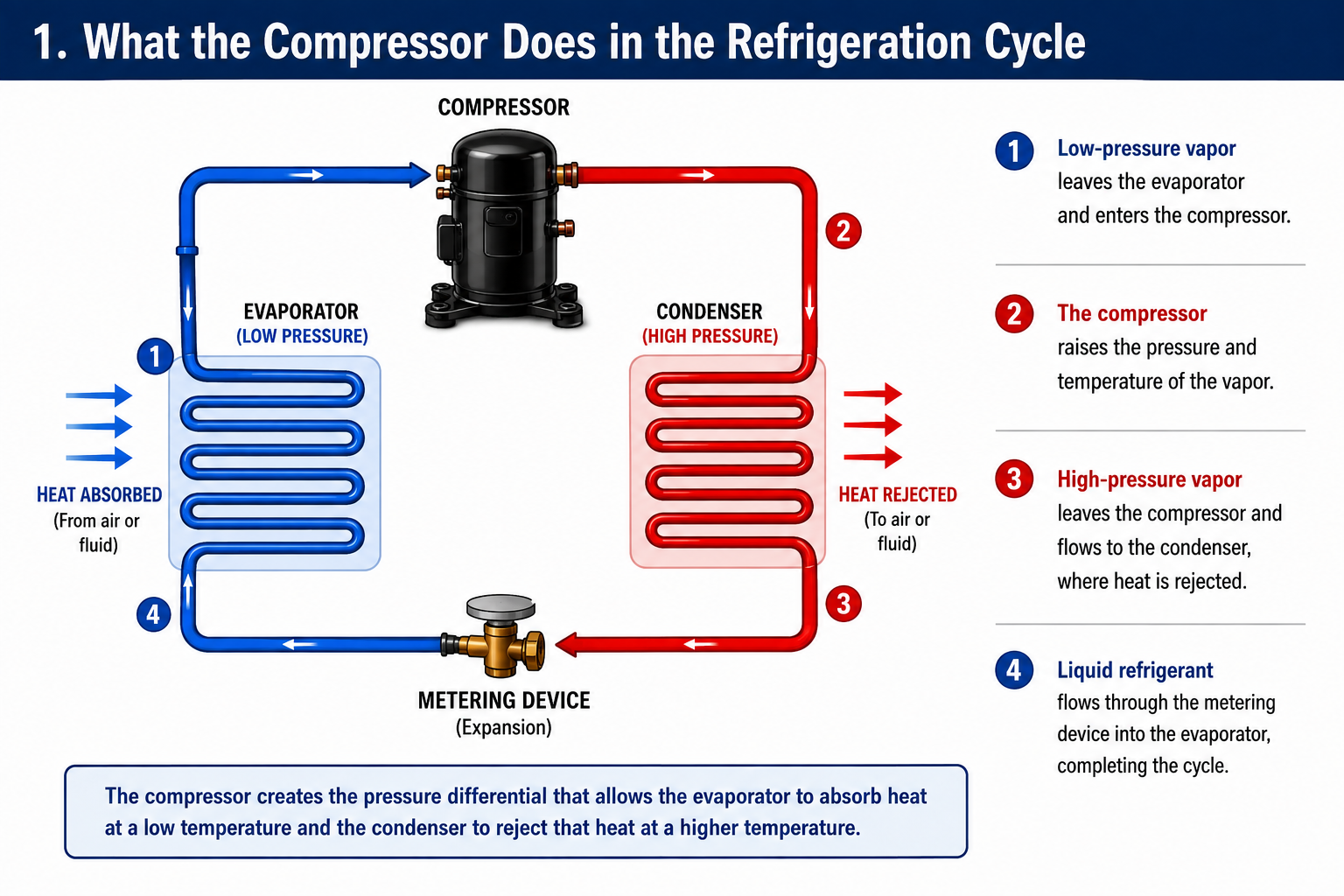
The compressor creates the pressure differential that allows the refrigeration system to operate.
Low-pressure refrigerant vapor leaves the evaporator and enters the compressor. The compressor raises the pressure and temperature of that vapor before sending it to the condenser.
The higher pressure allows the refrigerant to reject heat at a higher temperature in the condenser.
Technician Point
The compressor does not create cooling by itself.
Its job is to create the pressure difference that allows the evaporator to absorb heat and the condenser to reject heat.
A Compressor Is a Vapor Pump
A refrigeration compressor is designed to compress refrigerant vapor.
It is not designed to pump liquid refrigerant.
Entering the Compressor
The refrigerant returning from the evaporator should be vapor as it enters the compressor suction connection.
Leaving the Compressor
The compressor raises the pressure and temperature of the vapor before sending it through the discharge line toward the condenser.
Remember
Compressors compress vapor.
Liquid refrigerant should not enter the compressor.
What Is Liquid Slugging?
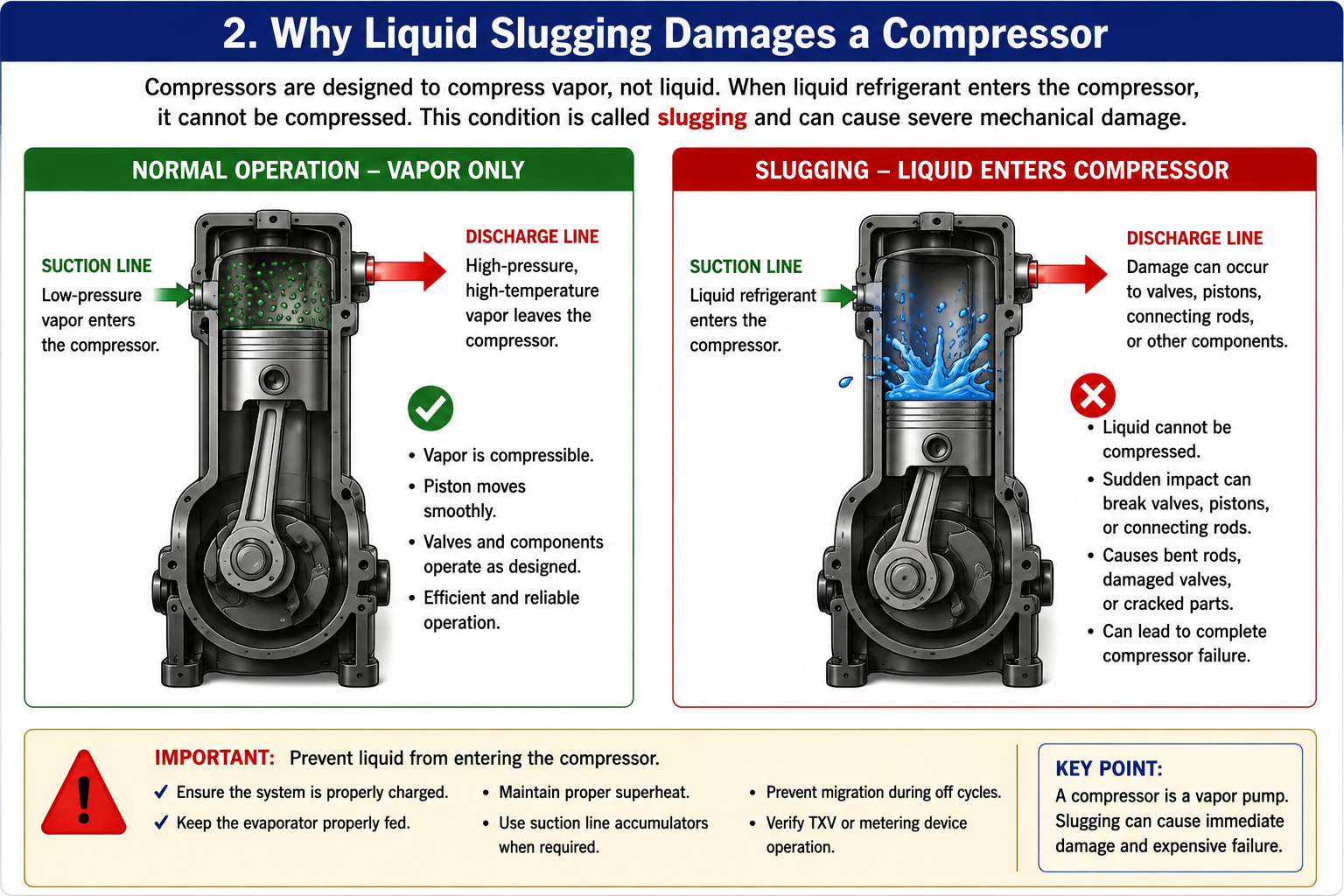
Liquid slugging occurs when liquid refrigerant enters the compressor.
Liquid cannot be compressed in the same way refrigerant vapor can. If liquid enters a reciprocating compressor cylinder or another positive-displacement compressor, the mechanical components may be subjected to extreme forces.
Possible Mechanical Damage
Liquid slugging can damage compressor valves, pistons, connecting rods and other internal parts.
Possible Compressor Failure
Severe slugging can result in immediate compressor damage or complete compressor failure.
Technician Point
Liquid does not compress.
If liquid refrigerant reaches the compressor, the compressor may try to force an incompressible liquid into a smaller space. The mechanical result can be destructive.
Compression Ratio
One way of describing compressor operating conditions is the compression ratio.
Compression ratio compares the absolute discharge pressure to the absolute suction pressure.
COMPRESSION RATIO
Absolute Pressure
Absolute pressure is gauge pressure plus atmospheric pressure.
For normal calculations near sea level, atmospheric pressure is approximately 14.7 PSI.
Example
If the discharge pressure is 235 PSIG and the suction pressure is 25 PSIG, first convert both pressures to absolute pressure.
235 + 14.7 = 249.7 PSIA
25 + 14.7 = 39.7 PSIA
249.7 ÷ 39.7 ≈ 6.3 : 1
Important
Do not calculate compression ratio using gauge pressure directly.
Both pressures must first be converted to absolute pressure.
Why Use Multiple Compressors?
Some refrigeration systems use more than one compressor.
This is especially common where the refrigeration load changes significantly during operation, such as in larger commercial refrigeration systems and cold-storage applications.
Higher Load
As the refrigeration load increases, additional compressors can be started to provide additional capacity.
Lower Load
When the refrigeration load decreases, fewer compressors can operate.
Why This Matters
Multiple compressors can provide better capacity control and temperature control by matching compressor operation to the refrigeration load.
Five Major Compressor Types
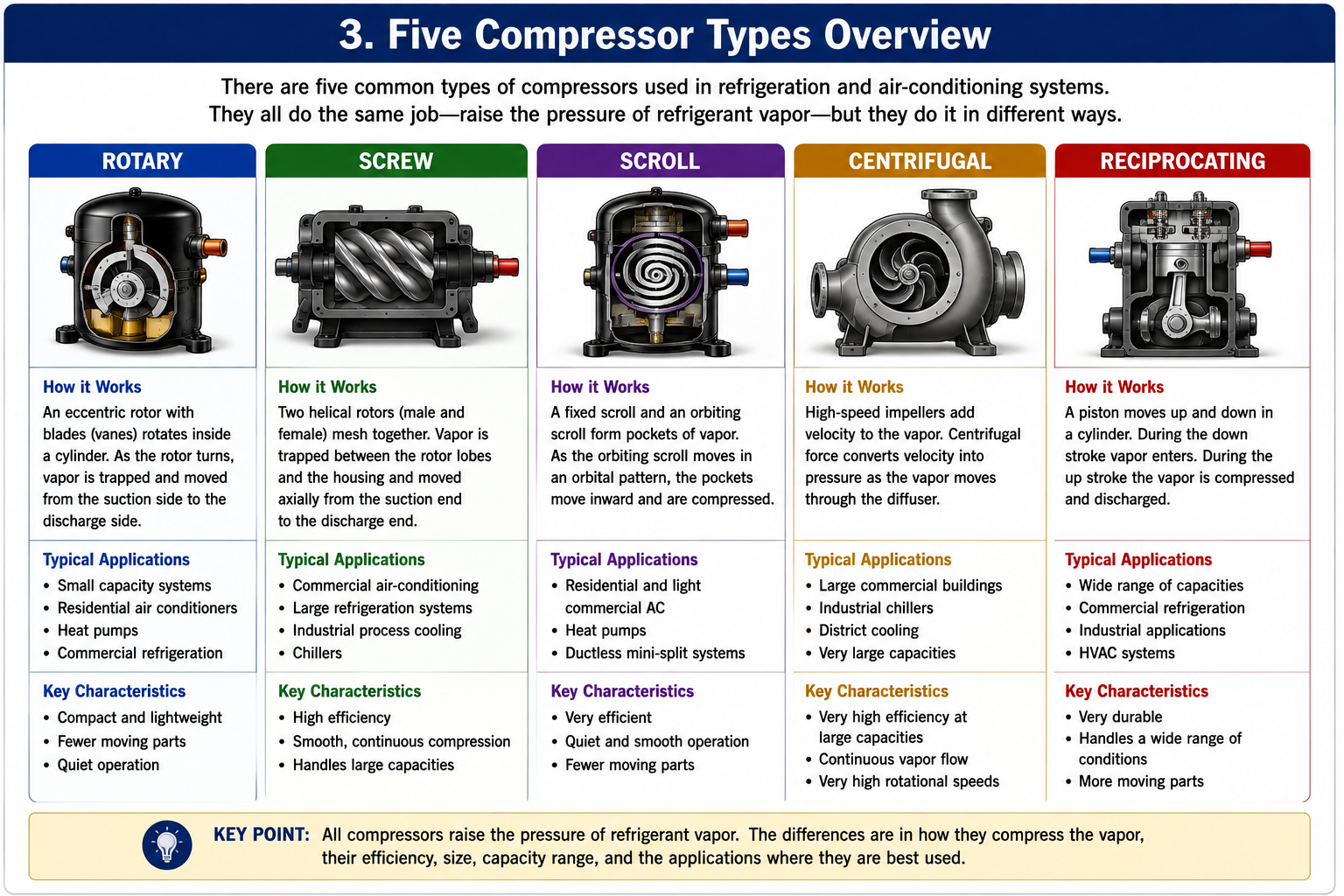
The source material identifies five major compressor types used in refrigeration and air-conditioning systems.
Rotary
Uses an eccentric rotor and vanes or blades to trap and move refrigerant vapor.
Screw
Uses intermeshing helical rotors to trap and compress refrigerant vapor.
Scroll
Uses stationary and orbiting scrolls to trap vapor in progressively smaller pockets.
Centrifugal
Uses a high-speed impeller and centrifugal force to increase vapor pressure.
Reciprocating
Uses pistons moving inside cylinders to draw in and compress refrigerant vapor.
Each compressor type will be studied in greater detail in later lessons.
Put the Concepts Together
The compressor creates the pressure differential that allows the refrigeration cycle to operate.
Low-pressure refrigerant vapor enters the compressor from the evaporator.
The compressor raises refrigerant pressure and temperature before sending the vapor to the condenser.
A refrigeration compressor is a vapor pump and should not receive liquid refrigerant.
Liquid entering the compressor is called slugging and can cause severe mechanical damage.
Compression ratio compares absolute discharge pressure to absolute suction pressure.
Multiple compressors can be used to match refrigeration capacity to changing system load.
Rotary, screw, scroll, centrifugal and reciprocating compressors use different methods to accomplish the same basic purpose.
Can You Explain Compressor Fundamentals?
You should be able to answer these questions before continuing.
1. What pressure change does the compressor create?
2. What condition should refrigerant be in when it enters the compressor?
3. What happens to refrigerant pressure and temperature as it passes through the compressor?
4. Why is a compressor described as a vapor pump?
5. What is liquid slugging?
6. Why can liquid refrigerant damage a compressor?
7. What is the formula for compression ratio?
8. Why must suction and discharge pressures be converted to absolute pressure before calculating compression ratio?
9. Why are multiple compressors sometimes used in the same refrigeration system?
10. What are the five major compressor types introduced in this lesson?
What You Should Have Learned
The compressor is the component that creates the pressure difference between the evaporator and condenser.
The compressor draws vapor from the low-pressure side and discharges vapor into the high-pressure side.
Compressors are designed to compress vapor rather than liquid.
Liquid refrigerant entering the compressor can cause slugging and serious mechanical damage.
Compression ratio is calculated using absolute discharge pressure divided by absolute suction pressure.
Multiple compressors allow system capacity to be adjusted as refrigeration load changes.
There are five major compressor types introduced in this course: rotary, screw, scroll, centrifugal and reciprocating.
Foundation for Compressor Study
The compressor is one of the most important components in the refrigeration system.
Before studying individual compressor designs, remember three basic ideas:
It creates pressure difference · It compresses vapor · It must be protected from liquid refrigerant
The next compressor lessons will examine compressor construction, operating methods, lubrication and protection in greater detail.