The Refrigeration Cycle
The vapor-compression refrigeration cycle moves heat from one place to another by changing refrigerant pressure, boiling point, temperature and physical state.
To understand how an air-conditioning or refrigeration system operates, you must be able to follow the refrigerant through the complete system and identify what is happening to it at each point in the cycle.
This lesson follows the refrigerant from the compressor, through the condenser, liquid line, metering device and evaporator, and then back to the compressor.
What You Will Learn
By the end of this lesson you should be able to:
Describe what happens to the boiling point of a substance when its pressure increases or decreases.
Follow the refrigerant from the compressor through the system and back to the compressor.
Recognize where the refrigerant changes from low pressure to high pressure and from high pressure to low pressure.
Recognize where refrigerant changes from vapor to liquid and from liquid to vapor.
Recognize where each occurs in the refrigeration cycle.
Identify the evaporator as the heat-absorbing portion of the system and the condenser as the heat-rejecting portion.
Start With the Pressure-Temperature Relationship
The vapor-compression refrigeration cycle depends on the relationship between pressure and the boiling point of a substance.
Pressure Decreases
When the pressure on a substance is reduced, the temperature at which that substance boils also decreases.
Pressure Increases
When the pressure on a substance increases, the temperature at which that substance boils also increases.
When a substance boils, it absorbs latent heat from the material or air surrounding it.
Technician Point
Lower pressure → Lower boiling point
Higher pressure → Higher boiling point
The refrigeration system uses this relationship to make refrigerant boil at a low temperature in the evaporator and condense at a higher temperature in the condenser.
The Complete Refrigeration System
Use this diagram as a reference while working through the lesson. Each section that follows examines a different part of the same refrigeration cycle.
Leaving the Compressor
We will begin the cycle at the outlet of the compressor.
At this point, the refrigerant has just been compressed and is leaving the compressor through the discharge line on its way to the condenser.
HIGH
HIGH
SUPERHEATED VAPOR
Know This Condition
Refrigerant leaving the compressor is a high-pressure, high-temperature, superheated vapor.
Entering the Condenser
The high-temperature, high-pressure refrigerant vapor enters the condenser.
Air moves across the condenser coil and heat is transferred from the refrigerant to the outdoor air.
Several different processes take place as the refrigerant travels through the condenser.
De-superheating
The first heat removed from the superheated vapor is sensible heat.
The temperature of the vapor drops toward its condensing temperature.
Condensing
As additional heat is rejected, the refrigerant begins changing from vapor to liquid.
This is a latent heat change.
Subcooling
After all of the refrigerant has condensed into liquid, additional sensible heat can still be removed.
The liquid refrigerant temperature then drops below its condensing temperature.
Technician Point
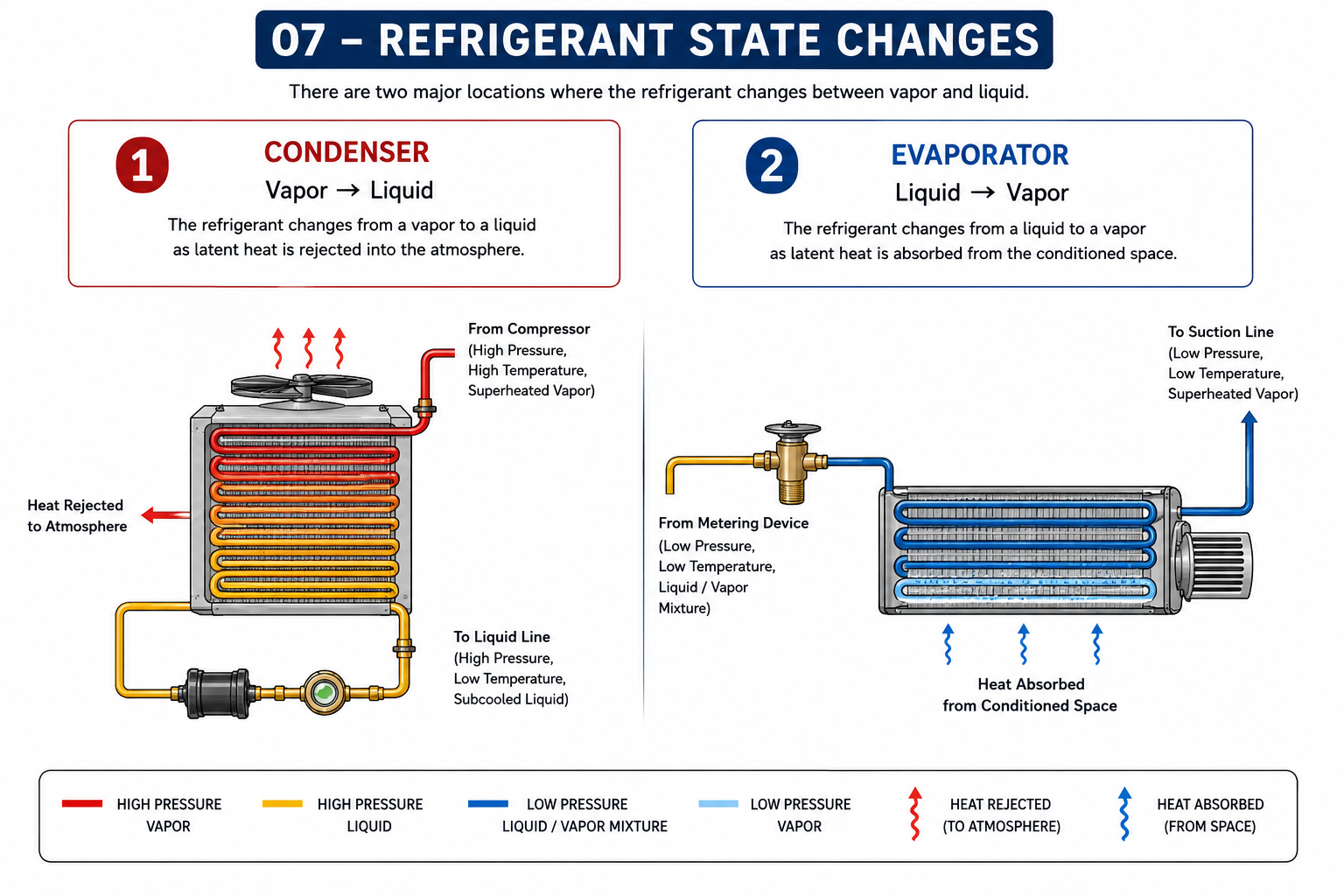
The condenser rejects heat.
The major refrigerant state change in the condenser is:
VAPOR → LIQUID
Leaving the Condenser
Near the end of the condenser, the refrigerant has completely condensed into liquid.
The refrigerant remains on the high-pressure side of the system, but its temperature has decreased as heat has been rejected.
As additional sensible heat is removed from the liquid, the refrigerant becomes subcooled.
HIGH
LOWER
SUBCOOLED LIQUID
Subcooling
Subcooling occurs after all of the refrigerant vapor has condensed into liquid and additional sensible heat is removed from the liquid refrigerant.
Through the Liquid Line
The high-pressure liquid refrigerant leaves the condenser and enters the liquid line.
Subcooling may continue as additional sensible heat is removed from the liquid refrigerant.
The refrigerant then travels through components in the liquid line before reaching the metering device.
Filter Drier
The refrigerant passes through the filter drier as it travels through the liquid line.
This component will become important in later lessons dealing with moisture, contamination and restrictions.
Sight Glass
A sight glass may also be installed in the liquid line.
Its purpose and what it can tell a technician about system operation will be covered later in the course.
Important Condition
The original lesson emphasizes that the refrigerant reaching the metering device should be liquid rather than vapor.
Through the Metering Device
The refrigerant now reaches the second major pressure-change point in the refrigeration system.
The metering device separates the high-pressure side of the system from the low-pressure side.
HIGH PRESSURE LIQUID
LOW PRESSURE
As refrigerant passes through the metering device, its pressure drops rapidly.
Because the pressure drops, the refrigerant’s boiling-point temperature also drops.
Flash Gas
A portion of the refrigerant immediately vaporizes as its pressure drops through the metering device. This vapor is called flash gas.
Technician Point
The metering device changes refrigerant from the high-pressure side to the low-pressure side.
The pressure drop lowers the boiling point so the refrigerant can boil at a low temperature in the evaporator.
Through the Evaporator
The low-pressure refrigerant enters the evaporator.
Because the refrigerant pressure has been lowered, its boiling-point temperature is also low.
Heat from the air or material surrounding the evaporator transfers into the refrigerant.
Refrigerant Boils
The liquid portion of the refrigerant absorbs latent heat and changes into vapor.
Heat Is Absorbed
The heat required to boil the refrigerant comes from the air or material surrounding the evaporator.
Technician Point
The evaporator absorbs heat.
The major refrigerant state change in the evaporator is:
LIQUID → VAPOR
What Happens After All the Liquid Has Boiled?
As the refrigerant moves through the evaporator, more of the liquid refrigerant boils into vapor.
The original lesson describes the refrigerant as being completely vaporized by approximately the final 25 percent of the evaporator coil. :contentReference[oaicite:1]{index=1}
Once all of the liquid refrigerant has vaporized, any additional heat absorbed by the refrigerant can no longer cause a state change.
Instead, that additional sensible heat raises the temperature of the refrigerant vapor.
Superheat
Superheat is the temperature increase of refrigerant vapor after all of the liquid refrigerant has vaporized.
LOW
LOW
SUPERHEATED VAPOR
Through the Suction Line
The superheated refrigerant vapor leaves the evaporator and enters the suction line.
The suction line carries the low-pressure vapor back toward the compressor.
Know This Condition
Refrigerant returning to the compressor is a low-pressure, low-temperature, superheated vapor.
Back to the Compressor
The refrigerant eventually returns to the compressor.
The original lesson states that the returning refrigerant is used to cool the motor windings and then picks up the heat of compression. :contentReference[oaicite:2]{index=2}
The compressor raises the refrigerant pressure and temperature, producing a high-pressure, high-temperature superheated vapor.
The refrigerant leaves the compressor through the discharge line and the cycle begins again.
The refrigeration cycle is continuous.
As long as the system operates, refrigerant circulates through the same components while absorbing heat at the evaporator and rejecting heat at the condenser.
The Two Points of Pressure Change
There are two major points where refrigerant pressure changes from one side of the refrigeration system to the other.
Compressor
The compressor raises the pressure of refrigerant vapor.
Metering Device
The metering device creates the pressure drop between the high-pressure and low-pressure sides.
Know These Two Components
Compressor: Low pressure → High pressure
Metering device: High pressure → Low pressure
The Two Major State Changes
There are also two major locations where the refrigerant changes between vapor and liquid.
Condenser
The refrigerant rejects latent heat while condensing from vapor to liquid.
Evaporator
The refrigerant absorbs latent heat while boiling from liquid to vapor.
Where Is Heat Absorbed and Rejected?
Evaporator
Heat moves from the conditioned space or surrounding material into the refrigerant.
Condenser
Heat moves from the refrigerant into the outdoor air or other condensing medium.
The Purpose of the Refrigeration Cycle
The refrigeration system continuously absorbs heat where it is not wanted and rejects that heat somewhere else.
Put the Complete Cycle Together
You should now be able to follow the refrigerant completely around the refrigeration system.
Compressor outlet: High-pressure, high-temperature superheated vapor leaves the compressor.
Condenser: Heat is rejected. The refrigerant is de-superheated, condenses from vapor to liquid, and may become subcooled.
Liquid line: High-pressure subcooled liquid travels through the liquid line, filter drier and sight glass toward the metering device.
Metering device: Refrigerant pressure drops from high to low. The boiling point drops and flash gas forms.
Evaporator: The refrigerant absorbs latent heat and boils from liquid into vapor.
Superheat: After all liquid has boiled away, additional sensible heat raises the temperature of the refrigerant vapor.
Suction line: Low-pressure superheated vapor travels back toward the compressor.
Compressor: The refrigerant is compressed and returns to a high-pressure, high-temperature superheated vapor. The cycle begins again.
Can You Trace the Refrigeration Cycle?
You should be able to answer these questions without looking back through the lesson.
1. What happens to the boiling point of a substance when its pressure decreases?
2. What happens to the boiling point when pressure increases?
3. What are the pressure, temperature and state of refrigerant leaving the compressor?
4. What happens to heat in the condenser?
5. What refrigerant state change occurs in the condenser?
6. What is subcooling?
7. What condition should refrigerant be in when it reaches the metering device?
8. What happens to refrigerant pressure through the metering device?
9. What is flash gas?
10. What happens to heat in the evaporator?
11. What refrigerant state change occurs in the evaporator?
12. What is superheat?
13. What are the two pressure-change components?
14. What are the two major state-change components?
15. What condition is the refrigerant in when it returns to the compressor?
What You Should Have Learned
Lower refrigerant pressure produces a lower boiling point, while higher pressure produces a higher boiling point.
The compressor changes refrigerant from low pressure to high pressure.
The metering device changes refrigerant from high pressure to low pressure.
The condenser rejects heat and changes refrigerant from vapor to liquid.
The evaporator absorbs heat and changes refrigerant from liquid to vapor.
Subcooling occurs after all refrigerant vapor has condensed into liquid.
Flash gas forms as refrigerant pressure suddenly drops through the metering device.
Superheat occurs after all liquid refrigerant has vaporized and the vapor continues to absorb sensible heat.
The liquid line carries high-pressure liquid refrigerant toward the metering device.
The suction line carries low-pressure superheated vapor back to the compressor.
This Is Foundation Material
You should be able to trace the complete refrigeration cycle without using your notes.
At any point in the system, you should be able to identify the approximate condition of the refrigerant:
Pressure · Temperature · Liquid or Vapor · Heat Being Absorbed or Rejected
The original lesson emphasizes that this material is expected to be retained and used throughout later refrigeration work. :contentReference[oaicite:3]{index=3}