Introduction to Mechanical Refrigeration
Air conditioning and refrigeration are based on one fundamental idea: move heat from a place where it is not wanted to a place where it can be rejected.
Before you can understand how an air-conditioning system operates, you need to understand heat, how heat moves, how pressure affects a refrigerant, and the basic components that make up a refrigeration system.
These principles form the foundation for almost everything that follows in the study of air conditioning and refrigeration.
What You Will Learn
By the end of this lesson you should be able to:
Describe refrigeration as a process that moves heat from one location to another.
Explain sensible heat, latent heat and specific heat.
Recognize conduction, convection and radiation.
Describe how pressure and temperature are related when working with refrigerants.
Identify the low-pressure and high-pressure sides of a refrigeration system and understand why system pressures are measured.
Recognize the compressor, condenser, metering device and evaporator and describe their basic functions.
Follow refrigerant through the major components of the system.
What Is Refrigeration?
Refrigeration is the process of moving heat from a place where you do not want it to a place where you can reject it.
In a residential air-conditioning system, for example, heat is removed from inside the house and transferred to the outdoors.
Important Concept
An air-conditioning system does not manufacture cold.
It moves heat.
Everything contains some amount of heat energy. Even substances that we normally think of as being cold still contain heat.
The amount of heat associated with a substance affects both its temperature and its physical state.
State
The state of a substance describes whether it is a solid, liquid or gas.
Heat Is Energy
Heat is a form of energy.
In HVAC/R work, heat energy is commonly discussed in British Thermal Units, or BTUs.
British Thermal Unit — BTU
A BTU is a unit used to measure heat energy.
As you continue through refrigeration and air-conditioning theory, BTUs will be used to describe heat transfer, equipment capacity and the amount of heat being added to or removed from a substance.
Types of Heat
There are several ways that heat is described in refrigeration work. Three concepts that you need to recognize are sensible heat, latent heat and specific heat.
Sensible Heat
Sensible heat is heat energy that produces a measurable change in temperature.
It is the temperature change that can be detected with a thermometer.
For example, if the temperature in a room changes from 70°F to 75°F, the temperature change represents a sensible heat change.
Latent Heat
Latent heat is heat that is added or removed while a substance changes state.
During the state change, heat energy is being transferred even though the temperature may remain the same.
A familiar example is water changing between liquid water and ice at its freezing temperature.
Specific Heat
Specific heat describes the amount of heat required to change the temperature of one pound of a substance by one degree Fahrenheit.
Different substances require different amounts of heat to produce the same temperature change.
For water, approximately one BTU is required to raise one pound of water by one degree Fahrenheit.
Technician Point
A thermometer tells you about sensible heat, but temperature alone does not describe all of the heat contained in an air-conditioning load.
Latent heat is also important, especially when moisture and humidity are involved.
How Heat Moves
Heat can move from one location to another in three basic ways: conduction, convection and radiation.
Conduction
Conduction occurs when heat moves through direct contact between materials.
Heat travels from the warmer portion of the material toward the cooler portion.
Convection
Convection transfers heat through the movement of a fluid.
The fluid may be a liquid or a gas.
HVAC/R systems commonly use moving air, water and refrigerant to transfer heat.
Radiation
Radiation transfers heat through electromagnetic waves.
Examples include heat from the sun, a fire or a radiant heater.
The Rule to Remember
Heat naturally moves from a hotter object or area to a colder object or area.
Mechanical Refrigeration at a Glance
The following illustration brings together several concepts that we will introduce in this lesson.
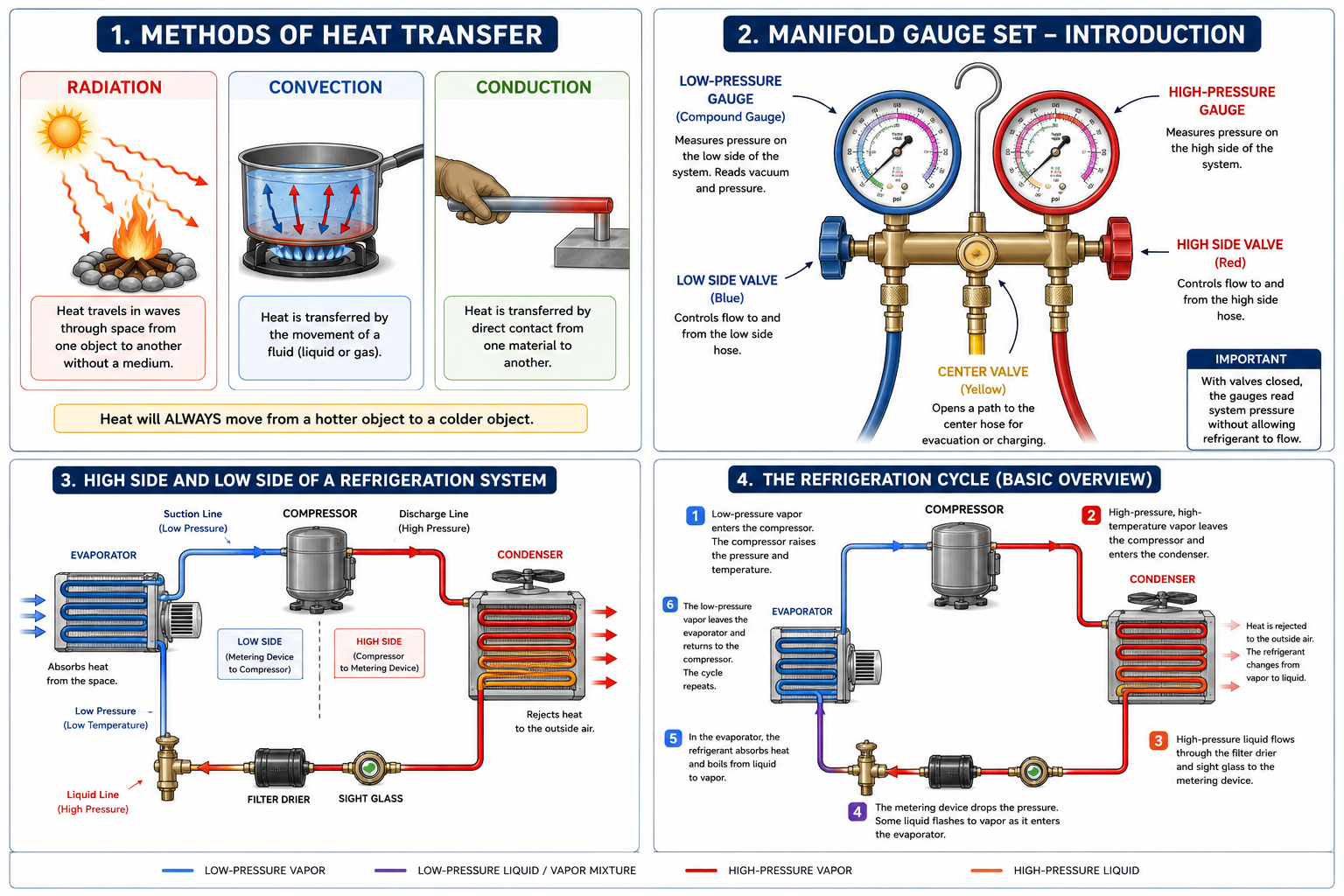
You are not expected to understand every part of this illustration yet. Each of these concepts will be developed in this course.
Air Conditioning Moves Heat Against Its Natural Direction
We have already established that heat naturally moves from warmer areas toward colder areas.
An air-conditioning system must do something different. It removes heat from the cooler conditioned space and rejects that heat into warmer outdoor air.
Doing this requires mechanical work.
Technician Point
The refrigeration system uses refrigerant, pressure changes and mechanical energy to move heat in a direction that it would not naturally move by itself.
Why We Use Refrigerants
A refrigerant is a substance selected because it can repeatedly change between liquid and vapor while circulating through a refrigeration system.
Those state changes allow the refrigerant to absorb heat in one part of the system and reject heat in another.
Evaporator
The refrigerant absorbs heat while boiling.
Condenser
The refrigerant rejects heat while condensing.
The refrigerant can repeat these changes over and over as it circulates through the refrigeration system.
Pressure and Temperature
Pressure and temperature are closely related when working with refrigerants.
As refrigerant pressure changes, the temperature at which it boils or condenses also changes.
This relationship allows technicians to compare refrigerant pressure with its corresponding saturation temperature.
Pressure-Temperature Chart
A pressure-temperature chart lists the saturation pressure and temperature relationship for a particular refrigerant.
If you know the refrigerant pressure, you can use the chart to determine its corresponding saturation temperature.
The original lesson uses R-22 as an example and shows approximately 43 PSIG corresponding to a saturation temperature of 20°F.
Technician Point
Pressure readings are useful because they allow us to determine what is happening to refrigerant inside a system without being able to see the refrigerant directly.
Introduction to Refrigeration Gauges
Refrigeration technicians use gauges to measure the operating pressures of a refrigeration system.
A typical manifold gauge set includes two gauges:
Low-Pressure Gauge
The low-pressure gauge measures pressure on the low side of the refrigeration system.
It is commonly a compound gauge, which can measure both pressure and vacuum.
High-Pressure Gauge
The high-pressure gauge measures pressure on the high side of the refrigeration system.
This Is Only an Introduction
Manifold gauge operation, hose connections, valve operation, service procedures and detailed pressure interpretation will be covered separately.
For now, the important concept is that gauges allow us to measure the pressures that exist on the high and low sides of the system.
The High Side and Low Side
A refrigeration system operates with two basic pressure regions: a high-pressure side and a low-pressure side.
Low-Pressure Side
The low-pressure side extends from the outlet of the metering device, through the evaporator and suction line, to the inlet of the compressor.
High-Pressure Side
The high-pressure side extends from the outlet of the compressor, through the condenser and liquid line, to the inlet of the metering device.
Two Pressure-Change Components
Compressor: Low pressure → High pressure
Metering device: High pressure → Low pressure
Understanding Pressure
Before working with refrigeration pressures, you need to recognize several ways that pressure can be described.
Atmospheric Pressure
Atmospheric pressure is the pressure produced by the weight of the atmosphere around us.
At sea level, standard atmospheric pressure is approximately 14.7 PSI.
Gauge Pressure
Gauge pressure is pressure measured relative to atmospheric pressure.
Most refrigeration service pressure readings are expressed as gauge pressure.
Absolute Pressure
Absolute pressure includes atmospheric pressure as well as the pressure measured above atmospheric pressure.
Absolute pressure is measured relative to a perfect vacuum.
Vacuum
When pressure is reduced below atmospheric pressure, the system is operating in a vacuum.
Vacuum measurements used in HVAC/R work may be expressed in units such as:
- Inches of mercury
- Microns
- Inches of water column
These measurements and their applications will become more important later in the course.
The Four Major Components
A basic vapor-compression refrigeration system contains four major components.
Compressor
The compressor raises the pressure of the refrigerant vapor.
Raising the refrigerant pressure allows heat absorbed in the evaporator to later be rejected through the condenser.
The compressor separates the low-pressure side from the high-pressure side of the system.
Condenser
High-temperature, high-pressure refrigerant vapor enters the condenser.
Heat is transferred from the refrigerant to the surrounding air.
As heat is removed, the refrigerant changes from vapor to liquid.
Metering Device
The metering device separates the high-pressure side from the low-pressure side.
It is located at the entrance to the evaporator and creates the pressure drop needed for refrigeration to occur.
Evaporator
Low-pressure refrigerant enters the evaporator and absorbs heat from the air or material surrounding it.
As it absorbs heat, the liquid refrigerant boils and changes into vapor.
Other Components You Will See
The basic cycle is built around the compressor, condenser, metering device and evaporator, but real refrigeration systems contain additional components.
Two components shown in our introductory diagram are located in the liquid line:
Filter Drier
The filter drier is installed in the refrigerant circuit and will become important when we discuss contamination, moisture, restrictions and system service.
Sight Glass
A sight glass may be installed in the liquid line and will become useful when we discuss refrigerant condition and system operation.
For now, simply recognize these components and their location in the liquid line.
The Basic Refrigeration Cycle
Now we can put the major components together and follow the refrigerant around the system.
Leaving the compressor: High-pressure, high-temperature refrigerant vapor moves through the discharge line toward the condenser.
Through the condenser: The refrigerant rejects heat to the surrounding air and changes from vapor to liquid.
Through the liquid line: High-pressure liquid refrigerant travels toward the metering device.
Through the metering device: The refrigerant pressure drops as it enters the low-pressure side of the system. A portion of the refrigerant rapidly flashes into vapor.
Through the evaporator: The refrigerant absorbs heat and boils, changing from liquid to vapor.
Back to the compressor: Low-pressure refrigerant vapor travels through the suction line and returns to the compressor.
The cycle repeats continuously while the system operates.
Heat is absorbed at the evaporator and rejected at the condenser.
Put the Concepts Together
The individual ideas in this lesson are connected.
Heat naturally moves from hot to cold.
A refrigeration system uses mechanical energy to move heat from the conditioned space to the outdoors.
Refrigerant absorbs and rejects heat while changing state.
Pressure affects the temperature at which refrigerant boils and condenses.
The compressor creates the high-pressure side of the system.
The metering device creates the transition to the low-pressure side.
The evaporator absorbs heat.
The condenser rejects heat.
Can You Explain the Basics?
You should be able to answer these questions before continuing.
1. What is the basic purpose of a refrigeration system?
2. In which direction does heat naturally move?
3. What is sensible heat?
4. What is latent heat?
5. What is specific heat?
6. What are the three methods of heat transfer?
7. Why is the pressure-temperature relationship important when working with refrigerants?
8. What does the low-pressure gauge measure?
9. What does the high-pressure gauge measure?
10. What is atmospheric pressure at approximately sea level?
11. What are the four major components of a basic refrigeration system?
12. Which component raises refrigerant pressure?
13. Which component causes the refrigerant pressure to drop?
14. Which component absorbs heat?
15. Which component rejects heat?
What You Should Have Learned
Before moving deeper into mechanical refrigeration, you should understand these fundamental ideas:
Refrigeration is the process of moving heat from one location to another.
Heat is energy and can be described as sensible or latent heat.
Heat moves by conduction, convection and radiation.
Heat naturally moves from warmer areas toward colder areas.
Refrigerants repeatedly change between liquid and vapor in order to absorb and reject heat.
Refrigerant pressure and saturation temperature are directly related.
Refrigeration gauges allow technicians to measure high-side and low-side pressures.
The compressor, condenser, metering device and evaporator are the four major components of the basic refrigeration cycle.
The evaporator absorbs heat and the condenser rejects heat.
The compressor changes refrigerant from low pressure to high pressure, while the metering device creates the transition from high pressure to low pressure.
Foundation for the Rest of the Course
This lesson introduces the concepts that will be used throughout the study of air conditioning and refrigeration.
Later lessons will examine the individual components, refrigeration gauges, pressure-temperature relationships, refrigerant state changes, superheat, subcooling and system operation in much greater detail.
For now, concentrate on understanding the basic relationship between:
Heat · Pressure · Temperature · Refrigerant State · System Components