BASIC ELECTRICAL FOR THE HVAC TECHNICIAN
12. Shop Project – Build a Circuit with a Transformer
Use a 24 VAC control circuit to operate loads in a separate
120 VAC circuit.
In the previous lesson you learned that the primary winding
of a transformer acts as a load on its supplying circuit,
while the secondary becomes the power source for a separate
low-voltage circuit.
In this project you will combine a transformer, relay,
switch and line-voltage loads into one operating system.
Safety First
This project was designed for a supervised electrical
training board.
Do not make or change wiring connections while the
trainer is energized.
The circuit contains both 120 VAC line voltage and
24 VAC control voltage. Keep the two circuits clearly
identified while wiring and troubleshooting.
Have the completed circuit inspected before power is applied.
What You Will Do
By the end of this project you should be able to:
Identify the 120 VAC primary circuit and the separate
24 VAC secondary circuit.
Recognize the transformer primary as a load on the
line-voltage circuit.
Recognize the transformer secondary as the power
source for the low-voltage circuit.
Use a 24 VAC switch circuit to energize a relay coil.
Explain how the relay contacts control the
120 VAC loads.
Predict voltage readings before checking them with a meter.
The Circuit You Are Building
Figure 24 contains two electrically separate circuits that
interact through the transformer and relay.
The upper portion operates from 120 VAC. The transformer
primary is connected to this circuit and acts as a load.
The transformer secondary supplies the separate 24 VAC
circuit. In that circuit, the secondary is the
power source.
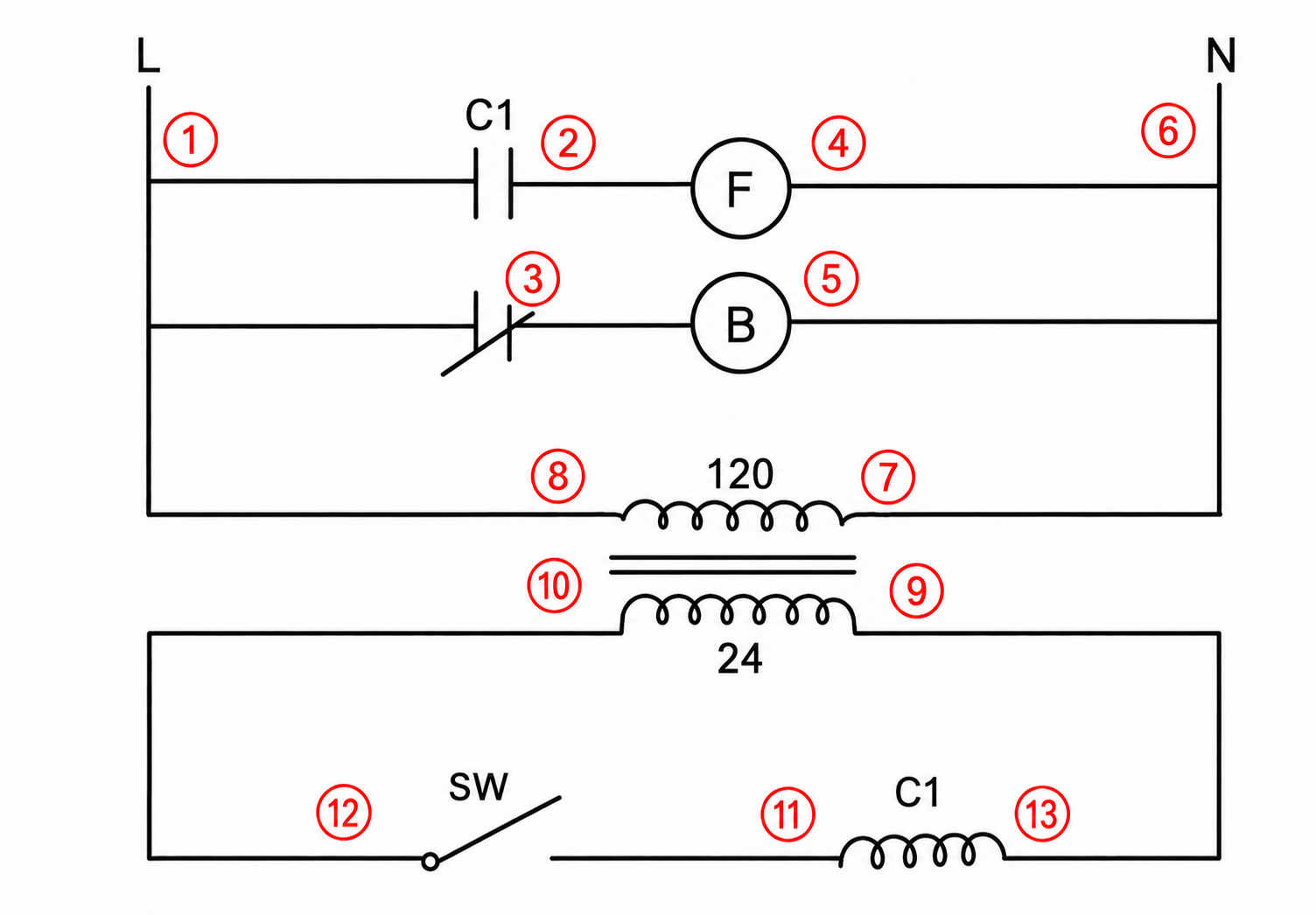
Transformer and relay shop-project circuit.
Before You Wire It: Identify the Two Circuits
120 VAC
Line-Voltage Circuit
L and N provide the source for the line-voltage circuit.
The transformer primary is connected across this
source and therefore acts as a
load on the 120 VAC circuit.
The C1 relay contacts also control the line-voltage loads.
24 VAC
Control Circuit
The transformer secondary produces the voltage for
this circuit.
The secondary is therefore the
power source for the 24 VAC circuit.
SW controls the C1 relay coil from this secondary source.
Certification Point
Do not call the transformer secondary a load.
The primary is a load on its supplying circuit.
The secondary is the source for the circuit
connected to it.
What You Should Have Learned
The transformer primary is a load on the
line-voltage circuit.
The transformer secondary is the power source
for the low-voltage circuit.
The primary and secondary circuits are electrically
isolated from one another.
A 24 VAC control circuit can operate a relay that
switches a separate 120 VAC circuit.
Relay contacts are shown in their normal position
with the relay coil de-energized.
You should be able to predict normal voltage readings
from the schematic before using the meter.
Knowing the correct voltage is not enough.
You should know approximately what voltage to expect
before placing your meter leads.
When troubleshooting equipment, a meter reading becomes
useful only when you can compare it with what a properly
operating circuit should be doing.